

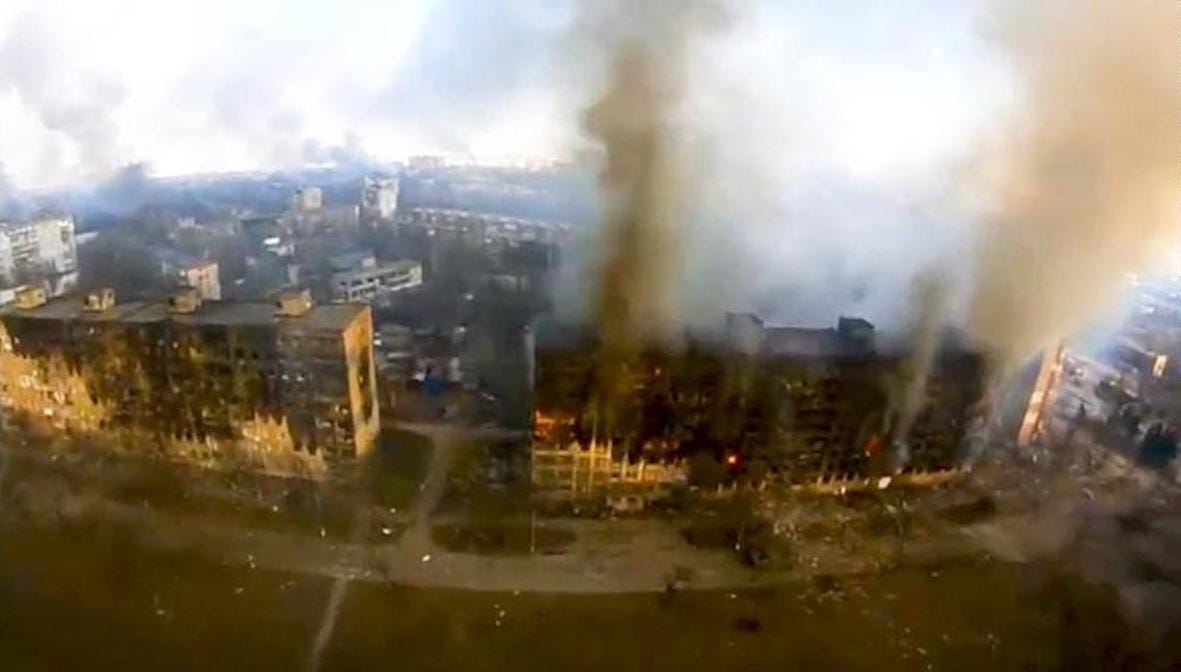
How Putin’s Russia Went From Failed State to Fascist State
Mar 22
Save
See that pic above? That’s drone footage of the horror and devastation that’s been wrought on Mariupol. So here’s one of the questions you might have right about now: why is Russialikethis?
The answer to that question is simpler than you might think. And it has plenty of ramifications for us, in the West. Because the truth is that nations like America, especially, and even Britain, are in the process of being Russified, economically, politically, socially, and culturally. Their economies are growingwildly unequal. Their polities are becomingincreasingly authoritarian. Intolerance and violence and bigotry are spreading. And a healthy social structure — broad middle class, few poor, fewer rich — has been replaced by ultra-rich at the top, and an underclass below.
The name of this disease is Russification — and it’s afflicting the West, too.
So. Why is Russialike this? What made it that way? There are a lot of answers to that question. Some go deep back in history. But there are more recent ones, too — and I think that they matter, much, much more. How did Russia become…well…Russified? How did it end up a broken society, where authoritarians and oligarchs rose, and kept any semblance of democracy a sham — to the point that now it makes wars of aggression, made of numerous war crimes, on Europe?
Let’s begin with a fact you probably didn’t know. A little thing called the Billionaire Boom.You’ve probably never heard it — it’s the kind of thing economists discuss. But you should have, because it affects all of us, and deeply. The Billionaire Boom is exactly what it sounds like.
“In the mid-2000s, the world witnessedan unprecedented surgein the number of billionaires. The best data we have suggest the number worldwide tripled between 2000 and 2010, and almost doubled again by 2015.”
Crazy, right? Here’s another fact about the Billionaire Boom.
“Thenumber of billionaires worldwiderose from 423 in 1996 to 1,826 in 2015. Their aggregate net worth increased from $1 trillion to $7.05 trillion, more than the combined GDP of Germany and the United Kingdom.” And those are just the assets that arecountable, not hidden in opaque “financial vehicles.” That’s a colossal, enormous number: it’s already almosthalf of America’s GDP.
What does the Billionaire Boom have to to with the question: Why is Russialike this? Everything.Think about what’s happening right now. Putin is making war on an innocent Ukraine — a bloody and savage war, of crimes against humanity, attacks on civilians, kidnappingkids. And behind him stand not just an army carrying guns — those poor chaps are expendable, as we can all see — but an army ofoligarchs.
The relationship between Putin and the oligarchs works like this. Putin gives themcontrol of state-owned enterprises, for a time. They get rich. And in return, they have to back him politically, and do his bidding. Any hint of dissent — and they get crushed. Their assets are taken back, their money and properties seized, and worse. The most outspoken of them, Berezosvky, was foundmysteriously hanged in his mansionin exile in England. Suicide or…? To this day, the police themselves can’t say. You begin to see how the game really works.
So. Behind Putin stands an army of oligarchs. The oligarchs are given temporary control of Russia’s abundant natural resources.Oil, gas, coal, steel, iron, nickel, timber, and much, much more. You can think of them, basically, as middle managers in this enterprise of a mafia state. In return for political fealty, they assume management of exporting these natural resources to the globe — which demands them hungrily, us in the West, and especially nations like China, whichuse them to make and manufacture stuff for…us in the West. It all comes back to us in the West in the end, because the richest 15% of human beings (that would be us)consume about 90%of the planet’s resources.
You begin to see a little problem there, perhaps. It’s called “the global economy.” LOL. But I’m getting ahead of myself.
So if the reason that Russia’s like this — a criminal state, basically — is the mafia-like relationship between Putin and his oligarchs…then who made the oligarchs?
You’re not going to like the answer to that question.We did. At least if you want to think seriously about the issue.If you just want to shout and scream, go right ahead. But you should probably stop readinghere.If you want to know, then the story goes like this.
The Soviet Union collapsed in the early 90s. And the economy did, too. As the USSR went down in flames, the question became: how was this former communist economy going to transition to…something else? And what was that something else going tobe? There were choices. It could have chosen European style social democracy — in its many flavours. Switzerland, for example, isgoverned by a council, not a singular leader. Germany’s famous for it’s form of multi-party representation and system. It could have chosen Canadian style social democracy, which is a little more American. Or, at the other end of the spectrum of modern politics, it could have chosen American style ultra capitalism.
As it turned out, Russia didn’t have much of a choice. As the USSR imploded, itbecame a mafia state. The streets ran red with blood. Shootings and killings became commonplace. There grew a need to impose order on this chaos. Who stepped in?We did.
“Meanwhile in Russia, the economy was collapsing. In 1991, Russia ran out of hard currency reserves. As abrupt price decontrol led to inflation, Russia’s central bank resorted to printing rubles to finance subsidies and wages. This worsened inflation, now running at over 100 percent a year, which in turn led to budget austerity and higher interest rates as a condition of IMF aid….
“Partly in desperation and partly in the hope of currying favor with the West, Yeltsin appointed a new cabinet and brought in two advocates of abrupt marketization, Yegor Gaidar as deputy prime minister, and Anatoly Chubais as minister of privatization. These appointments were applauded in Washington. But the execution of a dubious strategy was badly bungled. In a major speech to the Russian Duma on October 28, 1991, Yeltsin announced that all prices would be decontrolled on January 1, 1992. This virtually guaranteed hoarding before the fact and massive price inflation afterward. (‘How dumb can you be?’ says Sergei Plekhanov, one of Gorbachev’s senior economic advisers.) Russia almost overnight went from an economy of widespread shortages to one where the shops were full of goods that nobody but the rich could afford. By the end of 1992, inflation peaked at an annual rate of 2,333.30 percent. During this period, the IMF repeatedly extended credits in principle, then withheld disbursing the money because Russian austerity measures were not sufficiently draconian.”
Let me explain that. By now, it was in serious crisis. Hyperinflation had set in, and prices were rising by thousands of percent.It had no currency reserves left. Shortages were widespread. That istotaleconomic ruin. Hence, Russia needed constant bailouts from the IMF, the world’s lender of last resort. But that kind of debt comes with strictconditions. What kinds of conditions? Conditions like “marketization” and “privatization” and so forth — ultra capitalism.
Russia was going to have what’s come to be known aseconomic “shock therapy”— imposed on it. Economic “shock therapy” is a term that you should be familiar with by now. It basically means that the West demands a country choose an ultra capitalist socioeconomy as a condition of needing aid or debt. America demanded shock therapy for Russia — and made it joining Western institutionsconditional on it.
“Under Clinton,economic policy toward Russiawas largely the province of the Treasury, specifically Lawrence Summers, undersecretary for international affairs and later secretary. Summers, who worked closely with the IMF, sought to use the leverage of IMF loans, granted or withheld, to push Russia more in the direction of shock therapy and to condition U.S. policy on Russia’s progress. Key Russian leaders were lobbying Clinton to allow Russia to join the G-7, as a way of taking some of the sting out of the NATO decision. Summers blocked that as long as he could, to keep up the economic pressure.
“Vice President Gore, according to Talbott, warned Summers that ‘the strict conditions the International Monetary Fund attached to its loans to Russia put economic reform on a collision course with the political realities of a fledgling democracy.’ Nonetheless, Summers and the IMF prevailed. Functioning as loyal opposition was Joseph Stiglitz, chair of the Council of Economic Advisers and leading apostle of gradualism. The marketizers, he warned, ‘tried to take a shortcut to capitalism, creating a market economy without the underlying institutions.’”
Do you what happened there? Russia was never properly integrated into the West.NATO turned it down, and it wasn’t allowed to join the G-7untilit had had economic shock therapy. But let me continue the story before I return to that significant point.
What happened next? The shock therapy — as Stiglitz, who is probably the best economist of his generation, wascorrect. Taking a shortcut to capitalism didn’t work — Stiglitz meant you need institutions like secure property rights (Russia was still a mafia state) and functioning courts (Russia didn’t have them) and a stable currency (the ruble was still imploding) to really have a capitalist economy. Russia wasn’tready.
So financial catastrophe ensued. Russiadefaulted on its debtin 1998.
And then things took a nastier turn still. That currency default happened largely because Western hedge funds were attacking the ruble.That’s one side effect of opening up your economy too far too wide before it’s ready — speculators move in, and they can attack everything from your currency to your reserves to your assets.
This time, Russia needed a full bailout from the IMF. That’s very, very significant. Russia is the only white country — let’s just speak plain English about it — to haveeverneeded an IMF bailout. Mostly, IMF bailouts are for “developing” countries, which is code, of course, for not white, non-Western ones.
So Russia began to occupy this curious place in the world, which that last bit hints at.It wasn’t accepted as Western. But it was white. It wasn’t rich enough. It wasn’t modern enough. It had always seemed something alien to the West, which had long defined itself as “everybody whitebutRussia.” Maybe then you can begin to see where the paranoid Russian “need for security” comes from. The need for its own “sphere of influence.” Never accepted as Western, not Eastern, yet not brown or Black, not Asian, but still white, Russia came to occupy a difficult and strange, and it should be said, lonely, and profoundly insecure place in the world.
And that world wasnot its friend. What results did economic shock therapy have?
“Theabrupt imposition of marketization, full price decontrol, and crony privatization on an unprepared Russia, as a condition of desperately needed goodwill and aid from the West (little of which materialized), drove Russia in the 1990s into two cycles of hyperinflation, austerity, depression, unemployment, corruption, and then ultranationalist reaction.”
And the result of all that wasPutin. The culmination of Russia’s calamities was the debt default of 1998. AndPutin assumed the Presidency in 2000.
Such nations — one ravaged by poverty, fallen into despair — look for demagogues and strongmen. And emerging demagogues look forthem, too.Putin and the wrecked, impoverished Russia of the 1990s, convulsing under the whip of economic shock therapy, were a match made in heaven.
In other words, the results wereabout what you’d expect, at least unless you think nations deserve to be ruined. Let me put that to you another way, because by now you might object, and say, “but this is Russia’s problem!” Well, it is. But it’salsoours.
Let’s imagine the the same conditions that were imposed on Russia in the 90s were now imposed on, say, any healthy social democracy. Just choose one. France, Denmark, Germany, Canada, doesn’t matter. Austerity would mean it would have to cut its social programs. Privatization would mean that every single last public good — healthcare systems, pension systems, and so forth — would have to be sold off. “Marketization” would mean that people would only receive what they were paid on the “free market,” and enjoy no real social contract of those rich and renowned European social guarantees and rights.
Imagine all that happeningsuddenly. Over one decade. The result would be just what happened in Russia. Poverty. Hyperinflation. Currency collapse. And as people grew poor, they’d do what always tends to happen: they’d turn to nationalism. Demagogues would emerge, who’d blame scapegoats for their woes.Fascism would recur.
What we did to Russia was amistake. The surest way to drive a nation to fascism is to make it suddenly poor.Russia was never rich — like the West. But it goteven poorer. Even more desperate. And in that chaos, in that surge of poverty and despair, guess what happened?Putin did.
And who accompanied him? Well, his army of oligarchs. How did they get created? Putin didn’t make them — they preceded him.We made them. With “marketization” and “liberalization” and “privatization,” which are all conditions that the West, more or less, imposed on Russia.
Do you see what a tremendous mistake we made? Put your feelings to one side. I’m not asking you tosympathisewith Russia. I’m only explaining to you the story of how it became like this. I know the answer will make some of you angry. And yet history is what it is.
In many ways, Russia’s story parallels Nazi Germany’s.How did the Nazis rise? In the vacuum of despair and poverty that was the Weimar Republic. Where did that level of social collapse come from? Germany was burdened with debts for World War I — to Britain and France — that were simply unpayable. It couldn’t afford them — at least not without driving its own people to abject poverty and social collapse, a government which couldn’t afford to even have a stable currency, famously, hyperinflating it just to keep the lights on.
German fascism in the 1930s was the result of extreme, sudden economic shock therapy. Why would anyone have expected much different from Russia in the 1990s?
Here’s the irony. The link between sudden descents poverty and fascism was the famous conclusion of Keynes.Keynes was the greatest social thinker of the 20th century. It was on his famed insight that we rebuilt the global economy after the last world war. It’s entire point — the point of the institutions we built, like the IMF and World Bank — was to prevent another World War, by being lenders to and investors in nations, thus preventing sudden collapses into poverty. But fast forward half a century, and they were the ones demanding economic “shock therapy”, notpreventingit, precisely because American hardliners had effectively taken them over, and wanted to remold the worldin America’s ultra capitalist image.
Again, that’s not a slight. It’s just reality.It’s what actually happened. “For three decades, the practical expression of neoliberal power politics has been somethingcalled the Washington Consensus— a basket of policies imposed on countries that get overly in debt and seek aid from the IMF, the World Bank, the U.S., and the EU. These policies include budget austerity, deregulation, privatization, tax and welfare cuts, wage restraint, currency liberalization, and open capital market.”
So. Let me try to summarise all that.
Why is Russialike this? You don’t even have the words — or a lot of people don’t — for “this.” The word you’re looking for is “fascist.”Russia is a neo-fascist society. It’s easy enough to see, in its chest-beating nationalism, the way it treats women and minorities the way any kind of free expression or speech is cracked down on. And then there’s the tiny matter of, oh,the murderous war made of crimes against humanitylike kidnapping kids and bombing hospitals that’s currently being waged. Russia is a neo-fascist society, and Putin is a Christian fascist —his favourite thinkers and advisorsare this weird gang of semi-mystical fascists, who, just like the Nazis, really believe in it all: supremacy and purity of blood and devotion to the soil and purification through pain and the whole nine Nietzschean yards. Hey, doing that much violence almost always requires some form of convoluted justification masquerading as philosophy.
The word you’re looking for isfascist.
Am I sayingwemade Russia a fascist society? Well…I’m just saying maybe we could have helped itnot be one.
What does that mean? Well, think of what wecouldhave done. What do we want to do for Ukraine? The EU’s alreadyputting togethera Marshall Plan for it.That’s what we should have done for Russia in the 90s. We could and should have helped itreconstruct. But we didn’t. We did just the opposite, which is it saddled it with debt, and then kept on adding interest until repaying it was impossible. And just two years later…Putin.
We could have also stopped that vicious cycle from happening by forgiving its debt, which would havepreventedthe default of 1998, which was more or less the turning point towards full fascism. Remember the sequence: Russia implodes through the 90s, after the USSR unravels. Hyperinflation, violence, currency crises, the whole nine yards. Shock therapy isn’t working. Answer? More shock therapy, sorry. All that culminates in the debt default of 1998.And then Putin becomes President in 2000.
Don’t take my word for it. “Economist Jeffrey Sachs, who had advised the Poles in 1990–1991 and the Russians in 1991–1993,counseled cushioning shock therapy with massive economic assistance. Sachs called for a $30 billion Marshall-scale aid plan for Russia, as well as a cancellation of Russia’s debts to the West. He was told flatly by Bush’s deputy secretary of state Lawrence Eagleburger that large-scale aid to Russia was inconceivable in an election year.” Like Stiglitz, Sachs is a good economist.
Both seemed to understand then something the West didn’t, which would have fatal results. That after the USSR collapsed, Russia was being put into the same position as Weimar Germany.A wrecked nation, saddled with debts it could never repay. Shock therapy wasn’t going to work. It was only going to lead, probably, just as it did in Nazi Germany, tofascism.
And that is where we aretoday. The fascism part is real. All too real. A world war is brewing, in the worst case. In the best one, millions of refugees have fled a devastated Ukraine, and crimes against humanity, eerily reminiscent of World War II, are taking place. There are calls to try Putin at the Hague for them.Sound familiar?
The shock therapy didn’t work. It only prevented Russia from maturing into a proper democracy, with a functioning economy.It stopped Russia fully integrating into the West, joining its institutions, becoming a peaceful global citizen that way. And that shock therapy, it has to be said, wasour mistake. We should have learned from history. When nations fall into poverty traps, we should reconstruct them with Marshall Plans. Forgive their debt. It’s cheaper in the long run. Than what happens when wedon’t. War, ruin, hate, spite — the old cycle of fascism recurs.
It’s too late to much about that, of course, now. Or is it? Perhaps, even now, there’s a chance that insiders depose Putin. And if they do, then we shouldlearn our lesson.This time we should reconstruct and rebuild. Forgive — no,not the horror, just the debt. That is how peace is literallymade. Not with treaties and negotiations. But with that little bit of wisdom, that’s gleaned, through tears and regret, from history.
A note. I’m not justifying or sympathising or defending Putin or Russia. Please don’t misunderstand me. I am firmly against war,and especially this war, because it is made of terrible, terrible crimes.I am explaining to you how wars areprevented. How we got this wrong. What all this teaches us is that Keynes was right, yet again. It confirms his theory, one more time. Yes, socioeconomic collapses, replete with hyperinflation and worthless currencies and violence and shortages and unpayable debtdo indeed lead to fascism.
But we should never need more confirmations of that theory. The real world isn’t a lab. Real lives are on the line, as they are in Ukraine. Every time this theory has to confirmed anew only means we’vefailed to prevent violenceand ruin we could have.
We said it last time. Let’s say it again. We shouldn’t make the mistake ever —ever— again.
UmairMarch 2022


