

Brexit Was a Tale of Folly in Three Acts — And the Third Is Just Beginning
Member-only story
Follow
Eudaimonia and Co
—
15
Listen
Share
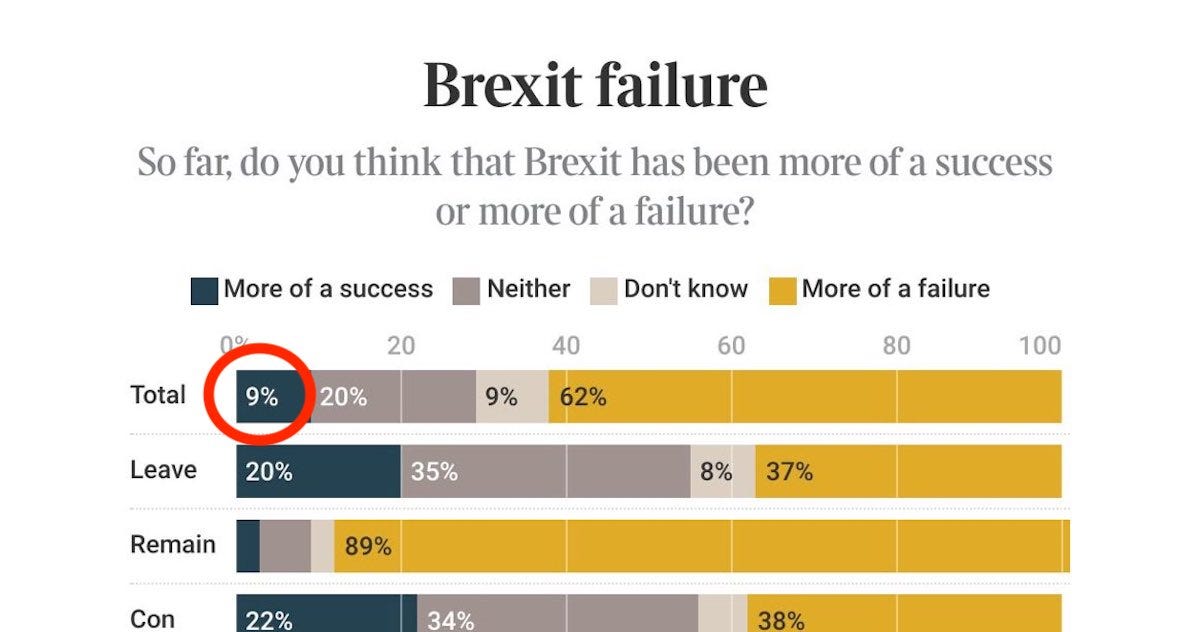
Here are some dramatic — almost chuckle-inducing numbers: just9% of Brits now think Brexit was more of a success than a failure. LOL. That’s funny, in a morbid kind of way. They’re right to think that, but…have any lessons been learned? From this most catastrophic of mistakes? You see, Brexit is a tale of human folly in three acts, history will say. And Act III is about to begin. That’s not a good thing, if you know your Greek tragedy, because it’s when the vultures really come home to roost.
How did Britain get here? Let me tell the story, briefly, of Acts I and II of the Tragedy of Brexit.
Act I happened like this. Britain descended — wasprovoked, incited, goaded — into a mania. A nationalistic one.These things happen. Nations descend into moral panics all the time. America’s in one right about now, over LGBTQ kids and their teachers. What made Brexit different though was…that….the critics weresilenced.
Let me be up front with you. I was acard-carrying criticof Brexit. As were many of my fellow economists, at least the good ones. To really understand “what the hell happened to Britain,” as more or less the entire world wonders, is to really have to know the following.
The critics issued dire warnings about what was to happen. Those warnings all came along the same lines, and went like this.Here was an island, which imported most of its economy. Worse, it imported most of its basics, from food to energy to the agents used to purify water. Breaking up with its largest trading partner? With no plan? And how was one to replace a relationship which provided frictionless trade for the basics a society needs most…with an entire continent…that produces the world’s finest stuff, from food to cars and on and on? That would be Europe, of course.
Sowe criticsmadea set ofpredictions. They went like this. The currency would tank. Inflation would skyrocket, since now all those imports were going to get more expensive, and plenty wouldn’t be available at all. That’d lead to shortages and rationing. Meanwhile, interest rates would soar, to try and control this inflation. That’d mean that, hit by the triple whammy of higher prices for basics, less availability of them, and higher prices for all that debt which was going to rise too, living standards would plummet. Fast and hard. They’d crater.
Now. These warnings werepoliticized. We critics were called “scaremongers” and “remoaners” and whatnot.We were painted as having apolitical agenda. But we didn’t. We were just trying to educate a nation about…wait for it…social science. Economics 101, in this case. Its effect on international relations, because of course, who’d want to do business or be friends with a nation in such foolish, self-inflicted trouble? Our warnings were not — let me emphasize — political. They were predictions about what was to unfold, in almost deterministic terms.
But they werepoliticized. That part matters, because we’re going to come back to the question: has Britainlearnedanything from this mess? Instead of being given anything like equal time, you know the story, or maybe you don’t. Criticism of Brexit wasn’t allowed. We critics were effectively blacklisted. An omertà developed, a code of silence. You can take me as a simple example, I’d appear regularly enough on British media. After I was critical of Brexit?Nada. Today, it’s emerged thatfigures in the BBCdeliberatelystifledcriticism of Brexit. Think about that for a minute. A nation’s most foolish minds were stifling it’s best ones, and you don’t have to include me on that list if you don’t want to, by all means don’t, just include figures from Danny Blanchflower to Gordon Brown.
This omertà, this code of silence around Brexit, no criticism allowed, comrade!! — it allowed the moral panic to become something much, much worse. Act I: a moral panic developed, a frenzy of nationalism — our problems are those dirty foreigners’ fault! Those…those…Europeans!! Wait, said critics — they’re your doctors and nurses and everyday laborers. You need them. Without them, you’re going to set in motion a chain reaction of implosion. But we said it to…nobody…because even, by that time, the LOL, “left wing” Guardian wasforBrexit. The moral panic was allowed to goall the way. Think about America: it got rid of Trump in four years. Its moral panic over LGBTQ kids and books and teachers hasn’t consumed the entire country, just the usual fanatical segments of it. But Brexitdidconsume…everything.
That was Act I, this bizarre charade of omertà, the silencing of criticism, across nearly every single British institution there was — and that paved the way for Act II.Boris Johnson signed a “deal” solaughably catastrophicthat…all those consequences we critics — we “scaremongers” — warned of gathered towering in the sky like an approaching cyclone. His deal took Britain not just out of the single market, it was basically the hardest of Brexits by any other name. No trading arrangements were made, more or less. No arrangements were made for people to move back and forth. It wasn’t really a deal, it was desperation, signing a piece of paper to, as the saying went, “Get Brexit Done.”
But. But because of the omertà, the code of silence, no criticism of this “deal” was allowed, either.We critics had been silenced from even mentioning Brexit to the public. So who was left to point out how catastrophic this so-called deal really was?Nobody. And so to this day, Britain has failed to understand just how much pain Boris Johnson’s “getting Brexit done” deal has put in motion for it. Basically, Johnson signed away Britain’s future, and Rishi Sunak is now feebly, eagerly…finishing the job.
Now. None of that is to relitigate the past. There’s no need to. It’s to make a point, that nobody in Britain is willing to admit yet. We critics of Brexit wereright.We were more than right — whatever the word for that is. I mean that in a strict and formal sense. Every single one of the consequences we predicted — again, literallypredicted— has come to pass.
And those awful consequences have come to pass much faster than we predicted. Me? My prediction was it’d take a decade to get here. But it’s all happened much faster than that. The implosion in living standards — again, that we critics all predicted, warned of, and then were dismissed and demonizedfor— has happened so rapidly that it’s now thefastest fall in living standardsin recorded history.
That’s not relitigiating the past. It’s asking Britain to actually take a hard look at thepresent.Like I said, and this is the startling part, nobody in Britain is willing to admit that the critic of Brexit were right. So profoundly right that the worst predictions — the very ones dismissed glibly as “scaremongering” arealreadythere for all to see, in less than a decade. But Rishi Sunak won’t acknowledge it — how can he? Keir Starmer, more troublingly, the leader of the opposition, won’t. Crack open a British newspaper, or turn on a news channel, and there’s no acknowledgement of it either: we critics wereright. And the Brexiters were painfully, badly, catastrophicallywrong.
Nigel Farage made headlines for admitting thatBrexit was a failure.LOL. Good, good. But the other half of the story? None of us critics were given headlines for warning about everything that’s happening now. Surely you can see the difference. Here’s why it matters.
We’re now approaching Act III of Brexit. The climax of the tragedy. Britain’s future has been destroyed.There is no coming back from that. And now painful, difficult, grim choices must be made. In three ways.
What kind of future is there for Britain’s social contract? You see, a much poorer country can’t afford to have the generous and expansive social contact a pre-Brexit Britain did. That’swhythe NHS is dying. It’s why waterways are full of sewage. The price of Brexit was always going to beBritain’s modern social contract.And now the choices must be made. The NHS, for example, can’t be saved. So…now what? How are Brits going to…have healthcare? Right about now, the idea is to let things go on in limbo, and slowly, those who can afford it will start to buy private, American-style health “insurance.” That’s not a plan. It’s a lackofone. That isn’t a choice being made. It’s a social contract disintegrating.
What kind of future is there for Britain’s economy? You see, before Brexit, Britain occupied an incredibly privileged position in the world of economics and finance.It was the gateway to Europe. Britain’s financial markets effectively are how the world accessed Europe’s…everything…its manufacturing, agriculture, industry, labour, innovation, technology. No longer. All that’sshiftedover to Paris, Frankfurt, Amsterdam. Now what’s Britain’s…economy…going to…beabout? Based on? What is it going to offer the world now? If an answer isn’t found, and found fast…today’s implosion in living standards will just…thunder on…like a pyroclastic flow down the side of a volcano.
And yet there are no easy answers, are there? Britain’s not renowned for any of the following: manufacturing, industry, technology, innovation. Nope. What can it do better than other countries, which is the essence of a little thing called “comparative advantage”? You see, when I ask that question, and look at Britain, I shudder. Because right now? The answer isnothing. Before, it was “being a gateway to Europe for the entire world economy.” But now? And yet comparative advantages don’t happen overnight.They take decades to build. Decades of investment, and carefulthinking, too.
South Korea’s the only nation that went from poor to rich — ever, really — and it took it half a century. Britain’s the only nation that’s going from rich to very much poorer — and it’s taken just half a decade. Surely you see the problem here.It’s one of a profound, lethal asymmetry. Positions, comparative advantages, are much,muchharder to build than they are to destroy. By an order of magnitude, easily. The scale of this catastrophe is something that’s still not well understood in Britain.
That brings me to point three. Who’s going todoall that thinking? You see, Brexit didn’t just destroy Britain’s economy, or its social contract, or its place in the world, as a gentle, trusted, respected elder member of the global order.It also destroyed something much, much deeper.Its mind.
This is why I harped on and on about omertà, how we critics were blacklisted, and so forth. Maybe you thought that was about point scoring. Hopefully you’re beginning to see why itwasn’t. Having exiled all its finest minds — every single one of whom was against the folly of Brexit, because, well, we could all see what was to come coming — now who’s left to think through this incredible mess for Britain?
You see, right now, in this moment of profound crisis, of real peril, is when societies need tothinkbest. Most clearly. All this mess — this interlinked set of crises, that Brexit really is, from a wrecked economy, to a lack of comparative advantage, to having become a laughingstock and pariah, to the rise of fanatics and lunatics giggling over it all, to the disintegration of a modern social contract. All of that. How do you sortthatout? That doesn’t take an everyday economist, sociologist, politician. It takes the best ones a societyhas. Its very finest minds and its brightest, noblest spirits.
But who’s left of those in…LOL…Britain? And if there are such figures, capable of answering such profound questions like: “what’s our comparative advantage going to be? How do we have a modern social contract again? How do we regain the trust of the world, one step at a time? What do we have to offer? How do we begin to go sane again as a society, after the drunken hysteria of the moral panic?”…how likely are they to even want to offer aid or help after being effectively exiled, insulted, ostracized, and disgraced for a decade?
You might think I’m obliquely talking about myself, but let me assure you, I’m not. I have a very nice life making disco and playing with my little doggie. My question isn’t about me. My question is big, and it’s real. Who’s even left in Britain to think this incredible mess through, and rebuild things like a comparative advantage, a functioning social contract, a position in the world, trust and respect, an agenda for governance?You see, these areprofoundquestions. They are the biggest ones of all: after destroying your society,how do you rebuild it? Can you?
Can you salvage anything at all from a mess like that — now that you can see the wreckage gleaming, smoking, shuddering as the hangover kicks in?
Average, everyday ideas, agenda, figures, and minds don’t cut it at that level.Aftera society’s thrown it all away. You need the best and brightest a societyreallyhas. And even then, often, it’s not enough. But Brexit has poisoned that well. By rubbing the noses of people like that in the dirt for so long, I’d bet they’re all thinking twice aboutevertrying to help their thankless, graceless society again. That happens, often, too. The kinds of people a society needs most aren’t there anymore when it needs them most, because they’ve been abused and reviled for so long, they’re long gone by then. In economics, we call this a “human capital deficit.” In plain English, we call it: “when a country gets permanently stupider.”
I know that sounds harsh, but I think I’m done apologizing. We critics wereright. Brexit really did destroy Britain. The only question left is: do Brits really get it yet? Because, like I said, in many ways? Nothing’s changed at all. The omertà’s still in effect. The code of silence rules. We all know — well, 91% of people are beginning to figure it out, at least — that Brexit was exactly the historic catastrophe the critics said it was going to be. But until and unless that part can be said loudly and clearly, kiss the future goodbye.
May 2023


