

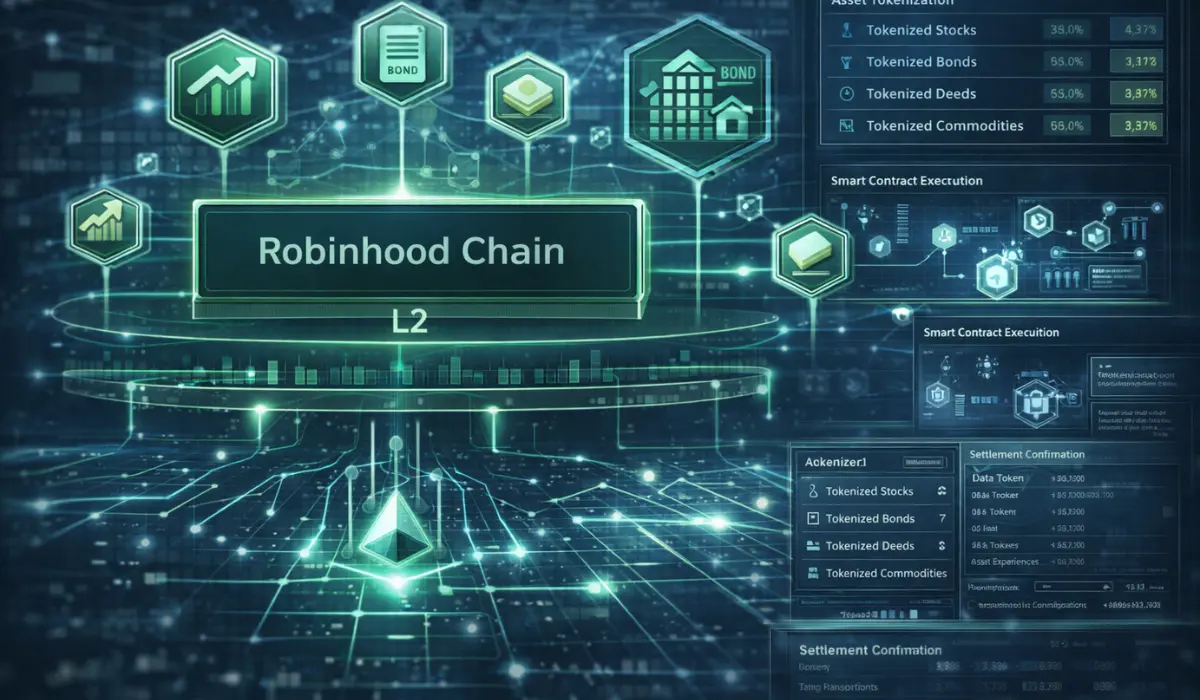
Popular American fintech and brokerage platform Robinhood has made its boldest strategic pivot to date with the launch of the public testnet for the upcoming Robinhood Chain. The company has chosen Chainlink as the official oracle provider and interoperability partner to power what it calls a “financial-grade” Ethereum Layer-2 network.
Built using the permissionless Arbitrum Orbit framework, the protocol is designed to move traditional financial services — specifically the issuance and trading of stocks — entirely on-chain. While it inherits the security of the Ethereum mainnet, Robinhood Chain is designed to meet the rigorous security, compliance, and performance demands of regulated markets, to onboard trillions of dollars in real-world assets (RWA).
Robinhood Chain Launched in Testnet, Designed for Trading Tokenized Stocks and ETFs 24/7
“We aren’t just scaling Ethereum; we are optimizing it for the next century of finance,” said Johann Kerbrat, VP and GM of Robinhood Crypto, at the Consensus Hong Kong conference. “By selecting Chainlink, we are ensuring that every asset on Robinhood Chain is backed by the most reliable data feeds and the most secure cross-chain infrastructure in the industry.“
The decision to partner with Chainlink is central to Robinhood Chain’s ambition. While Arbitrum provides the scalable execution environment, Chainlink delivers the critical external data and connectivity that transforms Robinhood Chain into a functional financial settlement layer.
Chainlink’s role in the project is multi-faceted. The decentralized oracle network will provide tamper-proof, real-time pricing for tokenized stocks, ETFs, and other assets that will trade on Robinhood. This is vital for accurate valuations, collateral management, and preventing market manipulation. By utilizing Chainlink’s industry-standard Cross-Chain Interoperability Protocol (CCIP), Robinhood Chain can seamlessly move tokenized assets and data between 60 public and private blockchains, including Ethereum, Arbitrum, Avalanche, Base, Optimism, Polygon, Solana, Aptos, Hedera, and BNB, among others – fostering a truly interconnected financial ecosystem.
Chainlink, the decentralized oracle that connects blockchains with real-world data, will also supply specialized tools that will allow Robinhood to program essential regulatory requirements, such as Know-Your-Customer (KYC) and Anti-Money Laundering (AML) checks, directly into the token smart contracts, which is critical for attracting TradeFi capital.
Robinhood Chain Targets T+2 Settlement Lag With Real-Time Atomic Trades
Robinhood CEO Vlad Tenev has been a vocal proponent of blockchain technology as a solution to systemic inefficiencies in traditional markets. Robinhood Chain will serve as the permanent home for tokenized stocks, allowing for 24/7/365 trading and instant settlement. This addresses the “T+2” settlement lag, referring to the two days it currently takes for a stock trade to clear, by enabling real-time, atomic settlement. Tenev famously blamed the lag for the trading halts the brokerage suffered during the 2021 meme-stock frenzy involving GameStop (GME).
The proposed blockchain can clear trades instantly, eliminating counterparty risk and the need for a complex clearinghouse mechanism that currently ties up billions of dollars in capital. Robinhood claims this strategic shift will create a more resilient and transparent market infrastructure.
Robinhood Chain’s launch positions the company directly in competition with other exchange-native blockchains, such as Coinbase’s Base and Kraken’s Ink. But it stands out from the rest as it focuses strictly on financial-grade assets like equities and ETFs rather than the more volatile retail-focused crypto assets. The ecosystem aims to establish itself as the premier bridge for onboarding institutional capital and regulated products onto the blockchain.
Robinhood Chain Targets Late-2026 Mainnet Launch
Early infrastructure partners like Alchemy, LayerZero, and TRM Labs have already integrated the testnet to ensure the network has a robust security stack. Meanwhile, Robinhood has committed $1 million to the 2026 Arbitrum Open House program to attract developers to build lending markets and perpetual futures exchanges on Robinhood Chain.
While the mainnet is slated for launch in late 2026, the testnet is currently open to developers. In the coming months, Robinhood plans to introduce test-only Stock Tokens that replicate the behavior of major equities, allowing for a full stress-test of the system. Once live, users will be able to self-custody their stock portfolio in a Robinhood Wallet, trade them at any hour of the day, and use those assets as collateral in the broader DeFi ecosystem.
As the financial world rapidly converges, the partnership between Robinhood and Chainlink represents a critical step towards a future where the distinction between a “stock” and a “token” becomes increasingly irrelevant, and financial markets operate with unprecedented efficiency and transparency.


