

Why We’re Underestimating How Catastrophic Climate Change Already Is — and How Much Worse It’s Going to Get
Jul 31
Member-only
Save
Where do we go from here? That’s the question you might be asking, looking around at the dire state of the world these days. It’s not looking good out there.
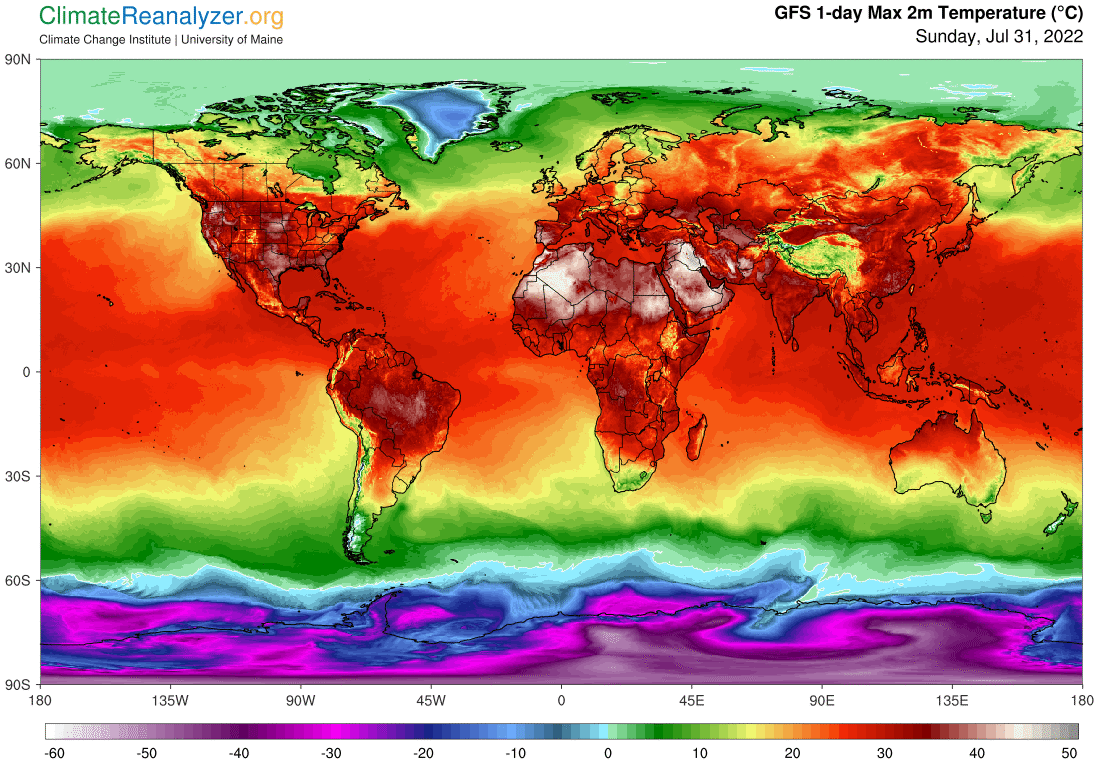
Let’s start with “climate change.” How much worse is it going to get? This is our world at about one degree of warming.Just one. What are its effects? You know them, because you’re living them. Megafires, megafloods, droughts, skyrocketing food prices, and heatwaves like you’ve never felt before.
To understand just how much worse climate change will get, you have to begin understanding how bad it really is now.And most people, I think, aren’t grasping that much. It is already much, much worse than our public discussions, pundits, and politicians suggest.
Let’s use an example from an unlikely nation — Britain. It’s northerly, and not exactly known for being a hot, dry country. Old Blighty? All it does is rain, right?Wrong.After a day or two which shattered records, and the heat climbed past 40 degrees Celsius, or 104 F, the nation was shocked. “Who would have thought that a village on the edge of London would be almost wiped out by wildfires in 2022,”says McGuire, emeritus professor of geophysical and climate hazards at University College London.
And now? Britain “braces itselffor a drought that is threatening major disruption to the nation. Failure to act now would leave Britain facing a future of queueing for emergency bottled water “from the back of lorries”.
Why is that? “All areas of the countryare affected, but in the south and east in particular the conditions are critical — with rainfall this July just 14% of an average July.” Hard not to have a drought when you’re in the middle of a heatwave, unless you live right on top a glacier — and then you get a flood. Meanwhile, “the government waswarnedfour years ago by the National Infrastructure Committee (NIC) that considerable new investment would have to be made in the nation’s water supply equipment by the 2030s.” But Britain has anultra-conservative government— which not only has made no preparations, it isn’t investing in much of anything.
That’s just one example of what’s happening at just one degree of warming. Just one.I could talk about theAmerican West drying up, Europe’scrop yields down,heatwaves in China, Asiaflooding, Australia’s “Black Summer,” or much, much more. But the point is that you get the message here. Our Big Problems are beginning tointeract.
What do I mean by that?
The way that I think most people think of “climate change” goes like this: governments are sorting out the problem, and one day, magically, we’ll cut carbon emissions, even if slowly, and the temperature will go back to “normal.”In other words, what we’re beginning to live through now isanomalous. Meaning it’s temporary, reversible, and something like a spate of bad, weird weather, a clutch of extreme seasons, lasting a few years.
People have this impression — this mis-impression — because we don’t teach them about climate change muchat all. Kids barely learn about it in school, adults get most of their info on the subject from pundits, who are paid tomake equivalences between propaganda and reality, and the result is that our culture takes Netflix movies more seriously than the planet being altered in ways that haven’t occurred for hundreds of millions of years,endangering all life on it. It’s not “climate change” — aright wing lobbyist invented that term— it’s anextinction.
The brutal facts are threefold, and everyone needs to understand them, for the sake of their own families and their lives, if not for human civilization’s.
Fact one: the climate is not going to magically go back to what it was.This is now permanent, at least given our current state of technology, economics, and politics. That is because the carbon and other emissions we have sent into the sky by and largestay there. We have a few “technologies” for “sequestering” and “capturing” carbon — aka putting back in material form — but they are speculative at best, andnowhere near ready for global usage. They might as well still be science fiction. In fact, the best solution for this problem is stilla tree.
This is a hard thing to get your ahead around. We’re used to living in a world, a way, in which technology comes along, and magically solves all our problems. It happened again and again after the industrial revolution. So much so that people got used to it, economists made the assumption it would just keep happening, and that way of thinking was called “growth.” There’ll be a better iPhone this year, hey, look, someone invented a dishwasher, air conditioner, pill for this disease. Amazing! It was amazing, and in some regards — vaccines, perhaps — this cycle of growth stillis.
But this cycle doesn’t apply to climate change.We don’t have the technology to “solve” the problem of emissions permanently raising the temperature of the planet.At all.So much so that desperate scientists are out theredreaming up thingslike putting space veils over half the planet and so forth. So why doesn’t this cycle of growth apply to fixing climate change?
Well, think about history for a moment — it’s the basic stuff of the industrial revolution which causes carbon emissions. Engines, motors, gears, all powered by fossil fuels. All that industrial revolution stuff was made possible by basic research — and that line kept going through the information revolution. Gears and motors and switches became computers and transistors and microcontrollers and whatnot. That was another wave of growth powered by basic research — meaning it came directly from science, at the most basic level, done in labs.
We are still not reallydoingthat for climate change. Biden’s latest climate billonly just now begins to even try to.It finally creates something called theNational Climate Bank, whose role is to begin to invest in basic technologies that can workwithoutemitting carbon. It’s a good beginning. And maybe one day, it’ll yield fruit. We can all hope.
Let’s imagine that it’s successful, and one day, it makes an investment in some lab, or some tiny startup, that has discovered how to make things go without carbon. What happens then? That brings us to fact two.
Fact two: carbon emissions arestill rising. That means the temperature keeps going up.Most people think that an absence of carbon emissions means the temperature goes down.Wrong. It means the temperature levels off around where it is now, just a bit higher, after rising more slowly for a while. And more emissions? They take us to even hotter temperatures,fast.
Remember, this is justone degree. Of “global” warming. So why do we already see such freakish and abnormal and terrible effects? Droughts, famines, mega fires, mega floods? How can just one degree cause all that? It’s not even such a large amount? Well, for two reasons. The heat isn’t distributed equally, and it has knock on effects. Oceans get hotter, currents move more slowly, distribute less heat — which means there’s less rain, hotter days, the wind patterns change. Phenomena like “heat domes” become commonplace.
Our planet is — was — in a delicately, finely balanced equilibrium. Now it’s heading towards somethingelse.Our economies were in a delicately, finely equilibrium, too. Now they’re heading towards something else, too.
One degree of warming — just one — has been enough to reduce crop yields around the planet by startling amounts. In Europe, corn and soya yields aredownalmost 10%. A Cornell Universitystudy found thatclimate change has reduced global crop yields by a staggering20%since the 1960’s.
This is atone degree. Presumably, at two? The effects will be exponentially — not linearly — worse. There won’t be twice as much wheat or coffee or mustard dying off — but much more than that. Here, again, people who’ve never talked to farmers make assumptions they shouldn’t. But you can just plant another kind of crop! Or just…move north!! It doesn’t work like that. Not that simple. And if you think it does, then, mate,youbuy the farm. There’s little to no “substitution effect,” as economists would say, with crops. You can’t just “plant something else” where maize and wheat used to grow — or you can, but it’s not going to feed people and livestock the same way, especially when 83% ofour calories as a civilizationcome from the same 10 crops.
Think about all that for a moment, because this is the great untold story of climate change so far.You know about the heatwaves and megafires — they make for startling, vivid pictures. But only this year has it become really clearjust how muchextinction is affectingour crops. They are down around the world, in vital categories. And worse is to come, because, remember fact two: emissions are still rising, which means temperatures are still rising.
So howmuch —how much more—are they going to rise? “Just look at what is happening already to a world which has only heated up by just over one degree,”says McGuire. “It turns out the climate is changing for the worse far quicker than predicted by early climate models. That’s something that was never expected.” We hoped to stop warming at 1.5 degrees by 2030, with a global system of non-binding pledges. Result? “In the real world, that is not going to happen. Instead, we are on course for close to a 14% rise in emissions by that date — which will almost certainly see us shatter the 1.5C guardrail in less than a decade.”
We’re heading, easily, towards the territorytwo degrees within a decade or so.How serious is that? Our crops are beginning to fail at the threshold of one degree of warming.We can still feed ourselves, most of us reading this, at least, even if prices are skyrocketing like never before, for basic foods. But how bad will crop failures be at two degrees? See our water systems struggling now? What about at two degrees? I shudder to think, and you should too. The economist in me knows that is an incredibly, incredibly bad situation to even have to contemplate.
Our crops and water. There is nothing, and I mean nothing, more fundamental than those. These things are the basics of civilization.Civilization emerged from agriculture producing a surplus for the first time, which let people — some lucky people — devote their lives to things other than subsistence. Art, science, literature, poetry, democracy — all these were born in that Cambrian Explosion of human potential.
But when things get scarce, suddenly, precariously, you know the result, and so do I:fascism returns. People, desperate, seek safety in any form of superstition, lunacy, or hate they can. Wars erupt. Cults are formed in the search for salvation — death cults. Demagogues emerge. Conflict and cruelty replace the civilized norms of goodness and peace. Violence rules all.
That’s fact three.Our problems interact.People begin under the mis-impression that stopping or limiting carbon emissionsreducesthe temperature — an absence of emissions causes a fall in temperatures. Wrong. That mental model is incorrect. The carbon stays in the sky, and the change is permanent, in the absence of some magic technology we aren’t close to having, becausewe aren’t investing in it.
Meanwhile, our emissions are still rising. They’re not just causing heatwaves and fires — they are having incredibly disturbing effects which affect us all, even if we don’t understand them. They’re causing crop failures, sending prices skyrocketing, making systems for water dry up, pushing energy systems to the brink, leaving people poorer every day now, even in rich countries. And all that is bringing with it political and social instability.
It’s not a coincidence demagogues have arisen across the world — it’s what happens as one great form of “growth,” one mega-economic model, loses steam, runs out of gas,stops working.We’re at the end of the industrial revolution now.Reallyat the end of it. And as mega-models like that fail, they bring with them instability, shattered hopes, crushed dreams, demagogues, the return of violence and conflict. When economic systems like this lose the ability to keep lifting people upwards — which ours did quite some time ago — they begin to come undone from the inside, people turning to extremists and fanatics and lunatics in the face of system failures.
That trend, too, is likely to accelerate in tandem with climate change, limiting our ability to fight it. To evenbuildnew systems. Remember how Britain’s heading towards a drought — but nobody much seems to care? Failed state territory. Societies with broken systems for food, water, energy, money, all the basics — but so riven by extremism and fanaticism and superstition and hate theycan’t come together to build new ones. Which is harder than ever anyways, because now everything’s running scarce.
This is where we’re heading. It’snot good.
But you should know. And you should think about it all.Interrogate your own beliefs, and check if you really begin with a solid understanding. Our best hope of fighting the dystopian future we’re currently in? Is that every one of us really understands the stakes.
If you think things are bad now — they are. But they can get so, so much worse.
Or even, yes,better. But that part is up to us.
UmairJuly 2022


