

The (Real) Explanation for the Global Energy Crisis
Sep 1
Member-only
Save
By now, you can’t fail to have noticed that much of the world’s been plunged into afull blown energy crisis. Hence, the question I get asked most often lately. It happens every day at the park, while the dogs run and laugh and play. Sometimes it’s asked angrily, sometimes out of sheer frustration, always out of a sense of desperation.
“Hey! You’re an economist. Tell me! Why are energy prices so ******** high?”
People ask me this question for a reason. Everyone knows, yes, there’s a war in Ukraine, which has caused the flow of gas to dry up. But people sense there’s to this crisis than just that, which is why they keep asking me — that the answer isn’t as simple as just “Russia.”
I’m hesitant to answer. Because the truth — if you want to know it — is going to leave you baffled, shocked, and shaking your head. Is thatreallyhow energy — what I hand over my hard earned money for —works? At the beginning, you’re — like the people who ask me this question — going to be bored. Then bewildered, then alarmed, then furious, then depressed.
Want to know why energy prices arereallyso high? Because the way that we’ve designed our institutions — our energy economies, if you like — iscrazy.It’s basically one giant grift, a cash grab, something very much like an insane, regressive con game. You might already think that, but buckle up, because the truth is so much worse than you think.
Let me quotedirectly from the IMF, in a research note nobody’s ever going to read: “Wholesale electricity markets in the EU follow a ‘marginal’ pricing system, in which the bid with the highest price (among all accepted bids to meet consumer demand) sets the overall price. In hours of high electricity demand, this is usually a fossil fuel plant (typically, a natural gas plant).”
Boring, right? I told you. Now get ready for the “bewildered” part.
Read it again. You probably think you read it wrong. Typo! They must have meant to saylowestprice, not highest price. Right? You think that because intuitively, you expect that a basic necessity of life — the things utilities provide — should be priced according to the lowest bidder.
Makes eminent sense. That’s how plenty of markets work.But not this one. It wasn’t a typo. You read it right.The market for electricity — in Europe, and in most of the world — reallydoesoperate like this. It works according to thehighestprice. The highest bid on this market then becomes the price — the “standard” price, aka “the wholesale price” — thateveryone pays.
The people that you buy your electricity from paythatprice — suppliers, middlemen — mark it up again, and sell it toyou. The reason your electricity bills are so high is that the market works according to ahighest bidder principle. So some plant out there, which generates electricity from coal or gas or what have you, says, hey, I’m going to bid this much — and thenthat highest bid becomes the price for the whole market, which gets passed onto you.
Right about now, you’re bewildered — and starting to be horrified. But that doesn’t even…that doesn’t even make any sense, your mind is shouting. At me. Just like my friends at the park do when I tell them this. You’re right, itdoesn’tmake any sense. Why should electricity be priced according to thehighestbidder?
Well, the thinking behind designing markets this way — and this is a market design, aka a human choice, not some kind of God-given creation — goes like this. Some kinds of electricity can be generated at zero marginal cost — the cost of providing another unit — like hydropower or nuclear power. So we can’t just…give them away for free…because those guys have to recover the huge fixed costs of building dams or nuclear power stations or what have you. Meanwhile, some kinds incur super high marginal costs — like coal or gas — because they need another lump of coal or another liter or gallon of gas. So this way of designing markets lets operators of clean energy recover their steep fixed costs, while letting operators of dirty energy earn big profits that they’d invest in…clean energy.
LOL.I know.Who on earth really thinks any of thatmakes sense?Have you ever heard of megacompanies — especially ones in dirty, extractive industries — magically doing the right thing when they started to earn megabucks? And wait, was going to happen in this weird, regressive market design if there was a sudden…supply shock, iethe oil and gas taps turned off?
You’re right.Don’t blame me. I told you that I think all this is crazy. And it’s not just me. Take itFrance’s Economy Minister, Bruno Le Maire: “An energy market in which the price of decarbonised electricity remains dependent on the price of fossil fuels is absurd. The more the price of gas soars, the more everyone can see this reality.”
France has come out as a strong critic of this approach to setting energy prices, for a very good reason, which is that it’s horrifyingly foolish.It’s regressive, as Lemaire points out, and worse, we can all see the grim reality that’s resulted from it. Households across the world arepoised to fall into povertyover the winter. People are going to be unable to afford to turn on the heating. There’s talk of kids freezing — and old peoplefreezing to death. Meanwhile, energy companies are making jaw-dropping profits — which they’re not going to magically invest in clean energy (why would they?), they’re just going to return that money to “shareholders,” aka hedge funds.
The whole system is a catastrophic failure.There’s a lesson there. How we design our institutions matters.
So how else could we design an energy market? Well, there are lots of ways. Lots of much better, smarter, fairer ways. Le Maire’s got one, which is super smart, actually: he wants to set prices based on ‘the average production cost of decarbonised energies and not the price of fossil fuels, and certainly not the price of gas.”
Makes a lot more sense, no? Now all those big energy companies really have an “incentive” to invest in clean energy, which is what they’ve been missing.We’ve tried the carrot,and it hasn’t worked. Decades of mega-profits? They just used it, mostly, to fund a world-changing propaganda campaign in climate change denial. Now, the stick: the price of energy is going to be lower than dirty energy, and so if you don’t invest in clean energy, bye bye, you’re going to gobroke.
See how smart Le Maire’s idea really is? Pretty brilliant, in fact.
Meanwhile, in reality, this way of handling energy is turning out to be disastrous. Instead of “incentivizing” investment in clean energy, what’s it really done? Well, since prices went stratospheric, there’s a redoubled wave of investment in dirty energy. Across Europe,LNG ports are being built— liquified natural gas — in an emergency. But that’ll have knock on effects of starving poor countries like India and Pakistan whichdepend critically on it, leaving millions there literally powerless. Global catastrophe awaits — all because our energy markets are designed to…
Our energy markets are designed to make dirty energy companies very, very rich. And not for much else.So when disaster struck — pandemic, and then war — and supplies went to the floor, the natural consequence was that prices skyrocketed. But much, much more — to you — than they should have.
When people suspect there’s more to the answer than just “Russia” — that something’s rotten here, wrong, that they’re being fleeced, they’re right. After all, it doesn’t take a genius to see that if Big Energy ismaking huge windfall profits, then the answercan’tjust be “hey, shrug, our prices went up, too.” Profits would have obviously stayed stable — but they’renot.
So this crisiscan’tjust be due to what us economists call a pure “exogenous shock,” aka pandemic, war, disaster, but something more mundane: greed, hubris, and folly.
Don’t just take my word for it, here’s Yanis Varoufakis, the former Finance Minister of Greece:
The absurdity stems from the delusion that states can simulate a competitive, and thus efficient, electricity market. Because only one electricity cable enters our homes or businesses, leaving matters to the market would lead to a perfect monopoly — an outcome that nobody wants. But governments decided that they could simulate a competitive market to replace the public utilities that used to generate and distribute power. They can’t.
Or take itfrom Ursula Von Der Leyen, the President of the European Commission:
This market system does not work anymore. We have to reform it… This is the task that the Commission has taken over now. This is not trivial, this is a huge reform. It will take time, it has to be well thought through. But we must step forward to adapt our electricity market to the modern conditions.”
Now you’re at the “horrified” part, because you’ve just realized that a huge, huge chunk of your income is basically being fleeced away from you,for no good reason. That you were right, when you suspected there’s more to this story than just “prices went up for everyone, including suppliers!!” They didn’t — not nearly proportionally, anyways, which is whyyou’re getting poorer, and they’re getting richer.
How much is it going to cost you? You’re probably wonderingthat, too.The rough answer is that you’re going to spend between10 and 20% of your income on energyfor the next few years. And the poorer you are, the higher that figure’s going to be, because of course pricing energy according to the highest bidder is super regressive. 10 to 20% of the average household budget being spent on energy is ahugenumber. Colossal, really. It’s going to drive millions upon millions into very real poverty. Still, if you want a figure to budget for and with, that’s what it is.
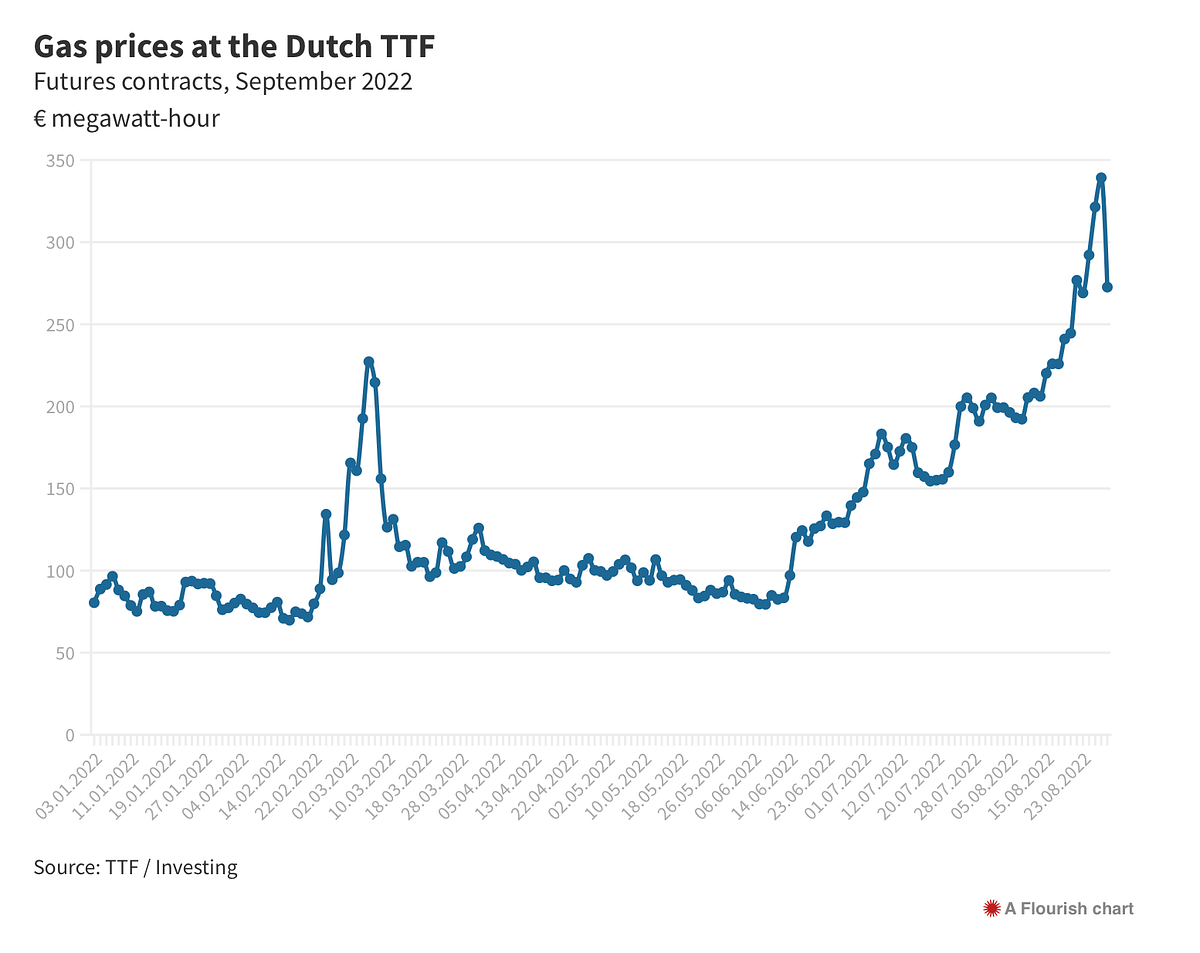
Alas, our story doesn’t end there. How is gas priced, which weirdly,moreelectricity is going to be made from, notless(because, well, now that you know the highest bidder sets the price, there’s money to be made in this crazy game)? There’s aDutch market that sets the prices forallof Europe’s gas. It’s called the TTF, or Title Transfer Facility: “Established in 2003, the TTF gained prominence as the energy sector became liberalised and is today considered the reference point to monitor and understand Europe’s gas market.”
So what’s wrong with that? Well, for a start, anyone can trade on it, which means that as the price of gas skyrocketed because of war, speculators stepped in and drove it up evenhigher.“Analysis by the EUAgency for the Cooperation of Energy Regulators (ACER) and the EC Gas Coordination Group show that gas prices have decoupled from market economics, and are instead following the impulses of fear and speculation. Messages regarding the supply of natural gas lead to grossly amplified market reactions that result in outlandish prices, which do not reflect the reality of gas reserves — or supply and demand within the union.” (The same is more or less true in America, where the gas price is set on the New York Mercantile Exchange, based on a single major pipeline in Louisiana.)
Now you should be horrified, as the implications of the above sink in. Why are your energy bills so high? Well, the price of electricity is set according to the highest bidder. LOL — good luck surviving extra self-made disaster while the planet boils, everyone. Meanwhile, the price of gas — from which much electricity is made — is vulnerable to speculation from every deep-pocketed psychopath with a business card reading “hedge fund manager.”
Put all that together, and you’ve got a recipe for regression. It’s regressive in three ways — each of which causing major damage to our societies and economies.Number one, all this is preventing investment in 21st century energy, infrastructure, and so on, because, well, why bother doing that when you can make a killing on the dirty stuff? Two, the poorer you are, the more you’re going to get hit, the more you’ll pay for energy as a percentage of your income, as prices just go on rising to the moon. And three, because everyone’s now paying so much for energy, that leaves far, far less over to put back in the public purse and invest in things we all need, whether education or hospitals or, again, clean energy.
Angry yet? You should be. There is an energy crisis, true. But beyond that is a crisis of institutions — ours are badly designed, obsolete, enriching a tiny few at the expense of everyone else, and dragging our societies down with them.The energy crisis could andshouldhave been much smaller than it is now. Much of it could have been avoided with better market designs — which is precisely whysmarter nations are already capping pricesand offering people help with prices, an admission that the way these systems were designed was fundamentally flawed. The larger crisis is one of institutions — and that’s a crisis that can turn something like an energy shock into a full-blown disaster, leaving millions in poverty needlessly.
See? I told you. Bored, bewildered, shocked, horrified, angry, upset. Now you know how the worldreally works,my friend. And that’s always a dangerous thing. Because now you can begin to change it, too.
UmairSeptember 2022


