

(Why the 2020s Are) The Age of Inflection
Dec 17, 2022
Member-only
Save
What will history think of this decade? How will it remember it? I think that it’ll come to be thought of as the Age of Inflection. An age where inflection points were hit — and after that, certain forms of decline, if not collapse, began to become irreversible, gather a pace and momentum all their own. If it feels like the world’s out of control these days — welcome to the Age of Inflection.
What do I mean? In the last year or two — since the 2020s began — the world’s crossed a series of Inflection Points. They’re not discussed nearly enough, but they’re the raw stuff of what civilization is. And to put it bluntly, ours isn’t in good shape. So we’re going to discuss, briefly, three great Inflection Points our civilization just hit.
There’s little that’s bigger or more elemental or fundamental than these — you can think of them as turning points on the scale of centuries, which affect the world, well into the future, perhaps even the deep future.We’re not talking about stock markets gyrating by the microsecond — we’re talking about how civilizations rise and fall over centuries. What is an inflection point? When the shape of a curve changes. When it goes from acceleration to deceleration, progress to regress. And that appears to be exactly what’s happening to the macro-indicators of our civilization.
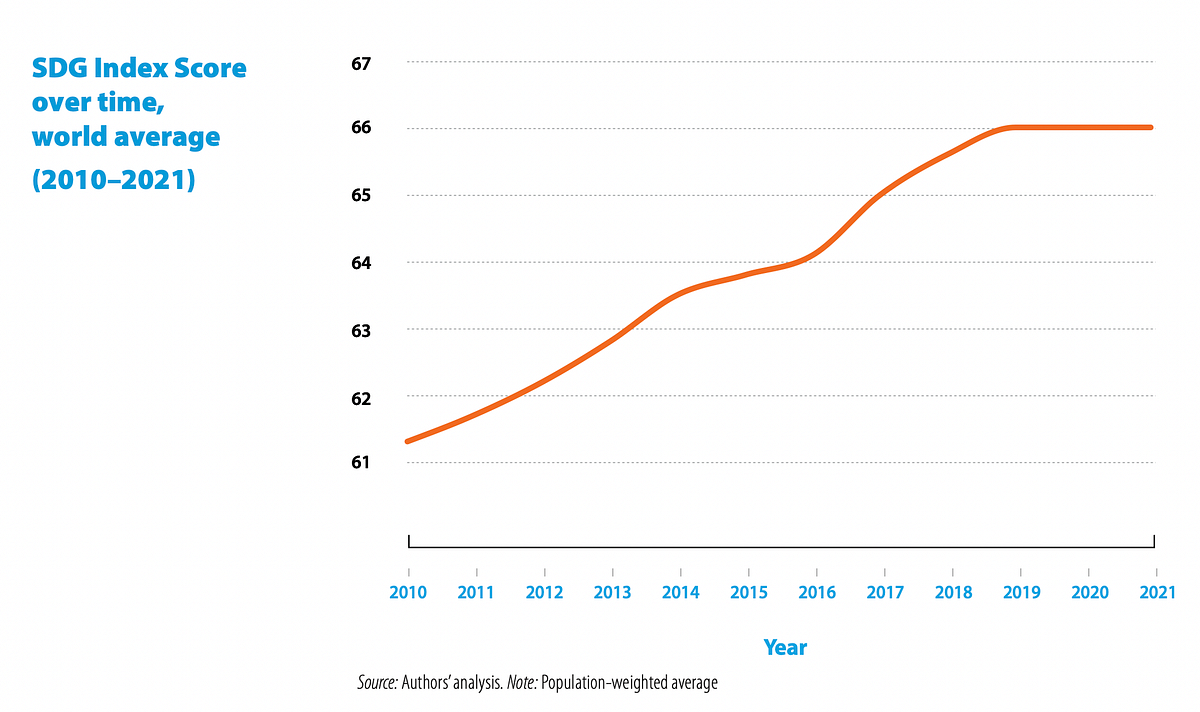
The first Inflection Point our civilization just hit is perhaps the most crucial one of all — and yet, it’s gone by largely unnoticed, except by nerds like me, and you perhaps.The world isnow going backwards.What does that mean? It’s not an opinion — it’s an objective fact. The UN keeps track of a thing called theHuman Development Index. Broadly speaking, it’s our civilization’s most authoritative measure of progress, in its simplest form. Are people living decent lives? Are they healthy and prosperous? Are they educated and enlightened? For the first time since records began, the index is now plungingdownwards.
That’s a sea change — and an ominous one. Let me put it to you another way: our civilization’s most authoritative measure of progress is now going backwards. This wasn’t supposed to happen. Not now — notever. The entire point of the HDI was to track what came to be thought of as increases in human living standards. Sometimes, there’d be quantum leaps, and most of the time, there’d just be the slow, steady uptick of everything from life expectancy to per capita income to education to trust and happiness. But what almost nobody expected was for human progress to come to a standstill — and then go into reverse.
It’s crucial to really think about that for a moment. The HDI plunging downwards isn’t a small thing — it’s one of the largest trends our civilization has, because it’s one of the largest-scale indicators that we have.It’s about the world, all of it, which includes each of us, and all our societies. It’s not showing a mixed picture — it’s showing, now, a steady, sharp decline.
So. Our civilization just hit a major, major Inflection Point. Human progress is going into reverse. Perhaps for the first time since….when?…go ahead and guess. Since the Industrial Revolution is probably the correct answer. We didn’t have an HDI back then, but if we did, it’d probably show a sharply accelerating curve of progress — living standards, longevity, happiness, all of it — right to…now. The Industrial Revolution was a quarter of a millennium ago. Perhaps you see how big this Inflection Point really is.
So. Inflection Point One is about progress. Now, progress is a demonized word these days. Let me emphatically point out that this isn’t about culture war level “wokeness,” whatever that even means anymore, as if…gay kids…being able to be…gay kids…was a bad thing.This is about the most fundamental stuff of a civilization — whether living standards are rising, flat, or falling. Our civilization just hit an Inflection Point on the order ofcenturies of progress grinding to a halt.
Think about that for a second. How…serious it is. The sheer sweep of history involved — and all that lies within it, too, the institutions and systems that fueled that historic wave of progress, which lasted centuries…untilnow.
So why is progress coming to a halt? Remember, this isn’t progress-as-in-“wokeness.” It’s basic, fundamental, material progress. Are people living longer lives? Are their incomes falling or rising? Can they educate their kids? Do they trust their institutions?Progress in that basic but grand sense is now in decline because of the Second Inflection Point.
Perhaps you heard that last year, the Amazon went from being a carbon sink — an ecosystem that absorbed carbon — to anet emitter. In other words, the lungs of the earth are now breathing out fumes. Not good, to say the least.
The Amazon is one of a number of what have come to be calledclimate tipping points. The others — andeverybody should know thisat this stage in history, yet too few do — include things like the ice sheets, the northern forests, the ocean currents, the monsoons in Africa and the Indian Subcontinent, and permafrost in the north. I won’t go into them in detail here — we’vediscussed them beforequite a fewtimes.
These are tipping point for a reason. If their delicate balance is altered, theyfuelfurther global warming. And then an acceleration effect takes place.Think about it very simply. The ice sheets reflect the sunlight, which is called the albedo effect, cooling the planet. But if the planet heats up to the point the ice sheets melt — as it is now — then the albedo effect is lost. Bang — a sudden double whammy, and warming accelerates that much more. The same is true, of say, the ocean currents, which disperse warm water, and circulate cool currents. And so on. The point, in pragmatic terms, is that climate change becomes a matter of “a little” or “a lot,” with far less likelihood of some kind of mildly uncomfortable middle ground. If the planet hits, say 2 degrees of warming, another degreebecomes more likely— the equilbrium in the middle simply doesn’t exist.
One of the most foreboding developments of the 2020s is that many of these tipping points appear to now have beenhit. We’ve already discussed one — the Amazon becoming a net carbon emitter. And yet climate scientists are concerned that we’re hittingnot one butfive:
The climate crisis has driven the world to the brink of multiple “disastrous” tipping points, according to a major study. It shows five dangerous tipping points may already have been passed due to the 1.1C of global heating caused by humanity to date. These include the collapse of Greenland’s ice cap, eventually producing a huge sea level rise, the collapse of a key current in the north Atlantic, disrupting rain upon which billions of people depend for food, and an abrupt melting of carbon-rich permafrost.
Now, the thing about it is that of course we won’t know for sure if those tipping points have been hit untilaftera ruinous acceleration in warming sets in. When it’s three degrees hotter, sure, we can say with 100% confidence. For now, though,it’s not looking good. If we haven’t hit those tipping points, we’re hittingthem. If we haven’t crossed them, we’re surely dangling not just a toe but a whole limb over the edge of the abyss.
How is that linked to the First Inflection Point, the Great Reversal in Progress? Well, it’s thecentral reasonour economies are slowing down.The 2020s arealreadya bleak economic decade, and things aren’t going to get much better. That’s precisely because we’re hitting the limits of the level of supply our planet can provide. Of the basics. You know this, becauseI’ve talked about it. The upshot is that from here on out, everything from food to water to clean air to energy to glass and steel and iron and cement and plastic — they all get more and more expensive, because supply is hitting hard limits. We can’t make the same level of stuff at the same scale — a civilizational one — as cheaply anymore, because now the side effects are here, from mega-weather to pandemics, and so is the main effect, which is resource depletion and mass extinction.
Let me put that in a more intuitive way. The First Inflection is about the Great Wave of Progress which began during the Industrial Revolution finally coming to an end. The Second Inflection — the one that’s driving the First — is thatthe industrialization killed the planet, butwe’re still a dirty, belching, fossil-fuel dependent civilization. So how can living standards go onrising? You see, we make literally everything out of fossil fuels, from the buildings which become hospitals in which we treat our elderly to the schools in which we educate our young, to the plastic household goods, like TVs and computers, we use without a second thought,right down to our food. When all that stuff is being made in ways pioneered during the Industrial Revolution — but the planet can’t provide the same levels of basics anymore, because being that kind of civilization is what wrecked it, well, of course we’ve found ourselves in a trap.
Our civilization’s now in a very real poverty trap. The beginning of declining living standardsisthe poverty trap in action. But they’re also just that — only the beginning.It’s not as if fresh water’s going to magically appear in a replenished Colorado River, from nowhere. As if the air’s going to clean itself. Or as if the crops we eat will magically grow themselves on a civilizational scale, without fossil-intensive fertilizer and pesticides. As if computers and TVs will pop into existence without plastic. And so on. All these things, which are the basics, arebeginning to creep upwardsin price, sometimes skyrocket, precisely because our civilization is now facing the beginning of the perhaps the greatest problem in its history: we can’t supply ourselves with the basics anymore at increasing levels of Abundance, like we expected, but only sharply falling levels of scarcity. A little less to go around every year.
What effect does that have? That brings me to my Third Inflection Point. About a decade ago, fascism began to sweep the world. What happened during the 2020s — and 2022 in particular — was another great global Inflection Point. Fascism resurging finally found its way to every corner of the globe. It was in 2022 that the last bulwark against it — Europe — fell, at last. The Trump era in America is how people often think of this new age of fascism rising — and yet the fact is then, Europe hadn’t yet really openly embraced neo-fascism. But now? Italy and Sweden have, andworse is sure to come, by the looks of things.
So my Third Infection Point is the ongoing death of democracy, at the hands of fascism.You don’t have to look very hard to see it, just look at what Twitter became, almost overnight — once a space at least aspiring to be democratic, in the deep sense of truths over Big Lies and peace and tolerance and so forth, and now…LOL. But of course that’s a tiny, tiny example, in a roiling sea of democratic decline and implosion. This trend is so great and so grave that political scientists have a name for it, “democratic backsliding.” Of course, that’s an anodyne way to put a pretty worrying development. When nations from India to Sweden to Britain to Russia have embraced the cult of the authoritarian, scapegoating, bigotry, and so forth — there is a very, very real civilizational scale problem.
Fascism isdriven now by just what it wasin the 1930s —impoverishment.Incomes in the rich world, and much of the poor one, went stagnant from about 2000 on, in some cases, like America’s before that. Today, they’re declining sharp and fast. Stagnant, then, and declining — now — incomes are one dimension of living standards, of human progress, going into reverse. And what they predict, without a shred of mercy, is fascism rising all over again.
Which is precisely what we see happening. You don’t have to think about Weimar Germany — just think of Squid Game. What is it a metaphor for? South Korea’s a nation that faces anendemic personal debt crisis. Though it became an affluent nation, rising from rags to riches, a resounding global success story — something perverse and unexpected happened. The average person didn’t enjoy a large enough share of the gains to really fully prosper — instead, they had to go into debt. In that sense, South Korea is a microcosm for our civilization, because that’s more or less the caseeverywhere. The average person is trapped inside arevolving door of debt, while the gains pile up in the hands of billionaires, like the dweeb who bought the social media website.
Now let’s come back to Germany in the 1930s — that’s exactly what happened back then, too. Back then, Keynes called all this “imbalances” — meaning that too much debt had accumulated, and caused a kind of runaway sociopolitical destabilization. Today, those imbalances are reasserting themselves with a vengeance. Even Americans, who should be some of the world’s richest people, are trapped by lifelong debt. And when that happens, well,like I said: expect fascism.
Because of course what debt means is that living standards are stagnant and falling.Just think about it. If you’re perpetually indebted, you’re basically that much less able — maybe evenunable — toinvest. Instead, you’re just trapped paying off interest, basically, forever, as so many are, which is what Squid Game was really about, which is where America’s once mighty middle and working class finds itself. And when people are unable to invest — they can’t afford homes, educations for their kids, healthcare, retirement. In turn, the public purse of societies grows depleted, and the systems which offer those things break, or never get built. A vicious cycle sets in. Poverty hardens and accelerate. And before you know it, there’s a demagogue — a Trump or a Farage or who have you — pointing the finger at some innocent scapegoat.
And that only makes the vicious cycle worse, because, well, you can attack scapegoats all you like, but if the real problem is that you’re so poor you’re basically indebted for life, even an idiot should be able to see the problem here. Pitchforks aimed at the powerless are hardly going to solve the problem of growing poverty.
Now let’s connect those Three Points. The Industrial Age’s revolution in progress is now drawing to a swift, sharp close. Not an opinion, an objective fact. Centuries of rising living standards are now — for the first time in history — going into reverse. That’s because, in turn, the Industrial Age’s dirty economy is out of time. The planet can’t take it anymore, and an industrial economy can’t offer the same level of Abundance anymore as it once could, on a depleted, wracked, gouged planet. Hence, living standards falling — and as they are, as life has grown more difficult, tenuous, insecure, unstable, a wave of fascism’s swept the globe. Reaching every corner of it by this year, into even places once though to be immune by many, like Europe’s mature social democracies.
Inflection Point One: industrial-age progress ends. Two: the planet crosses tipping points, as we push the industrial economy on a planet that can’t take it, in the desperate attempt to eke a last bit of “growth” from it. Three: fascism rises, as scarcity takes the place of abundance.People come to believe their neighbors and colleagues are the hated scapegoats behind this mess, the cause of it all, pedophiles who drink kids’ blood, and society should only belong to the pure and true, which is one way to solve the problem of declining living standards, for a very short time, but not a very good one, because, well, it takes democracy with it.
All that’s what the Age of Inflection’s about. Why it feels like the world’s hurtling towards dystopia.It is.We are crossing turning points on the scales of centuries and millennia now. Our civilization is in shockingly poor health. All isn’t lost, yet. We have, still, the power tochange our trajectory. But not for long, my friends, because every day now, the cause of civilization grows more feeble, beset from within and without. We’d all, I think, do well toremember that— and be on its side. Because, well, what else is the future made of?
UmairDecember 2022


