

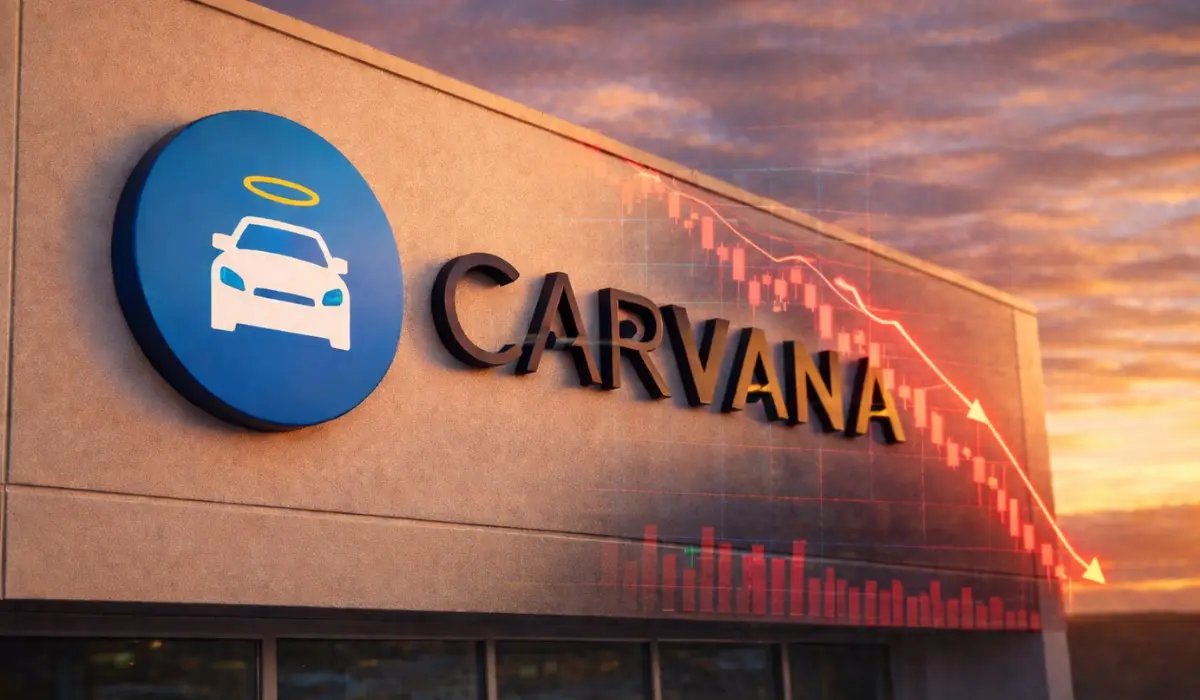
On February 18, 2026, CVNA stock plunged 20% despite the backing from strong revenue of $5.6 billion and record retail unit sales of 163,522. The reason cited is primarily a missed adjusted EBITDA (earnings before interest, taxes, depreciation, and amortization) forecast and an unclear outlook for Q1 2026.
Carvana, the online used car retailer, reported its Q4 adjusted EBITDA of $511 million, below the estimates of $535.7 million and 10.4%. The management cited reconditioning costs as the near-term margin risk, which further added to investor skepticism.
Margin Pressures and Cost Headwinds
Carvana Co.’s (CVNA) market outlook remained unclear after its EBITDA forecast failed to meet estimates for Q1 results. Ernie Garcia III, the CEO of Carvana, stated in his letter to shareholders that the management is expecting a sequential improvement in both retail unit sales and adjusted EBITDA in Q1 2026, as well as considerable growth in both over the entire year 2026.
Wall Street anticipated a Q1 adjusted EBITDA estimate of $671 million, with retail unit sales hitting 175,478. Reflecting on Q4 results, Garcia said that the drop was caused by the higher reconditioning costs of its vehicles. He also added that the firm is expecting higher costs as well in Q1, though the company projects higher profit per unit. Overall, Carvana was facing immense pressure at the start of this year.
With the short seller Gotham City Research’s allegation of Carvana exaggerated its earnings report in January that the company exaggerated its earnings report and failed to disclose benefits it received from DriveTime, a privately held subprime lender and used-car retailer owned and controlled by Garcia.
According to the reports of Gotham, those benefits inflated Carvana’s earnings by about $1 billion in 2023 and 2024. Carvana, however, has denied these statements. The firm’s technical indicators are bearish, with ADX at 38 signaling a strong downtrend, oversold RSI at 34.9, and MACD striking negative.
Although even after the drop, the valuation points to a premium, with the TTM price-to-earnings sitting near 79.8, price-to-sales around 4.28, and enterprise value to EBITDA near 38.6 on recent metrics. Such a level of metrics demands consistent improvements in profitability. Wall Street consensus remains bullish, with 31 buy ratings, 1 sell rating, and the remainder at hold. However, the quantitative framework shows mixed signals with recent company ratings portraying a C+ with a Sell tilt. Investors should interpret this divergence between analyst sentiment and quantitative ratings as a signal to employ measured position sizing, strict risk limits, and an emphasis on margin quality.
20% Selloff: From Volume to Profit Quality
With the reconditioning rates staying elevated, the Street’s anticipation and models look demanding and unfavourable. Thus, given the lack of specific guidance, Carvana’s reports imply caution for investors and traders. The firm is focusing on key drivers such as gross profit per unit, reconditioning turnaround times, SG&A per unit, and financing spreads from securitizations. The valuation is remaining rich.
The stock trades near 80x trailing EPS, about 4.3x sales, and an enterprise value multiple around 38.6x EBITDA. Debt-to-equity is elevated, though the liquidity ratios remain adequate. For the CVNA stock to re-rate higher, investors will need steadier margins with strong cash generation and clear cost relief in Q1.
The 20% selloff reflects a shift in focus from volume to profitability quality. Hence, a clear Q1 margin indication with cost control, and a more thorough view are essential for catalyzing the recovery.


