

How Bad Will the Economy Get? You Don’t Want to Know
Jun 19
Member-only
Save
Inflation skyrocketing. Stock market tanking. Pundits are calling it “a tough new economic climate” and “a slow economy.” So…how bad is the economy going to get?
If you really want to understand this question, then let’s talk about it seriously and subtly. There’s a certain thing, a kind of stupidity, which happens in our economic discourse. The economy’salwaysbooming. Have you noticed? As soon as “the pandemic ended” — which of courseithasn’t— the economy was said to bebooming.
The truth, though, is far from that. Do you know anyone who feels good about their economic prospects? I don’t.With the exception of aging generations, and maybe including plenty of them, literally every single person I know has spent their adult worried intensely about one thing first and foremost.Money.
At this point, we have a downward spiral of what’s called intergenerational inequality. Wages have been stagnant in America since the1970s. In Europe, since 2000 or so. That hurts the generations who’ve grown up amidst stagnation most. So at this point, Gen X did worse than the Boomers, and it was considered to be almost funny, but then Millennials didworsethan Gen X, and things started to look pretty bad, and now Zoomers basically have noeconomic future whatsoever. Owning a home, starting a family, retiring? LOL —good luck with that. And the generations which come after them? They’ll have it even worsethan that.
Why? Let me come back to the reason. Sorry to be annoying, but let’s talk about the economy a bit more first, in general terms.
They say that the reason the economy is cratering right about now is…the aid people received at the peak of the pandemic. LOL.That’s not true.There’s this theory that’s spread and far and wide by crackpots, which goes like this: “printing money equals inflation!!” Sorry, it’s not remotely that simple.
How do we know that government aid isn’t the reason the economy’s tanking now? Just by looking around the world, and observing. If it were the case that stimulus led to inflation, then of course countries with the greatest support would have the highest inflation. But that’s not true. Europe, which offered peopleway, way more supportthan America and the UK, haslowerinflationrates. And plenty of countries which offered people no support — because they’re poor nations — have skyrocketing inflation rates.
It’s not about stimulus.
This isn’t demand-led inflation. When people subscribe to this naive pop myth that “printing money during the pandemic caused inflation,” what are they really saying?That the economy’s cratering right now because people havetoo much money. LOL. Do you know anyone who has too much money? That’s an absurd thing to say. If people had “too much money,” presumably they’d use some of it toget out of debt. To invest, to spend on luxuries and so forth.None of that’s the case. People aremoreindebted than ever. “TheQuarterly Reporton Household Debt and Credit for the first quarter of 2022 shows a solid increase in total household debt of $266 billion.” See my point?
This isn’t about some kind of sudden massive spike in demand because people are suddenly whooping and cheering in the streets, because for the first time in anyone’s adult life, they havetoo much money. LOL —are you kidding me?
This issupply sideinflation. Let’s do a few painfully obvious examples of it.Americans can’t gettamponsandbaby formulaat the moment. Why is that? Because, I don’t know, every woman in America suddenly got her period all month long in a warning about Gilead via the Supreme Court? Because, suddenly, there was a round of instantaneous virgin births numbering in the millions?Of course not. Americans can’t get these basics because these basics are currently beingunderproduced. The problem is on thesupply side.
Why are there supply side problem stretching throughout the economy? Well, one reason is Covid — it caused labour shortages across sectors from healthcare to transportation. But the bigger picture here is about “climate change,” aterm I don’t like. It’s causingall kinds of shortagesthat nobody much — at least in the orthodox worlds of business and finance — ever really expected. Paper shortages — bye, tampons. Harvests of all kinds are beginning to fail, from sugar to wheat to coffee.
As the resources of the planet dwindle, in anticipation, warlords and oligarchs start conflicts to try and seize what of them they can — hence, Putin’s targeted Europe’s breadbasket, Ukraine.Yet another reason is our reliance as a civilization on centralized production. Why is it that there’s just a handful of baby formula factories for an entire nation? Does that make any sense to you? Shouldn’t essentials like this be produced in every town? Then there’s our civilization’s reliance on fossil fuels — they grow more expensive by the day, precisely because of all the above, war, climate change, pandemics.
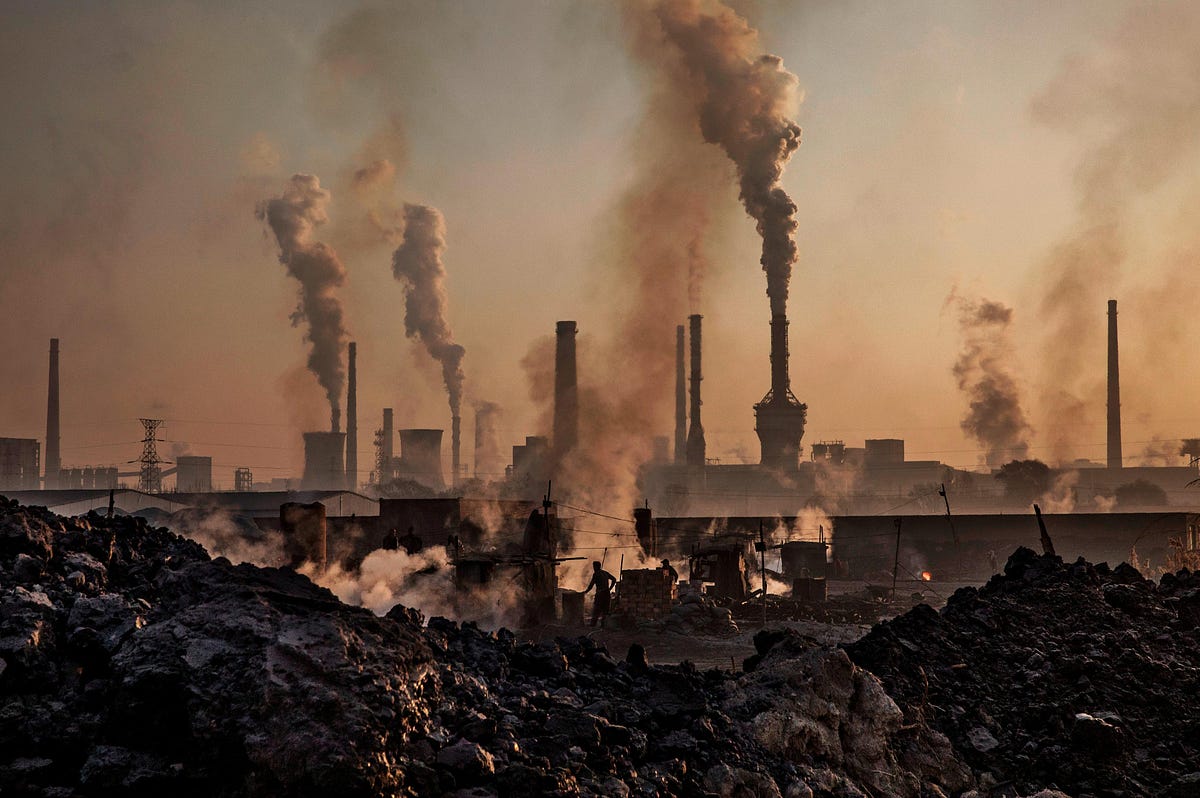
See the big picture here. We are living on a dying planet. We killed our planet.Birds drop dead from the skyaround the globe now. Heatwaves stretch across much of it, and then come megafires and floods. We aren’t ready for this.
We are a civilization with an industrial economy on a dying planet.
What happens to civilizations like that? Theycrash.Inflation, war, and stagnation wreck them. As the resources run out, people get poorer — fast, because prices skyrocket. As the temperature increases, infrastructure fails — and what little resources are left must be devoted to fixing it. As ecosystems die off, just providing basics — water, energy, clean air, medicine, food — becomes impossible, and things go into shortage.
Sound like what’s happening to our world?It should.
Industrial economies aren’t built for dying planets. They’re extractive.Exploitative. Rent-seeking.They don’t nourish, create, care, give birth to. They just manufacture lowest-common-denominator stuff and literally turnlife into death:plastic, fossil fuels, forests ripped down, oceans polluted, skies full of carbon, rivers turned to poison. They take without giving, and then they concentrate all the illusory wealth they’ve created in the hands of a tiny few, who have no incentive to invest it back in anything at all. Hence, billionaires grew so muchricherduring the pandemic they could have ended world hunger or cancelled debt a hundred times over.Crazy town.
Industrial economies aren’t built for dying planets, because of coursethey’re what kill planets.
You might say, well, Umair,why does that matter? It matters for a very, very important reason. What’s about to happennext.
In response to all this, central banks are raising interest rates. Now, you have to understand something about our institutions, which is going to freak you out a little bit.Central banksknowthat this isn’t going to work. “Baileysaid thatrunaway energy and food costs driven by global market forces were beyond his control, admitting he feels ‘helpless’ when it comes to surging inflation.” Why not? Well, because what difference does raising an interest rate make whenthe problem is on the supply side? Is raising an interest going to, I don’t know, plant a forest to renew the paper supply? Restore the soil, so the wheat harvest doesn’t keep on dying? Build a new factory for essentials like baby formula?
Of course not.
Central banks know that what they’re doing iswrong. Crazy, right? So why the aitch are they doing it? Because…well…they’re on autopilot. Central banks, the way we’ve set them up, canonly do two things. One, raise interest rates, two, lower them. But they’ve been at zero for decades now. This is what our institutions do. They just…react…in this weird, automatistic, unthinking ways. The idea is that doing thewrongthing is better than doing nothing.
But obviously it’s stupid, absurd, ridiculous, lethal, anduntrue.
Raising interest rates when there is a huge, huge supply shock racing through the global economy — everything dwindling, all our resources running out, our factories crippled, just getting things across the globe a major challenge — is acatastrophicmistake. It’s only going to make things worse. Much, much,muchworse.
If people had “too much money,” then sure, raising interest rates would make sense. Butnow?
Think about the average person’s life now. They don’t just not have “too much money,” LOL — they never have enough, so they’realways in debt.But now, they’re beginning to face chronic shortages, of everything from computers to food to soon enough electricity and even water. The basics are becoming harder and harder to get. So what is raising interest rates really going to do? It’s just going to make thingsmore expensive. Most people exist oncredit. Credit card debt, mortgage debt, student debt — a game of musical chairs, because in real terms, nobody much makes enough toreallylive on. And so raising interest rates is going to make the average person’s lifehell.
Now they’re going to face shortages and inflation — but also paying more and more interest on the debt they owe. How much debt is that? The average American owes about $25Kin personal debt. That’s about a year’s median income. That number is about to go way, way up.
Next, raising interest rates is only going to make inflationworse. Think about it. If we raise interest rates — but the problem is underinvestment, in everything from factories to forests to oceans — what are we really doing? We’re now making it evenharderto invest. To raise money, to cross the threshold of viability, and so on.
How do you solve a problem like this, then?
Look. We are facing the greatest supply shock in human history. Our resources are running out.This isn’t a joke, it isn’t hyperbole, it isn’t alarmism. Even theFinancial Times— the last good economic paper left — talks about it now. As our resources dwindle, of course the result will be inflation, skyrocketing prices, shortages, even forms of rationing, like California’sdoing for water.
What do we have to do to fix this? We have to invest. We have tobuild. We need new factories to supply the basics, built on new infrastructure that doesn’t kill the planet.We need everything from better power grids to water systems to food systems right down to basic hygienic products, not to mention advanced things like medicine, education, management, financing it all.The old ones — the systems we built for an industrial civilization — are not going to work for much longer.
We are an industrial civilization at aturning point. The greatest one in human history so far. A few hundred years ago, we had this thing called the industrial revolution. Yes, it was a net good. But it also ended up having externalities — hidden costs. One of those waskilling the planet. The price of all this manufactured plenitude ended up being the carbon in the skies which is raising the temperature to the point that we are having one of deep history’s handful ofExtinction Eventsnow.
Industrial civilizations cannot last forever. After they chew up a planet’s resources, a civilization has only two options. One, replenish the planet, or two, flee. The billionaires have the fantasy of fleeing a dying planet. LOL, have fun on Mars, guys, I hearthe weather’s great up there. Really nice place, too, lots of museums, cafes, bars, restaurants. I kid. Maybe one idiot can survive that way, but a civilization can’t — at least notours. We don’t have another planet to flee to, and even if we found an earth-like one, we don’t know how to get there, not one person, let alonebillions.
We’re stuck here, on this dying planet that was killed by our industrial civilization. That leaves with only one realistic choice.Evolve.Advance. Transform our economies — into the next stage, what lies beyond industrial ones, economies we might call renewable ones, where everything is manufactured in loops, where balance is the purpose of the system, not profit. Alter our societies and cultures — so that just killing everything on the planetisn’t OK,but something regarded as reprehensible, just like Antonio Guterres, theUN Secretary General’s warned.
How bad is it going to get? Maybe I didn’t answer the question clearly enough yet. How bad do you think it is now? That depends, probably, a lot on your age. So take however bad you think it is now, and imagine things gettingmuch worse.That shortages become the new normal. That prices keep skyrocketing — half because a planet is facing extinction, and half becausepsychotic billionaires profiteer from what’s left. That amidst all that, your already huge debt load only grows, to the point that you’re just paying the interest, and the principal never goes anywhere. And then things just go poof. Suddenly, one day, you can’t get this or that anymore. Not for a year, two, three. Then the basics begin to stutter and flash out. Water systems go down regularly, energy grids, food, hygienic products, medicine.
This is where we’re headed.
All this? It’s just the beginning. This isn’t a recession. It’s the beginning of the Extinction Depression.Hold on, I’ll wait while you call me an alarmist. See that? Don’t look up. Look down. Thebirds are falling deadfrom the skies.
UmairJune 2022


