

The Mega Scale Impacts of Climate Change Are Here — And They’re Devastating
Oct 1
Member-only
Save
It’s Antonio Guterres, the Secretary General of the UN, who’s put the plight we face at this juncture in human history most simply and profoundly. “We have a choice.Collective action or collective suicide. It is in our hands.”
It should be becoming startlingly clear, right about now, just how right he is. This is what a civilization committing climate suicide looks like.
What do I mean by that?
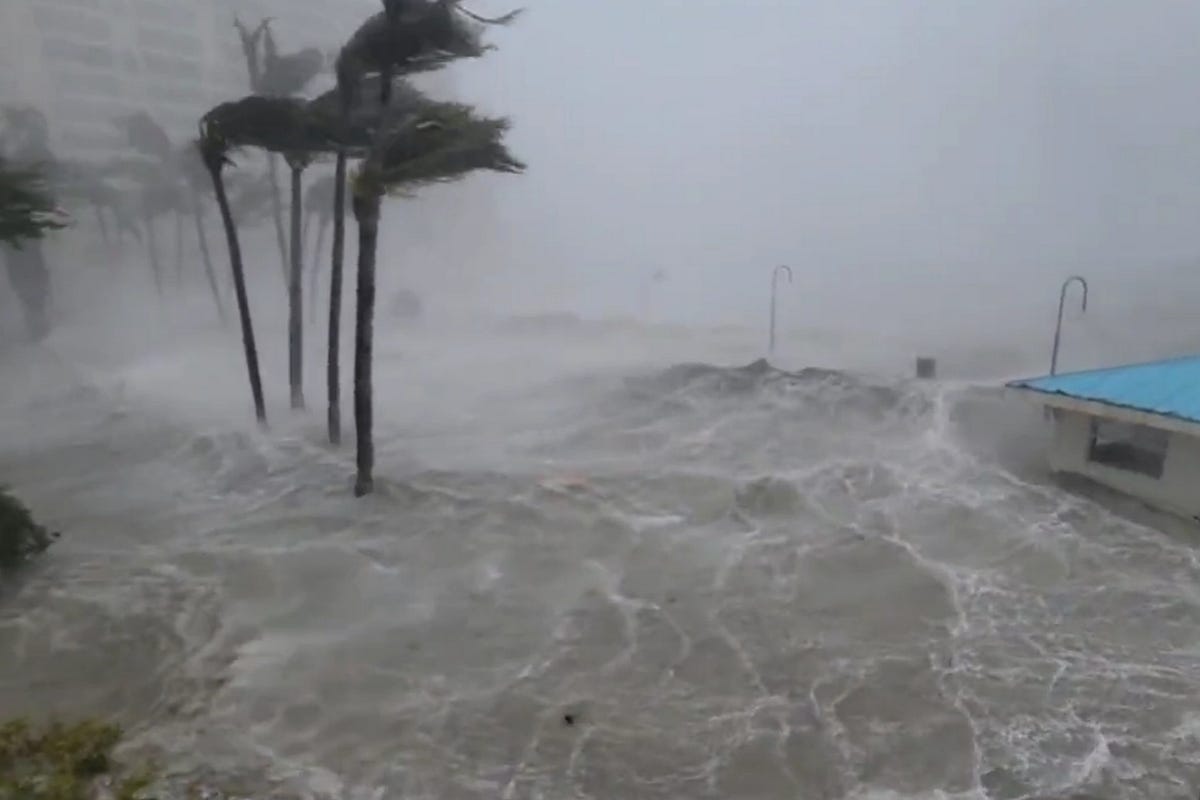
Think of the last four months alone.In each of those months, a mega-scale impact of climate change — aka Extinction — has occurred. Just last week, Floridadrowned, as Hurricane Ian hit it with hammer blow after blow. In September, Pakistanflooded, leaving tens of millions of people’s lives, homes, futures underwater. In August, amega-heatwavestretched around the globe, from China to America. In July, Britain had its hottest day ever — the mercury crossing 40 degrees Centigrade — while Europe, from France to Portugalburned.
2022 will be remembered by history as the year that the mega-scale impacts of climate change became suddenly, frighteninglyreal.
“Many of the storms of the past five years — Harvey, Maria, Florence, Michael, Ida and Ian — aren’t natural disasters so muchas human-made disasters, whose amplified ferocity is fueled by the continued burning of fossil fuels and the increase in heat-trapping carbon pollution, a planet-warming ‘greenhouse gas.’”
We’ve crossed a threshold. And that threshold is far more profound and ominous than many think. Let me try and describe it well, although it’s hard to — because we are talking about a set of changes that are the greatest in human history, and will affect all of it going forward.
No corner of the globe, we’ve seen, is immune from the mega-scale impacts of climate change.Just in the last few months, the list of places affected includes Florida, Pakistan, China, Europe. These places have next to nothing in common — except, of course, they all now in the crosshairs of a rapidly warming planet. Ignorance or denial — humanity’s approach so far — isn’t working, precisely becausenobody’s immune to Extinction.
The problem is compounded by another grim fact. The mega-scale impacts of climate change are arrivingwayahead of schedule. The models predicted thatsuch events wouldn’t really materializeuntil the 2050s or so — entire nations drowned, whole regions burning, events on vast scales that even drones and satellite images fail to capture them well. The mega-scale impacts of climate change are arriving decades faster than predicted or expected. They’re herenow.
That’s because the planet is heating up far, far more rapidly than predicted — and the effects arethreatening to hit tipping points, if they haven’t already. Everyone should know that climate changeisn’t linear: it’s unlikely that we’ll get 2 degrees or 2.5 degrees. Instead, because the planet is made of ecosystems in delicate balance with one another, it’s more likely that we’ll get a little, or a lot. The probability of getting 3 or 4 degrees, in other words, is higher than 2 degrees, because at 2 degrees, tipping points are hit — ocean currents shut down, great forests burn, glaciers and polar ice sheets melt, all of which suddenly increase the temperature themselves. The planet’s ability to thermoregulate itself isn’t linear — it has a series of equilibria, it appears, not evenly distributed, but which exist at a small degree of warming, or alot of it.
And it appears, ominously, that we’re headed towards…a lot. Warming is happeningfar, far fasterthan the best predictions of the most sophisticated — Britain wasn’t supposed to cross 40 degrees Centigrade, India and Pakistan weren’t supposed to cross 50 — for decades to come. And because that’s happening so much faster than predicted, so, too, the mega-scale impacts of climate change are arrivingnow.
It appears to me that we aren’t really contending with this simple but brutal fact. Things havechanged. And they’ve changedfor good.Just a few years ago, the mega-scale impacts of climate change were rare — and for that reason, mostly theoretical.But not anymore. Now, they are beginning to hit usevery single month.
By mid 2022, it was rarer to have a monthwithouta mega-scale climate event than it was to have a monthwithone. Think of what that means. Mega-scale climate events are only going to become more and more regular. That means that going forward, they’ll bemonthlyoccurrences. Sure, there’ll be periods without them — but unlike in the entire rest of human history,thoseperiods will be the outliers. And the statistically normal periods will be the ones with mega-scale climate events.
You should know what that means by now. Floods that drown nations and states, fires that incinerate entire regions, temperatures shattering records, cities becoming uninhabitable — and all the consequences such things imply. Europe’sheatwave spoiledsome 30% of its crops — and this is just 2022. The impact of that on inflation is yet to come, but it’ll send prices even higher by the winter. Then there are the costs of repairing ruined regions, like Florida — and the even higher costs of displacement. What happens when an entire region is underwater or incinerated? It’s economy justshuts down. Nothing is made, consumed, produced — and growth suddenly flatlines, as unemployment and homelessness and poverty spike. That’s not good for anyone, because it only accelerates the stagflationary pressures already ripping through our economies.
The effects of mega scale climate change events are catastrophic, in other words. Not just the human suffering, which is awful — but the consequences to economies, societies, and polities. As refugees flee, as regional economies are shattered, the pressure on public purses amplifies, all of which destabilizes polities, only lending strength to the right wing tide sweeping the globe, too. That money’s for my kids — not forthose people! I don’t care if they don’t have a place to live — I can barely make ends meet myself!!
Let me repeat my first point. We haven’t come to terms yet with the brutal fact that we have crossed perhaps the gravest and most historic threshold is human history.The mega-scale impacts of climate change are here,now, long before they were predicted to be. From this point on in the next chapter of human history, mega scale climate events are going to be the norm, not the outlier. Right now, every month or so. And then faster and faster — right on into the gyrating heart of Extinction.
What does the endgame look like? You should know that, too, by now. Entire regions of the planet become uninhabitable — and even that might exceed our best understanding of it now. Right now, most of us who are thoughtful assume that some places will become too hot to live in, crossing thewet-bulb temperatureregularly, some places will be Fire Belts, some Flood Belts, some Drought Zones and so forth. But just as mega-scale events arrived sooner than expected, who really knows how bad it could get? Maybe some coasts will be poisoned, some rivers overrun by invasive, toxic species, maybe all that will — asscientists increasingly conclude— fuel new pandemics, and so on.
Let me try and make my second point clear now. Extinction is happening faster than we ever thought it could. I use “we” in the big sense — there are those of us who warned of it, certainly, but institutionally, even the best science and modeling and whatnot that we have expected Extinction to proceed a slower timescale. One that would give us crucial decades to respond to it — and try to ensure the survival of our civilization. But now all that is at severely elevated risk, precisely because Extinction is happening much, much faster than we thought. Europe’s rivers didn’t run dry in 2052 — but in 2022.
Where does that leave us? In a maddening place. You see, we all know what has to be done — and even if we don’t consciously know it, we still know it, at an instinctive level. We need to vastly reduce the fossil fuel intensity of our civilization, and we need to do it at light speed, in historic terms — a handful of decades, if we even have that.
Let me put the situation to you bluntly, because everyone should know these simple facts.Carbon emissions arestill rising.The only time they’ve ever paused in human history was during Covid. And that tells us something ominous — it took aliteral shutdown of the entire global economyto really stop carbon emissions rising at all. And of course, the most basic fact of all about Extinction is that as carbon emissions rise, so does the temperature —permanently.
We are nowhere near reducing carbon emissions — and yet the mega-scale climate events are arriving now, not in 2050. See the Existential Problem?
What needs to happen, at this juncture in human history, is something like the following. The greatest wave of investment,ever, period. Clean energy, everywhere, as fast as possible. Research in new forms of it, like fusion reactors, or what have you, to power the next generation of it.On top of it, closed loop manufacturing systems for what we consume — things like shoes and clothes and household goods remade from existing stocks of stuff, not new stuff, because the truth is that producing new amounts of even this basic stuff requires huge amounts of petrochemicals, from plastic itself to extracting cotton and oil. Finally, we need to learn to produce the most basic stuff of our civilizationwithout petrochemicals— food without agricultural fertilizer, steel, glass, and cement without oil-powered ovens that needs to kept on 24/7 at super-high temperatures, and to do that, we need research, huge amounts of it,now.Do you know how many green steel plants our civilization has right now?One.
People vastly,vastlyunderestimate how dependent our civilization is on fossil fuels. They imagine that the problem is cars and coal. But it goes, much much deeper than that. All the plastic stuff in your house? Made of oil byproducts. So what do we make it out ofnow? The food you eat? Made with industrial fertilizer that comes from petrochemicals — our civilization literally can’t feed itself without fossil fuels. Buildings? We have no idea how to make them without fossil fuels. Our civilization’s entire energetic basisisfossil fuels — 84% of it,still.
And we need to reduce that below 50% or so, in the next decade or two, to have any hope of surviving as a civilization, or even as countries and societies, instead of just fallen democracies overrun by lunatics, extremists, fanatics, and fascists, scapegoating the nearest innocent, refugee, gay, woman, kid, for the apocalypse now arriving on the doorstep every month. But hitting that number isn’t just about building a few wind farms here and there. It is aboutmuch, much more.
Let me make my third point now. We need to reinvent our civilization’s basic systems.All of them. Food, water, energy.Material systems, from the stuff we build with to the clothes we wear. None of this stuff can be dependent on fossil fuels anymore. It has be made in closed loop systems powered renewably — or else, increasingly,we won’t have it all. Think of the way Europe’s crops went up in flames, or how Pakistan — the world’s fourth largest supplier of textiles — wasmore than a third underwater. The stuff we take for granted, if it still has to be made of fossil fuels, isn’t going to be around much longer, for the very simple reason that catastrophe after catastrophe is already wiping out systems of it made that way, as the planet boils, and prices are already going through the roof.
Now. You might ask yourself, “but where’s the money for all that going to come from?!” The answer is very simple. All of that stuffis an investment. Itpays for itself, in record time, even financially.What does renewable energy? It’s free. No more mega-energy bills. The lesson applies more broadly. Stuff made clean is cheaper, over the long run, in most cases, almost immediately, because the idea is to cycle it, not extract, refine, mine it anew. What’s stopping us is the political will to pay for the flxed costs, and that is why we need initiative like Joe Biden’s Climate Bill, to kickstart the process. But that’s a tiny step, truth be told — we need a Global New Deal along these lines.
Or else our civilization isn’t going to make it. It’s that binary, that simple, and that brutal.You might have even thought, until recently, “so what? Maybe half the planet burns or drowns. But some places will survive! I don’t know, smart countries, like Sweden!!” Think again, because Swedenjust wentfascist. It’s becomingly increasingly difficult to imagine that any aspect of our civilization survives Extinction — that thought appears to be, by the day, being revealed as escapist wishful thinking,
Three facts. Mega-scale climate events are herenow. Extinction is happening much faster than we thought. Our civilization’s basic systems — all of them — need reinvention at a fundamental level, if we’re going to survive.
This is ourchallenge in the 21st century. The one that history will judge us on, the one which decides if there’ll be much of a future, and the one that makes this era the most crucial and decisive and consequential in all of the human story so far, all 300,000 years of it.
And so far? It’s not looking good.
UmairOctober 2022


