


Understanding technical terms and jargon is essential for success in any field an individual engages with. Free Cash Flow (FCF) is a common technical term associated with finance, specifically corporate finance. The concept of FCF can be defined as the surplus cash a company generates after it pays for the money needed to run and maintain its complete operations.
Free Cash Flow (FCF) is the surplus cash a company generates after paying for operating expenses and capital expenditures required to maintain and grow its business. In simple terms, it is the cash left over after running and maintaining operations. This remaining cash can be used for dividends, debt repayment, expansion, acquisitions, or share buybacks.
A company’s free cash flow shows how much real and flexible cash that particular company has to spend on paying dividends, buy back shares, pay down debts, invest in new projects, and build a cash buffer. A company’s free cash flow can be calculated using a common formula known as the Free Cash Flow (FCF) formula.
Free Cash Flow (FCF) is defined as the difference between cash from operations and capital expenditures, explaining that FCF represents the amount of cash generated by a business after accounting for reinvestment in non-current capital assets.
Here is the simplest form of the FCF formula,
| Free Cash Flow = Operating Cash Flow − Capital Expenditures (CapEx) |
FCF is an important component in displaying the financial health of a company. FCF indicates the “cash on hand” that can be used for reinvestment, distribution to shareholders, and the company’s ability to operate independently without relying on additional financing from outside. A company with strong and positive free cash flow can fund new products, research and development, project expansion, etc.
Types of Free Cash Flows
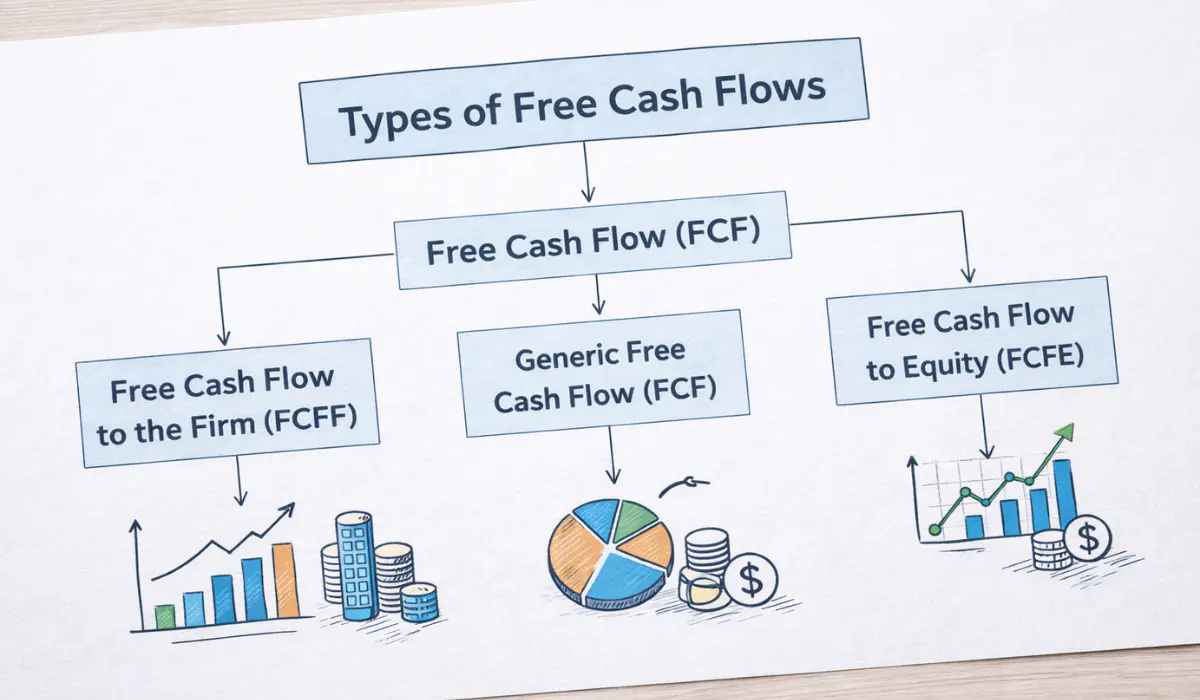
There are primarily three types of Free Cash Flows: Free Cash Flow to the Firm (FCFF),
Free Cash Flow to Equity (FCFE), and Generic Free Cash Flow (FCF). These three types help analyze cash available to various stakeholders in a particular company.
1. Free Cash Flow to the Firm (FCFF)
It represents the cash available to all capital providers, including both the stakeholders and lenders. Simply, the idea of Free Cash Flow to the Firm shows the firm’s operating cash flow before considering the associated financial decisions.
General Formula to Find FCFF = FCFF=EBIT×(1−Tax Rate)+Depreciation & Amortization−Capital Expenditures−ΔWorking Capital
- EBIT = Earnings Before Interest and Taxes
- Δ Working Capital = Change in Working Capital
FCFF’s one-line intuition can be explained like this: Cash from operations after tax − Cash reinvested to keep the business running.
2. Free Cash Flow to Equity (FCFE)
Free cash flow to equity is the cash available exclusively to equity shareholders after meeting all expenses, reinvestment requirements, and debt obligations. If we simplify the idea and consider the FCFF as a whole pie, the FCFE is the slice left for the owners once the bank takes its cut.
General Formula to Find FCFE = FCFE=Net Income+Depreciation & Amortization−Capital Expenditures−ΔWorking Capital+Net Borrowing
The FCFE is generally used for valuing the equity directly and estimating shareholder value or sustainable dividend capacity.
3. Generic Free Cash Flow (FCF)
It is a simplified measure frequently cited in financial reporting and market commentary; it represents the same concept as Free Cash Flow. Generic cash flow reflects the cash in balance after operating expenses and capital spending, but without strict standardization.
Here is a table that explains each three simply.
| Type | Cash Available To | Consider Debt? | Common Use |
| FCFF | Debt + Equity holders | No (before debt payments) | Enterprise valuation |
| FCFE | Equity holders only | Yes | Equity valuation |
| Generic FCF | Varies | Varies | Cash efficiency analysis |
These three concepts answer three different questions: FCFF answers how much cash the business generates overall, FCFE answers how much cash belongs to shareholders. And, Generic FCF answers how much cash is left after running the business?
Why Is Free Cash Flow Important?
Free cash flow is a key metric, as it represents the cash a company generates after capital expenditures, providing a clear measure of its financial health. It ultimately measures the cash a business can deploy to fund development and growth from its own resources. The concept of free cash flow offers a transparent view of a company, providing a clear picture of its operations and financial capacity.
Free Cash Flow (FCF) is a critical metric because it is less susceptible to manipulation and provides a clear picture of a company’s financial health. It also helps identify potential red flags early, such as rising working capital requirements, heavy capital expenditure burdens, or possible earnings manipulation.
The Bottom Line
Understanding the fundamental concepts of any field is essential, and free cash flow is one such key metric that everyone involved should be familiar with. Positive FCF and negative FCF show how a company is doing and how much potential it has to grow in the future. It’s important to note that a negative free cash flow (FCF) is not always a red flag. For instance, a new startup may report negative FCF simply because its infrastructure investments are significantly higher compared to those of more established companies.


