

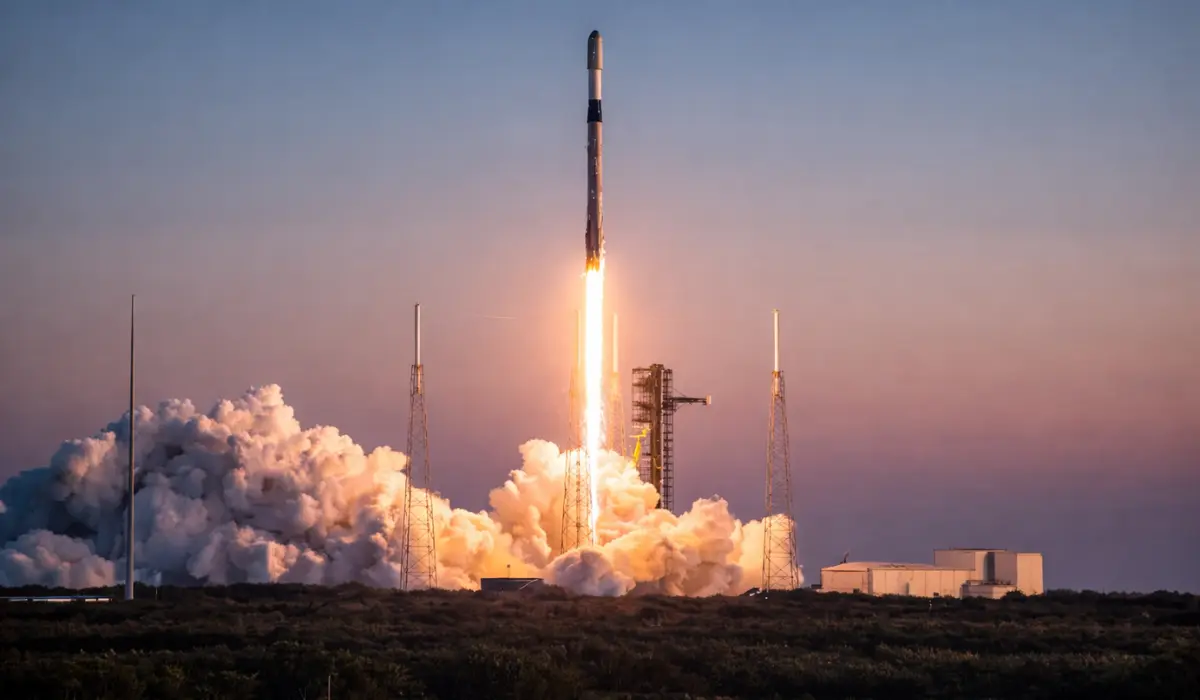
On February 24, 2026, SpaceX carried out a twilight mission that lit up Florida’s evening sky, launching 29 Starlink Satellites aboard a Falcon 9 rocket.
This mission follows a $1.25 trillion merger of SpaceX and xAI. The rocket thundered off from Pad 40 (SLC-40) at Cape Canaveral Space Force Station, marking the latest expansion of Starlink, the company’s global broadband constellation. Tuesday’s mission, internally designated Starlink 6-110, represented the 18th Starlink flight of 2026, underscoring the rapid cadence at which SpaceX continues to build out its low-orbit internet network.
At the heart of the mission was the workhorse Falcon 9 Block 5, the latest and most capable iteration of the Falcon 9 family. Known for its reliability and reusability, Falcon 9 once again demonstrated the cost-efficiency strategy that has become synonymous with SpaceX under the leadership of founder and CEO Elon Musk.
Precision Launch Into Low Earth Orbit
The two-stage Falcon 9 climbed through the dimming sky, its exhaust plume illuminated by the setting sun. As it pierced the upper atmosphere, sunlight refracted off the expanding vapor trail, creating a luminous halo visible across much of central Florida.
Approximately eight minutes after liftoff, the rocket’s first stage, the reusable First Stage Booster, separated and began its controlled descent. Meanwhile, the second stage continued propelling the 29 satellites toward Low Earth Orbit (LEO), the operational zone for Starlink’s growing network.
The booster successfully landed on the autonomous drone ship, stationed in the Atlantic Ocean. The landing marked another recovery milestone for the booster, reinforcing SpaceX’s reusable rocket model that has significantly lowered the cost of orbital access.
Following orbital insertion, the 29 satellites were deployed into Low Earth Orbit in a carefully timed sequence. Over the coming days, each satellite will use onboard propulsion to maneuver into its assigned position within the Starlink constellation.
Expanding the Starlink Constellation
Tuesday’s payload consisted of V2 Mini Optimized satellites, an upgraded configuration designed to enhance bandwidth capacity and network resilience. Some units in recent batches have included early Direct-to-Cell capability, a technology aimed at enabling standard mobile phones to connect directly to satellites in areas without terrestrial coverage.
By operating in Low Earth Orbit, typically between 300 and 600 kilometers above Earth, Starlink satellites provide lower latency compared to traditional geostationary systems. This enables faster internet speeds suitable for video conferencing, gaming, and real-time communication, a critical advantage for rural and remote communities worldwide.
The continued deployment from Cape Canaveral reflects the strategic importance of Florida’s Space Coast to SpaceX’s operations. Pad 40 (SLC-40) has become one of the company’s busiest launch sites, supporting a high frequency of both commercial and government missions.
Sustained Launch Momentum in 2026
With this mission, SpaceX continues an aggressive 2026 launch schedule, emphasizing rapid deployment and constellation scaling. The Starlink 6-110 mission not only adds capacity to the network but also reinforces the company’s dominant position in commercial spaceflight.


