

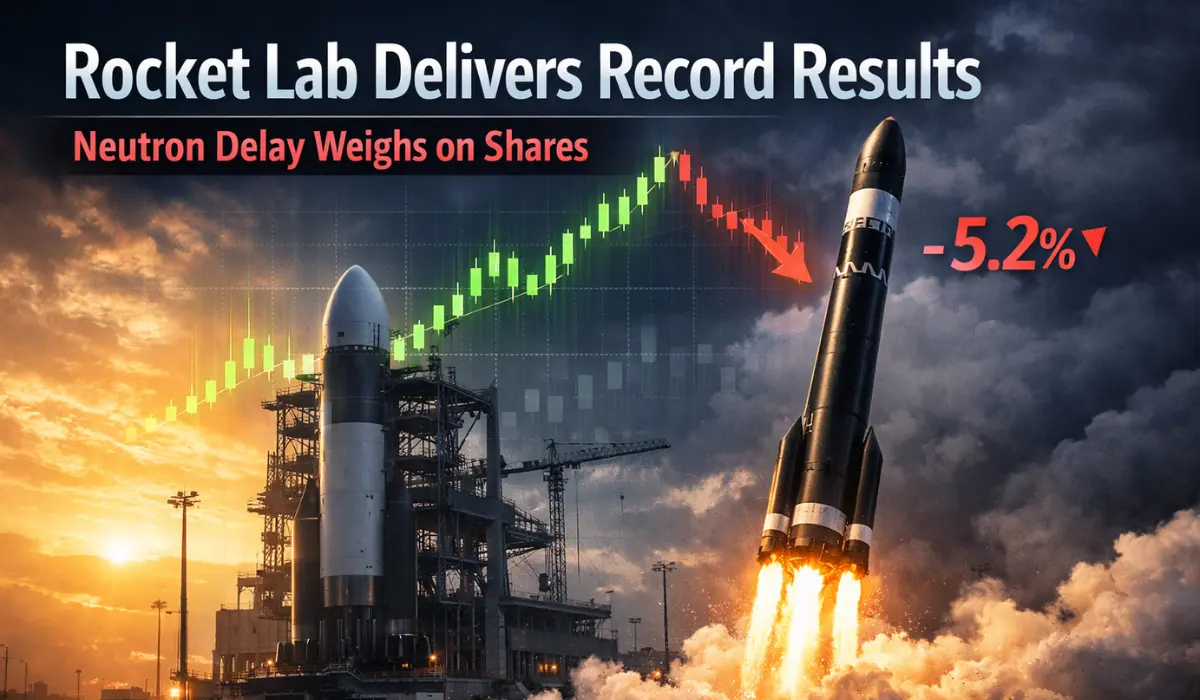
Rocket Lab USA Inc. ($RKLB) posted record financial and operational results for 2025, highlighting accelerating demand across its launch and space systems businesses. However, shares came under pressure after the company confirmed a delay to its next-generation Neutron Rocket, shifting its debut into the second half of 2026.
Meanwhile, Shares of Rocket Lab USA Inc. (RKLB) closed at $69.10, down 4.89%, and slipped further in after-hours trading to $68.60, a decline of 0.72%, as investors reacted to the company’s Neutron delay despite record annual results.
Record Revenue and Expanding Backlog
Rocket Lab founder and CEO, Sir Peter Beck, stated, “It was also the quarter in which two spacecraft we built for NASA and the University of California Berkeley were successfully launched toward Mars for the historic ESCAPADE mission, proving Rocket Lab can deliver decadal-class science missions on rapid timelines for a fraction of the cost of traditional interplanetary programs. We ended the year with a record $1.85 billion in backlog, representing 73% year-on-year growth, a figure we look forward to building upon in 2026.”
The performance was driven largely by the Electron Rocket, which completed 21 launches in 2025, the highest annual cadence in company history. Management described Electron’s reliability as approaching a “century-level” mission success rate, reinforcing its role as a dependable option for small satellite deployments.
A major contributor to the expanding backlog was an $816 million award from the Space Development Agency, a strategic win that strengthens Rocket Lab’s footprint in national security missions and satellite production.
Yet despite record revenue and launch activity, investor focus shifted to development challenges surrounding Neutron. The company disclosed that a Stage 1 tank rupture occurred during hydrostatic testing, prompting additional engineering work and pushing Neutron’s first launch into Q4 2026.
The rupture was traced to a manufacturing defect in the composite structure of the first stage. Beck emphasized that the issue was identified during routine structural testing, a standard part of new vehicle development, and not during flight operations. No injuries were reported.
To address the root cause, Rocket Lab is accelerating its transition to an Automated Fiber Placement (AFP) manufacturing process. The AFP method replaces certain hand-laid composite fabrication techniques with robotic precision layering, designed to reduce variability and prevent structural inconsistencies. Management indicated the shift should strengthen production quality ahead of full-scale vehicle assembly.
Neutron is widely viewed as pivotal to Rocket Lab’s long-term valuation strategy. While Electron supports steady revenue growth in the small-satellite segment, Neutron is intended to compete more directly with SpaceX in the medium-lift market, opening access to larger commercial constellation deployments and government missions.
Development of the Archimedes Engine, which will power Neutron, continues through qualification testing. The company reiterated its confidence in the engine program but acknowledged that structural redesign and validation efforts would extend the vehicle timeline.
Operational Momentum Remains Intact
Rocket Lab’s launch operations at Wallops Island, Virginia, remain active with Electron and HASTE missions, preserving operational momentum even as Neutron advances through additional engineering milestones.
Recent filings with the SEC reflected continued investment in infrastructure and production capacity to support the medium-lift program. Still, equity markets often price aerospace growth companies based on future catalysts, and Neutron represents Rocket Lab’s most significant upcoming inflection point.
The contrast between record execution and developmental delay defines the current narrative. On one side: 38% revenue growth, a $1.85 billion backlog, and the company’s highest-ever launch count. On the other: a roughly one-year slip in the program is expected to expand Rocket Lab’s total addressable market.
For investors, the key question is whether strong cash flow from Electron and expanding government partnerships can offset timeline risk tied to Neutron. Rocket Lab has demonstrated consistent operational delivery. The next phase will test its ability to translate engineering refinement into a successful medium-lift debut.


