

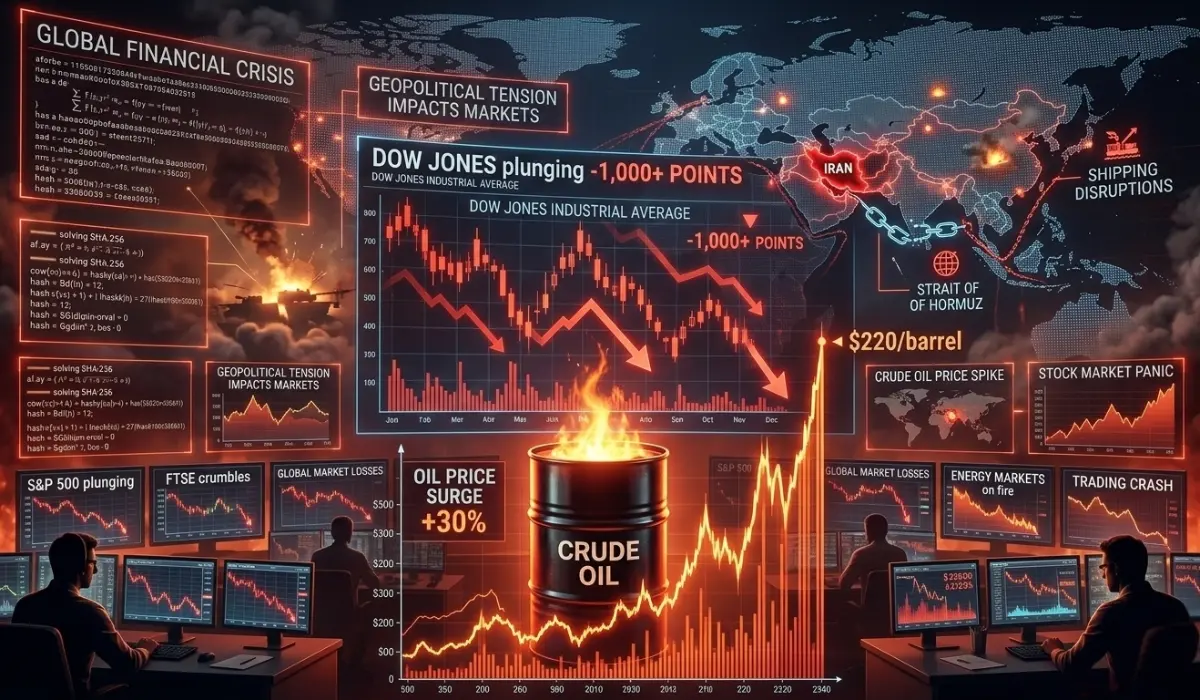
U.S. stock futures tumbled amid a sharp escalation in the U.S.-Israeli conflict with Iran, triggering a major risk-off reaction in global markets. The sell-off was driven by surging oil prices, with West Texas Intermediate (WTI) crude jumping 30% to $118.46 a barrel, its largest single-day gain since 1988. Brent crude, the international benchmark, spiked by 27.78% to $119.04, as fears grew of prolonged disruption to global energy supplies. This surge in oil marked the first time it rose above $100 per barrel since Russia’s 2022 invasion of Ukraine.
Oil Surge and Middle East Tensions Trigger Worldwide Market Decline
Rising fears and higher energy prices are weighing heavily on the U.S. economy, threatening to slow growth significantly. Futures tied to the Dow fell more than 1000 points or 2.11%, S&P 500 futures lost 1.88%, and Nasdaq 100 futures dropped 2.26%.
The broad market downturn triggered indiscriminate selling across assets. Japan’s Nikkei 225 tumbled 6.65%, falling below the 53,000 mark for the first time since February 6, while the Topix was down 2.25%. South Korea’s Kospi triggered its second circuit breaker in four sessions today, leading to a regional sell-off. In Hong Kong, the Hang Seng Index fell by nearly 3%, and the CSI 300 on mainland China was down 2%.
Oil futures jumped after major Middle East producers were forced to cut their output because of the continued closure of the key Strait of Hormuz waterway. Iraq, the United Arab Emirates, and Kuwait, which are the three major producers in the Organisation of the Petroleum Exporting Countries (OPEC), have cut production amid an accumulating backlog of barrels, as export routes remain blocked.
Safe-haven assets like gold and silver initially rose but later retreated as the dollar strengthened. The U.S. dollar surged 0.83% against the euro and was up 0.60% against the yen. In the meantime, although Bitcoin slumped to around $66,000, the asset is now up 1.79%, trading at $67,156.76.
U.S. President Donald Trump posted on Truth Social that a gain in oil prices was a “very small price to pay” for destroying Iran’s nuclear threat. U.S. Secretary of Energy Chris Wright also downplayed the prospect of rising energy prices and said it is “temporary.”
Israeli Airstrikes Target Iran’s Oil Infrastructure
The conflict intensified after U.S and Israeli strikes killed Iran’s supreme leader. While signalling continued resistance, Iran named slain leader Ayatollah Ali Khamenei’s son, Mojtaba Khamenei, as the new supreme leader.
Burning up the situation further, on Saturday, Israel carried out air strikes targeting Iran’s oil infrastructure for the first time since the start of the war. The strikes hit four oil storage facilities and an oil production transfer centre in Tehran and the province of Alborz, according to the reports of Iranian state media.
Iran’s Revolutionary Guard Corps (IRGC) on Sunday threatened to target the energy facilities across the region in retaliation, warning that if the U.S and Israel continue attacking, it could cause oil prices to soar to $200 a barrel.
U.S. jobs data released Friday was surprisingly weak, briefly stalling dollar gains and lifting expectations for Federal Reserve rate cuts. By Monday, however, those expectations had faded, with traders now pricing in less than 40 basis points of easing by year-end.
Near-Term Market Sentiment Stays Cautious
The International Monetary Fund has estimated that every sustained 10% rise in oil prices will simultaneously result in a 0.4% rise in inflation and a 0.15% reduction in global economic growth. Higher fuel costs will raise transportation and shipping expenses, pushing the price of groceries, consumer goods, and travel. Moreover, if inflation keeps rising, it can be hard for the Federal Reserve (the Fed) to cut interest rates.
Investors are watching for potential rebounds should tensions ease or corporate earnings prove resilient, but near-term caution dominates amid the uncertain geopolitical backdrop.


