

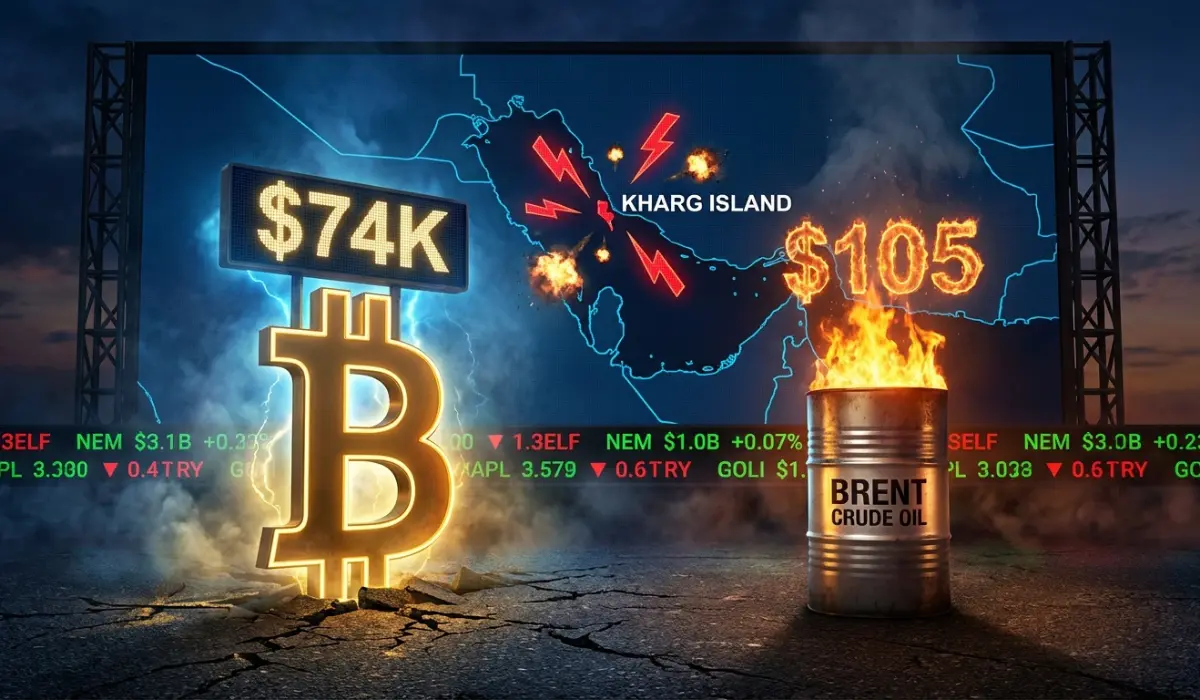
Bitcoin (BTC) posted major gains over the weekend as escalating tensions in the Middle East pushed oil prices higher. The world’s largest crypto traded at about $72,750 on Sunday, up roughly 2.5% during a volatile session that saw it climb above $73,300 earlier in the day before retreating.
Meanwhile, Crude oil was up roughly 3% over the past day, climbing to around $100 per barrel – its highest level since July 2022 – as the U.S.-Iran war entered its third week following U.S. strikes on military facilities on Kharg Island – a strategically-located port on the Strait of Hormuz that handles about 90% of the country’s oil exports.
Traders across asset classes are now assessing the risk of disruptions to energy flows through the strait, watching closely for signs that the conflict could widen and spill into broader financial markets.
Crude Oil Prices Surge to $98 per Barrel
In a Truth Social post on Saturday, President Donald Trump said the U.S. Central Command (CENTCOM) had conducted “one of the most powerful bombing raids in the history of the Middle East” that targeted military sites in Kharg Island. He said the U.S. deliberately avoided striking the oil infrastructure on the island but warned that the decision could change if Iran interferes with shipping through the Strait of Hormuz – a narrow shipping corridor in the Persian Gulf that carries roughly one-fifth of the world’s oil supply.
Iran, which ramped up oil output in the run-up to the February 28 launch of the war by the U.S. and Israel, has continued to ship oil from Kharg at a rate of 1.1 million to 1.5 million barrels per day (bpd), according to data from TankerTracker.com and Kpler.
Markets were also watching for any sign that the CENTCOM strikes had caused damage to the island’s intricate network of pipelines, terminals, and storage tanks. Even minor disruptions could further tighten global oil supply, adding pressure to an already volatile market.
Speaking to Reuters, Dan Pickering, chief investment officer for Pickering Energy Partners, warned that taking out the infrastructure on Kharj would mean taking 2 million bpd out of the market “for good.”
Iran’s armed forces said Saturday that any attack on its oil and energy infrastructure will result in attacks on energy infrastructure owned by oil companies cooperating with the U.S. in the region. Iran has all but shut shipping through the Strait of Hormuz, which routes 20% of global oil supply, mostly to Asia.
Trump has demanded that allied nations – specifically those most dependent on Middle Eastern energy – deploy their warships to ensure the safe passage of oil containers through the strait. He mentioned China, Japan, South Korea, France, and the United Kingdom as countries that should participate in the naval coalition.
“I’m very concerned it elevates the temperature, and Iran has less to lose, and it seems to escalate. Iran, when backed into a corner, is highly emboldened to act,” said Patrick De Haan, an analyst with U.S. fuel price tracker GasBuddy.
China Leads Kharg Exports as Goldman Predicts $100 Oil
Iran has exported 1.7 million bpd crude so far this year, of which 1.55 million bpd was shipped from Kharg. The island, which sits 16 miles off the Iranian coast and about 300 miles northwest of the Strait of Hormuz, has a storage capacity of roughly 30 million barrels, and holds about 18 million barrels of crude as of early March.
Much of the oil shipped from Iran via Kharg goes to China, the world’s largest crude importer. Iranian oil accounts for 11.6% of China’s seaborne imports so far this year, and is mostly bought by independent refiners attracted by discounted prices due to U.S. sanctions on Tehran. Meanwhile, Beijing has been taking measures, including banning refined fuel exports, to preserve supplies amid disruption in the Middle East.
Goldman Sachs expects Brent Crude prices to average over $100 per barrel this month if the U.S.-Iran conflict continues to choke oil supply. Analysts at the investment bank said in a Friday note that prices could average at $85 bpd in April.
Crypto Market Recovers as Spot ETFs See Returning Inflows
Meanwhile, altcoins mirrored bitcoin’s gains, with Ethereum (ETH) climbing 4.7% to $2,188, XRP gaining 3% to trade at $1.45, and Solana (SOL) advancing 4.8% to $92. Analysts suggest the latest price appreciation reflects a rebound, supported by inflows into crypto-exchange-traded funds (ETFs) last week.
Andri Fauzan Adziima, research lead at Bitrue, attributed BTC’s surge toward $73,000 to strong spot U.S. Bitcoin ETF inflows, short squeezes from liquidations, and institutional or whale accumulation “amid low post-halving supply.”
Spot bitcoin ETFs reported net inflows on all five trading days last week, totalling $767.3 million.
Adziima noted that the apex crypto has been showcasing its “digital gold” resilience amid the U.S.-Iran tensions and oil volatility. He explained that the latest price action looks like a solid relief bounce from mid-$60,000 lows rather than the confirmed start of a longer bull rally.
“Upside needs sustained momentum to confirm, though cycle timing keeps $80K possible if inflows persist,” the Bitrue analyst said. He added that the $70,000 to $71,000 range is a key support level for bitcoin this week, while breaking the $73,000 to $74,000 zone could lead to a surge toward $80,000.
At the time of writing, Bitcoin (BTC) is trading at $73,911 – up 3.05% in 24 hours.


