

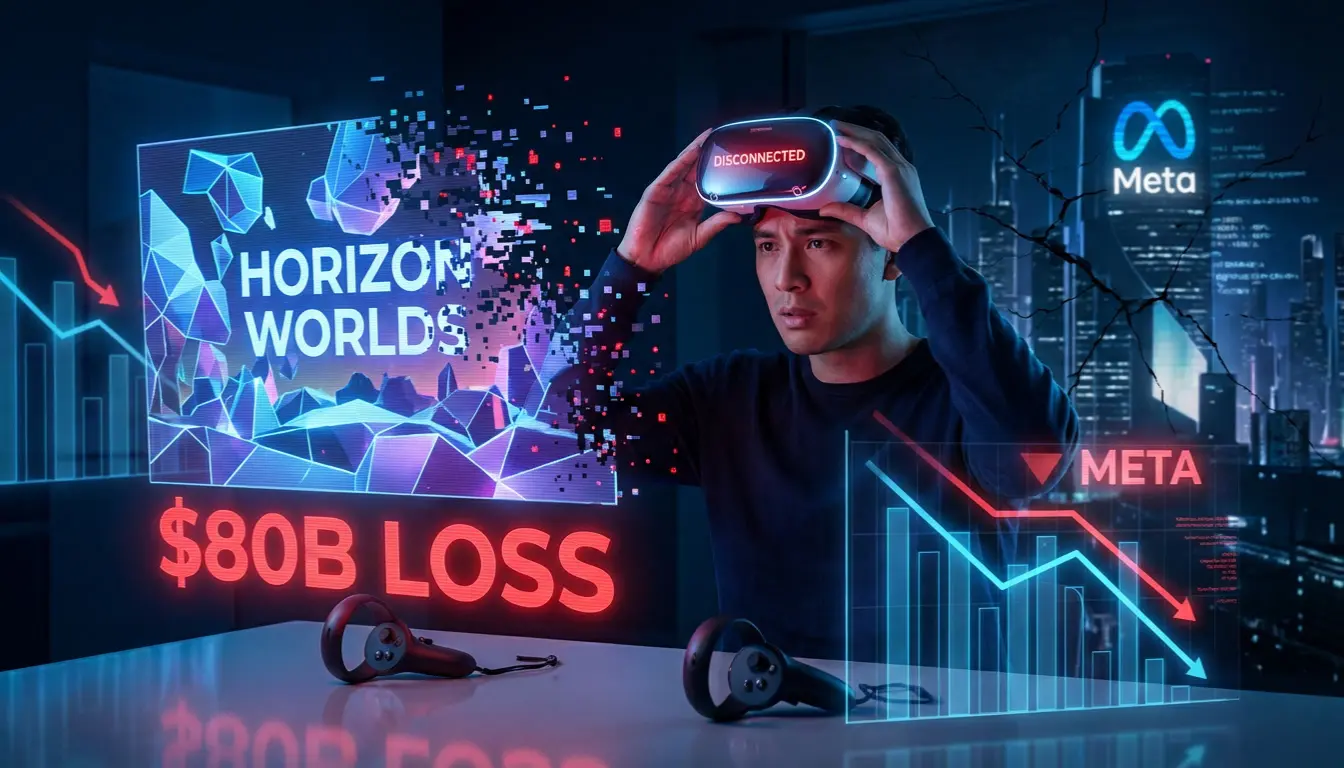
Meta Platforms, Inc. is officially ending its metaverse ambitions after accumulating nearly $80 billion in losses since 2020, primarily through its Reality Labs division. Meta announced the shutdown of Horizon Worlds on VR headsets, with the app being removed from the Quest store by the end of March 2026 and fully discontinued on June 15, 2026. Later, it will survive only as a mobile app, positioned to compete with platforms like Roblox and Fortnite rather than to fulfil any vision of a virtual future. This marks the end of Meta’s flagship vision for a shared virtual world.
Reality Falls Short
The CEO of Meta Platforms, Mark Zuckerberg, positioned the metaverse as the next pivot of the internet back in October 2021, when Meta was rebranded from Facebook. He once believed that Meta would reach a billion people and host digital commerce and support jobs for millions of creators and developers, but the future was never bright. The platform never drew more than a few hundred thousand monthly active users, which is not enough for a project like the metaverse, which consumed billions of dollars.
Since 2020, Meta has bagged up an estimated $70-$80 billion in operating losses. In 2024 alone, the unit posted a record operating loss of $17.7 billion. In the fourth quarter alone, Meta posted an operating loss of more than $6 billion (Q4 and FY2025). In January, Meta laid off approximately 10% or 1,000 Reality Labs positions and shuttered several VR game studios. A fitness app called Supernatural, which Meta acquired for $400 million in 2021, has stopped producing new content and has been wound down.
What changed the calculus was AI; when ChatGPT arrived in late 2022, Meta pivoted its public messaging fast. The AI research division, long led by scientist Yann LeCun, gave the firm a credible foundation to build on. The integration of AI into Meta’s core systems subsequently improved ad revenue through more efficient targeting. The stock recovered by 2024, and Meta nearly tripled in value from its 2022 lows, but the metaverse kept bleeding.
Internal reports earlier suggested that the firm had set a 20% annual attrition target for 2026 and 2027. In the meantime, Meta’s ad business remains strong, with the firm posting $59.9 billion in Q4 2025 revenue, up 24% year over year. Wall Street consensus targets META stock at $838.
Strategic Pivot to AI
Meta is now shifting its focus to artificial intelligence (AI) and AI-powered wearable devices, such as Ray-Ban smart glasses, which have seen tripled sales in the past year. Analysts in the tech world commented on this as a clear pivot, as the artificial intelligence projects are bagging up budgets everywhere.
The firm reported in a community blog post that it is not completely walking away from virtual reality, but separating the two platforms, which will help each one to focus and grow independently. Meta has not abandoned the virtual reality hardware; the Quest will remain, and the firm will continue to support developers building VR experiences, meaning that now the headline is no longer metaverse but AI.
While Meta initially trailed competitors like OpenAI and Google, it is now solidifying its position as a primary AI power through its Llama models. However, the firm’s recent announcements, including its Llama language models and AI-powered features across social media platforms like Facebook and Instagram, mark where leadership sees the real opportunity.
In a February blog post announcing the change, the vice president of Content at Reality Labs, Samantha Ryan, said that Meta would be “doubling down the VR developer ecosystem,” by shifting its focus to mobile, as phones reach billions of people, and if the app gets easier to use and attract creators, it could find a new life without the headset barriers.
Industry-Wide Attention
The broader VR industry is watching closely, and Meta was the biggest investor in consumer virtual reality, subsidising hardware and content development in hopes of building a critical mass. Hence, with Meta retreating, smaller players like HTC and startups building VR experiences face a tougher road. However, this strategic pivot reflects a broader industry trend, which is cutting experimental projects with no clear path to profitability and doubling down on AI-driven growth.


