

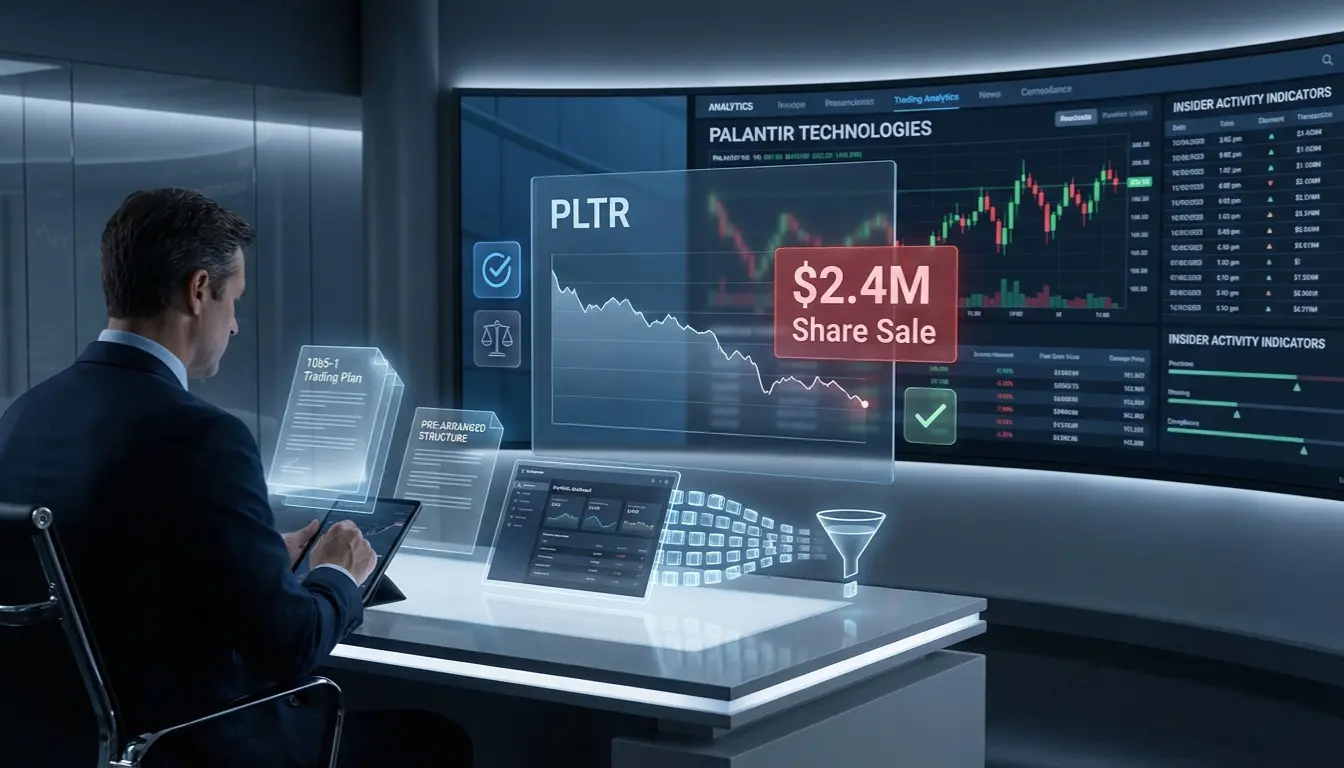
Palantir Technologies Inc. has drawn market attention after one of its top executives made a significant stock sale earlier this month. On March 16, 2026, director Alexander D Moore sold 16,000 shares of Class A common stock through multiple open market transactions. The sale brought in roughly $2.4 million, with individual share prices ranging between $151.31 and $153.68.
The transaction is part of a pre-arranged Rule 10b5-1trading plan, which Moore set up back on December 11, 2025. Such plans are commonly used by executives to sell shares in a structured and transparent way.
Even after this sale, Moore continues to hold a substantial stake in the company, with 1,156,978 shares still under his direct ownership. Palantir stock has seen strong performance over the past year, delivering around 77% returns. However, in 2026 so far, the stock has slipped by about 14%, reflecting some cooling after its earlier gains. Analysts note that the stock is currently trading at a high P/E ratio of 244, suggesting elevated valuation levels.
Consistent Selling Pattern Signals Planned Strategy
Alexander D Moore, one of the earliest members of Palantir Technologies Inc., has been steadily selling shares over the past several months as part of a structural plan. Moore, widely known as the company’s first hired employee, has carried out multiple transactions under a pre-arranged Rule 10b5-1 trading plan.
On November 3, 2025, he sold 19,990 shares, generating about $4.09 million, with prices ranging from $202.63 to $206.60. This was followed by another sale on January 2, 2026, where he offloaded 15,582 shares for approximately $3.46 million, with shares priced between $167.30 and $181.04. Most recently, on March 16, 2026, Moore sold 16,000 shares for around 2.4 million.
The pattern of these transactions pointed to a planned and consistent approach rather than a sudden reaction to market conditions. Such moves are often linked to portfolio diversification or managing financial exposure, rather than signalling concerns about the company’s performance.
High Valuation Keeps Analysts Divided
Palantir Technologies Inc. has delivered remarkable growth performance in recent years, but its valuation continues to raise questions among analysts. The company’s shares surged by more than 170% in 2025 and have climbed nearly 1000% over the past 2 years, making it one of the standout performers in the tech sector.
Despite this strong momentum, concerns remain around how expensive the stock has become. As of early 2026, Palantir is trading at close to 250 times forward earnings, a level far higher than major peers like Nvidia at around 33x and Microsoft at approximately 29.9x.
On the financial side, the company continues to show solid growth, reporting 47.23% revenue growth and an impressive 80.81% gross profit margin. However, opinions on the stock remain split. Firms like Morgan Stanley hold an overweight rating, while Jefferies has taken a more cautious stance with an underperform rating, pointing to valuation concerns and ongoing insider selling.
AI Partnerships Strengthen Long-Term Outlook
While insider selling has drawn attention, Palantir Technologies Inc. continues to push forward with major strategic initiatives, especially in the field of artificial intelligence. The company has been expanding its reach through partnerships that highlight its growing role in defense, energy, and advanced data systems.
One of the key collaborations involves Ondas Holdings and World View Enterprises, where the focus is on building AI-powered intelligence, surveillance, and reconnaissance systems using high-altitude balloon technology. In another move, Palantir partnered with Centrus Energy, helping identify nearly $300 million in potential cost savings through AI-based solutions.
The company has also teamed up with Nvidia to launch a sovereign AI operating system framework. This integrates Palantir’s full software suite, including AIP, Foundry, Apollo, and other platforms.
These developments show how Palantir is strengthening its position in critical sectors, supporting its long-term growth outlook despite short-term market fluctuations.


