

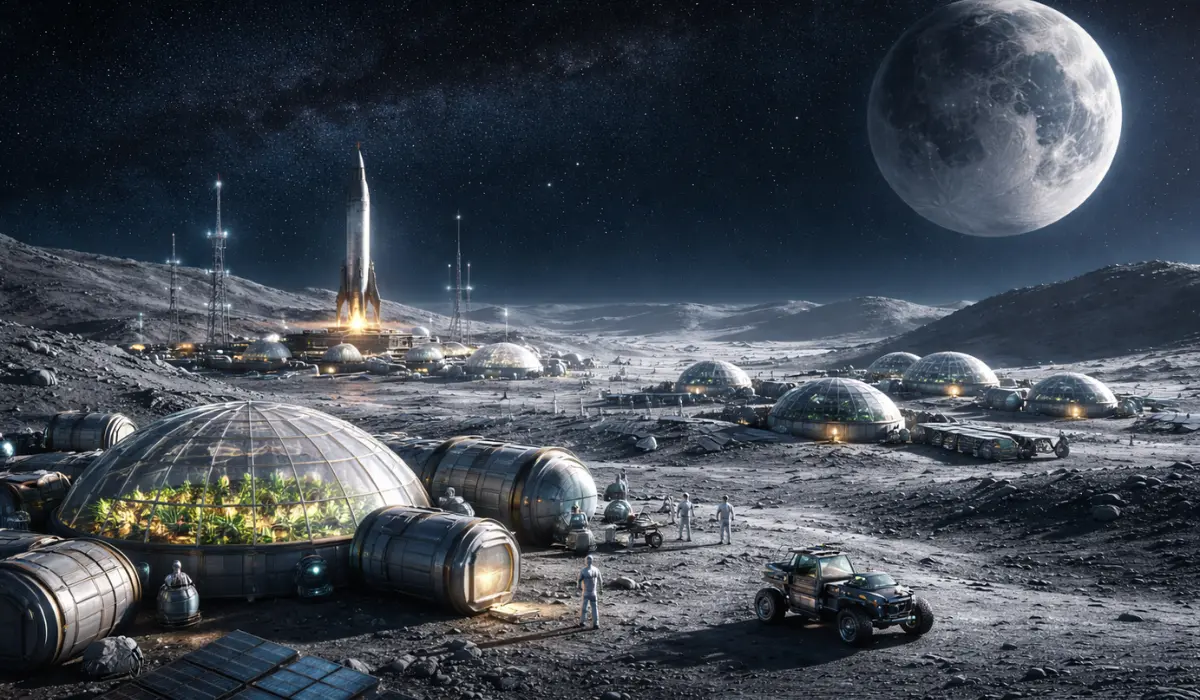
NASA has paused the Lunar Gateway station in its current form and redirected its resources to build a $20 billion lunar surface base over the next seven years, a move confirmed by Administrator Jared Isaacman in late March 2026. The agency will repurpose the Gateway’s Power and Propulsion Element to create Space Reactor-1 Freedom (SR-1 Freedom), a nuclear-powered spacecraft designed to demonstrate deep-space nuclear electric propulsion.
Race to the Moon Intensifies
United States space agency chief Jared Issacman has announced an array of unprecedented changes to the Artemis moon program, which is expected to expand humanity’s footprint in space, as the U.S. is in a race to return to the moon before China sends its astronauts there around 2030.
The moon base plan includes an aim to send more robotic landers, deploy a fleet of drones, and lay the groundwork for using nuclear power on the lunar surface in the near future. The new strategy shifted from an orbital outpost to a phased, surface-focused approach, which will land the crews every six months by 2028, using repurposed hardware and working with commercial partners to acquire a government-owned Core Module for the ISS. The module would serve as the attachment point for commercial space modules, which could eventually detach to become a free-flying space station.
The moon base is intended to support long-term human presence on the lunar surface, with robotic missions expected to pressurize the site, test technologies, and begin to build infrastructure before astronauts return later this decade. NASA envisions a three-phase approach that includes testing, learning, establishing early infrastructure, and enabling long-duration human presence. However, the pivot leaves an uncertain future for key partners like Japan, Canada, and the European Space Agency, which had originally agreed to supply components for the Lunar Gateway station.
While Artemis III remains scheduled for next year to test integrated systems, the timeline for the first crewed lunar landing has shifted to early 2028. Isaacman said at an event, called Ignition, that the moon base will not appear overnight, but it will be built over the next seven years with a dozen missions. During a session of briefings at the firm’s headquarters in Washington, Isaacman stated that U.S. President Donald Trump’s national space policy and the competition from China’s space program have ignited a quick pivot and tight timeline.
Legislative Push for Space Leadership
NASA has also disclosed that it is planning to launch a spacecraft called the Space Reactor 1 Freedom to Mars before the end of 2028, as it aims to demonstrate advanced nuclear electric propulsion in deep space. The agency reported that upon reaching the Earth’s planetary neighbour, the spacecraft will deploy helicopters (the ‘skyfall’ mission) to explore the Martian atmosphere, moving nuclear propulsion from laboratory tests to operational deep space. The spacecraft is similar to the Ingenuity robotic test helicopter that flew with NASA’s Perseverance rover and landed in February 2021.
Sen. Ted Cruz, the Texas Republican who chairs the Senate committee, posted on X that the bipartisan NASA Authorization Act, recently approved by the Senate Commerce Committee, includes key provisions to support NASA in turning an American lunar base into reality. He also asserted that the Senate will work forward with NASA to maintain America’s superiority in space. While Chase Mission, a former NASA researcher, said that the changes in the agency’s space exploration plan are not surprising, the details are met with shock and confusion.
However, critics and experts have expressed skepticism regarding the 2028 timeline for the nuclear mission, with some calling it unrealistic or mockable, though the administration emphasizes the strategic necessity of accelerating American leadership in space.


