

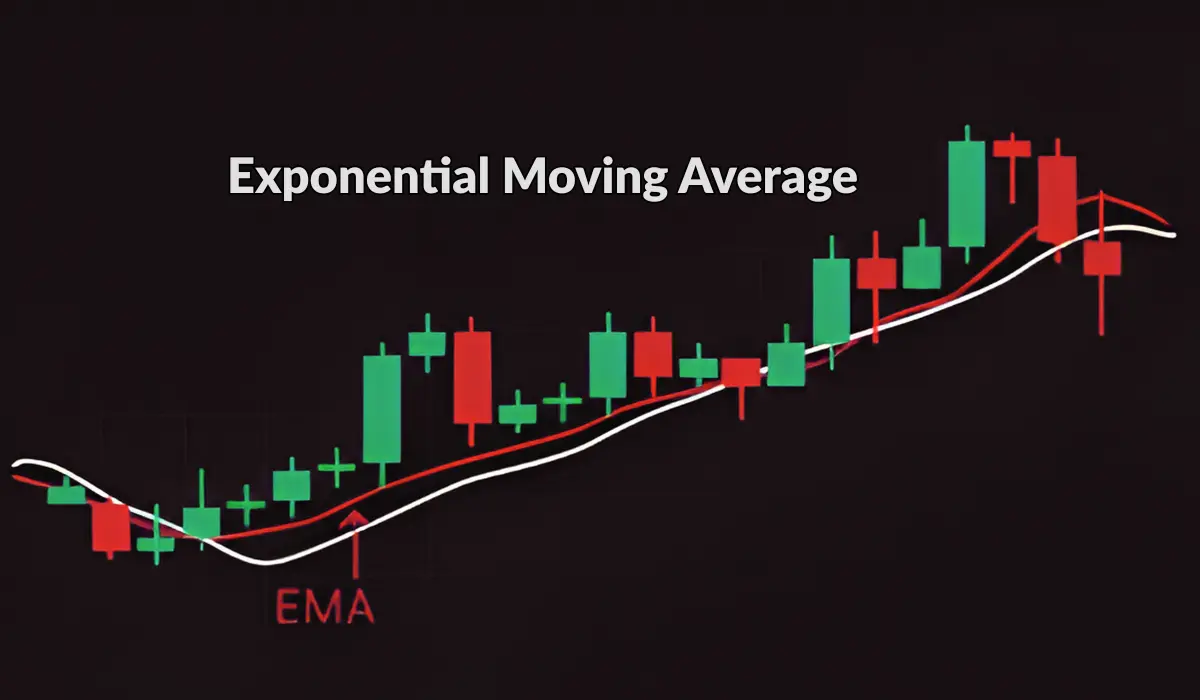
An Exponential Moving Average (EMA) is a metric used in finance that emphasizes the recent prices of a asset. It helps traders identify trend direction, support/resistance levels, and potential entry/exit points by quickly reacting to price changes. EMA is calculated for both the short-term and long-term. While short-term EMAs suit intraday trading, long-term EMAs give insight into the long-term prospects of an asset. A rising EMA suggests an upward trend, whereas a falling EMA suggests a downward trend. Using multiple EMAs or combining EMAs with other metrics helps in getting a clearer picture of the market.
In this article, you will read about the key aspects of EMA, an explanation of the formula used for calculating it, its applications, and the risk factors associated with using it.
Key Insights From Analyzing the EMA
EMA gives investors a quick idea about the market and the general trends. Here are the key insights that you can deduce from analyzing EMA.
- Direction and Momentum: EMA gives you insights into the direction and momentum of the market at the time of analysis. A rising EMA implies an uptrend and a falling EMA implies a downtrend; the slope indicates trend strength. A steeper slope generally signals stronger momentum, while a flattening slope may signal consolidation.
- Responsiveness vs. Noise: Since EMA takes recent price data into consideration, it can be considered responsive to short-term price movements.
- Signals and Crossovers: Crossovers (price crossing the EMA or a shorter-term EMA crossing a longer-term EMA) are commonly used as entry/exit signals in many trading strategies.
Formula for Calculating EMA
Here is the formula used to calculate EMA.
EMA Today = (Value Today * α ) + EMA Yesterday * (1 – α )
Here, α = 2N + 1
N = number of periods
Value Today = The current period’s price (usually closing price), which receives the heaviest weight to reflect recent market action.
EMA Yesterday = EMA value from the previous period.
Exponential Moving Average (EMA) Versus Simple Moving Average (SMA)
EMA and SMA are two moving averages commonly used for analyzing the market. While EMA is suitable for short-term trading, SMA indicates the long-term trend of an asset. In the table below, you can find the differences between EMA and SMA.
| Feature | EMA | SMA |
|---|---|---|
| Calculation Basics | EMA uses a smoothing factor to assign greater weight to more recent data, resulting in a steeper, more responsive line. | SMA refers to the average of prices over a chosen window (e.g., 20 days) with equal weights attributed to each data point. |
| Weighting | EMA emphasizes the recent price. | SMA gives equal weight to all data points. |
| Sensitivity | EMA is more sensitive to price changes. | SMA is less sensitive and reacts slowly to price changes. |
| Signal Timing | EMA provides earlier entry/exit signals. | SMA lags in providing clear signals. |
| Use Cases | EMA is suited for short-term trading and early signal detection; popular in intraday or swing strategies with 9-day or 21-day periods. | SMA is ideal for long-term trends and reducing noise in volatile markets; common periods include 50-day or 200-day. |
Applications of EMA
EMA has several applications in technical analysis across markets. EMA shows the direction in which the price of an asset is moving. EMA is relevant because it uses recent data points for analysis. A rising EMA indicates that the particular asset is set for purchase; on the other hand, a falling EMA shows a downtrend, which shows that it is the right time to sell the given asset.
Another important use of EMA is its crossover strategies. In the case of crossover strategies, two EMAs of different lengths are used. When the short-term EMA crosses above the long-term EMA, it creates a bullish signal; when it crosses below, it creates a bearish signal.
EMA can act as an indicator of key support and resistance levels. During an upward market shift, prices may pull back toward the rising EMA and bounce; on the other hand, in downward shifts, prices may retreat toward the falling EMA.
Risks of Using EMA
While EMA is a helpful metric to understand the pulse of the market, there are certain risks to using it. Firstly, EMA is a lagging indicator that is slow to catch the fast-changing market trends and price movements of a currency or commodity. Even though it is more efficient than SMA, it still relies on past data, which makes it less effective in predicting new trend creation.
EMA can signal false actions called Whipsaw price action, where even minor price changes will be recorded with high importance, creating crossovers between buy and sell signals and sudden trend reversals. These false signals created by the EMA will cause sudden losses in volatile markets.
Another risk factor concerning the EMA is the time period selected for identifying the EMA. Shorter periods, such as 10-day, offer more signals but more noise, while longer periods, such as the 50-day, are smoother but show solid signals later. EMA is not an effective indicator in catching the trend reversals caused by external factors such as geopolitics. It cannot predict the future trends either.
EMA, when combined with other technical analysis indicators such as RSI or MACD, can result in risk mitigation to an extent. Moreover, a strict awareness of the general volatility trends and less reliance on EMA during highly volatile windows will help mitigate these risks to a certain extent.
The Bottom Line
EMA is an important metric in analyzing the market for a certain currency or commodity. It is best to measure the recent prices and show clear early entry or exit signals. EMA has several applications in technical analysis; however, when used in isolation, there are certain risks to using EMA, which can be mitigated when it is combined with other metrics, such as the MACD.


