

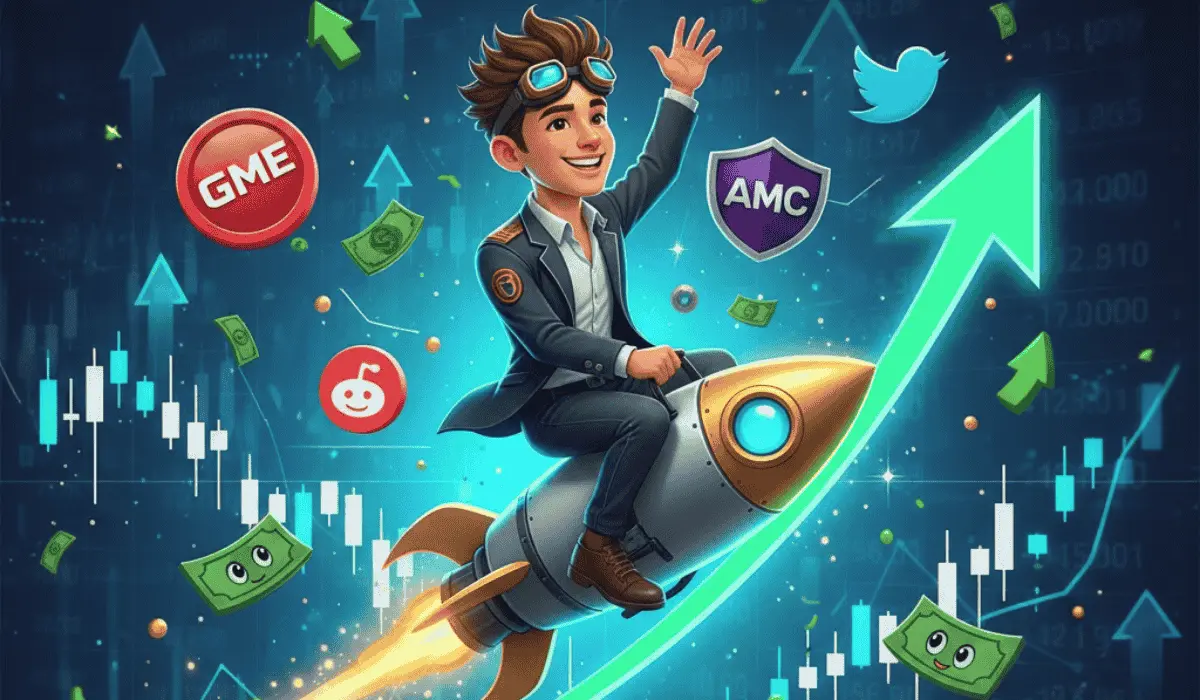
Key Takeaways
- A meme stock is the stock of a publicly traded company that gains popularity through social media buzz and online community enthusiasm, rather than its fundamental business performance.
- Some of the popular meme stocks in the market include GameStop (GME), AMC Entertainment (AMC), Tesla (TSLA), Palantir (PLTR), and Bed Bath & Beyond (BBBY).
- They are highly volatile with gains sometimes followed by sharp declines, creating substantial upside and downside risk in short timeframes.
- Liquidity and trading volumes of meme stocks can drastically reduce suddenly if the popular opinion becomes adverse for the given meme stock.
- Investors should limit their exposure to meme stocks to 1-5% of their total portfolio using only speculative capital.
A meme stock is the stock of a publicly traded company that gains popularity through social media buzz and online community enthusiasm, rather than its fundamental business performance. These stocks are highly volatile and will have high trading volumes based on social media buzz. Popular opinion determines the success and failure of meme stocks.
Meme stocks also experience rapid shifts in price, sometimes exceeding 50% in a day, and unexpected spikes in retail trading activity. Young and inexperienced investors tend to invest in meme stocks more than seasoned investors.
The meme stock wave highlighted how retail participation, behavioral factors, and platform mechanics can create price dislocations. Some of the popular meme stocks in the market include GameStop (GME), AMC Entertainment (AMC), Tesla (TSLA), Palantir (PLTR), and Bed Bath & Beyond (BBBY).
Characteristics of Meme Stocks
Meme stocks have high social media influence as they gain prominence after being highlighted on online forums, social networks, or trading communities where ordinary investors share ideas, memes, or hype around a stock. They are highly volatile with gains sometimes followed by sharp declines, creating substantial upside and downside risk in short timeframes.
The trading volumes of meme coins can spike and decrease quickly, which can amplify price moves. Moreover, they are less influenced by fundamentals such as earnings, cash flow, and balance sheet quality during meme stock episodes, as sentiment and momentum drive prices more than fundamentals. Meme coins are mostly meant for individual investors rather than institutions.
History of Meme Stocks
Meme stocks started forming by the late 2010s and exploded in 2021 with GameStop (GME). This explosion in 2021 was driven by commission-free trading apps and active online communities. Social media platforms (notably Reddit), trading communities, and influencer activity are the key drivers for meme stocks. Over the years, GameStop and AMC Entertainment became the most recognizable meme stocks, with others like Bed Bath & Beyond, Blackberry, and Tesla appearing in various meme-stock discussions over time.
Risks of Investing in Meme Stocks
Buying meme stocks is quite a risky affair; due to their high volatility, meme stock investments are similar to gambling or sports betting. Here are the key risks associated with meme stock investments.
- The price of a meme stock can see sudden, unpredictable surges or sudden downfalls based on investor sentiment or popular opinion spread through social media.
- Liquidity and trading volumes of meme stocks can drastically reduce suddenly if the popular opinion becomes adverse for the given meme stock.
- Meme stocks trading sometimes looks like gambling, which can erode capital quickly.
- Another risk associated with meme coins is the potential for market manipulation, pump-and-dump schemes, and regulatory scrutiny.
- As meme stocks work based on hype, whenever the hype fades, the prospects of the stocks will also fade.
How to Mitigate these Risks?
The risks related to meme stock investments can be mitigated with targeted strategies. Investors should limit their exposure to meme stocks to 1-5% of their total portfolio using only speculative capital. They should also set strict position sizing and predefined exit rules, such as trailing stop-loss orders at 10-20% below entry or technical levels, to automate sales during downturns.
Before investing, investors should do fundamental analysis beyond social media buzz, checking short interest, financial health, and early trend signals. It is advisable to enter the market in nascent hype phases rather than peaks, and monitor volume for liquidity risks.
Behavioral discipline is important for success in meme stock trading. Investors should avoid emotional FOMO by sticking to a written trading plan, ignoring crowd sentiment on platforms like Reddit. They should also prioritize personal financial needs, like debt or emergencies, over holding for tax optimization during spikes.
The Bottom Line
Meme stocks, even though highly volatile, are essential to the diversification of the portfolio of an investor. It goes without saying that investing in meme stocks carries substantial risk due to their high volatility and potential for sudden declines once the social media-driven momentum wanes. Meme stocks live around short-term trends and rarely transition to stable holdings. Revival of interest after price falls also remains episodic and occasional. Meme stocks are not good enough as long-term investments, and their hype is often short-lived, making them unreliable.


