

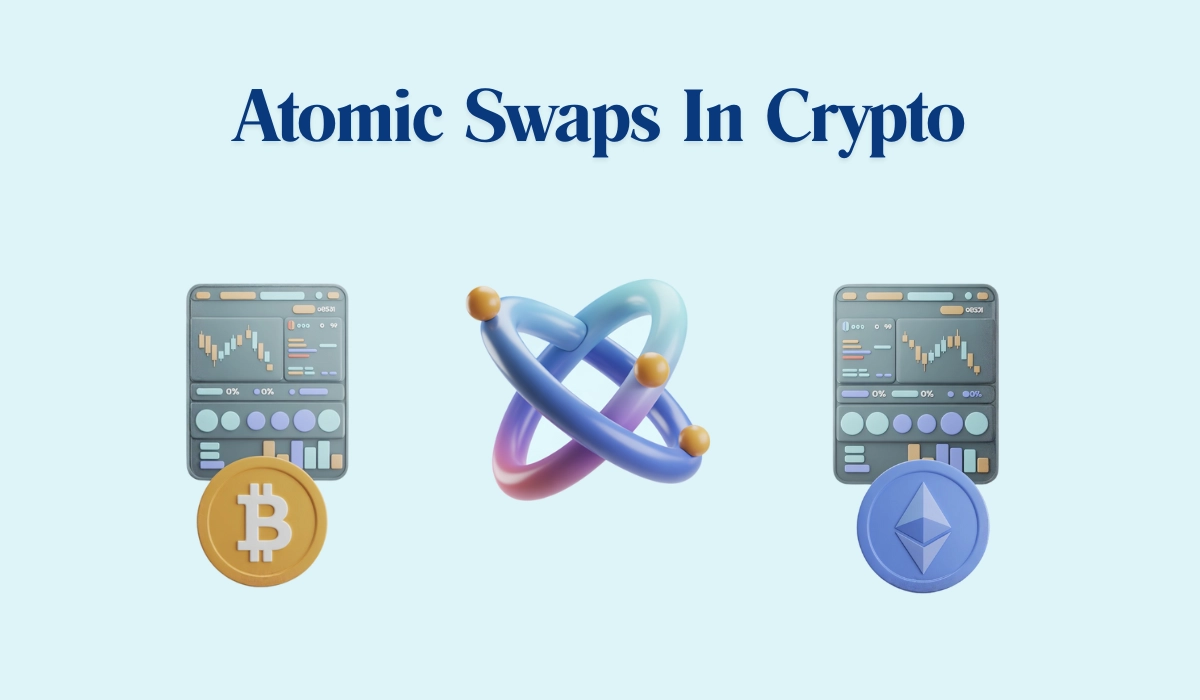
In simple terms, atomic swaps are ways to exchange cryptocurrencies directly across different blockchains. This method focuses on removing centralized intermediaries like exchanges, which simplifies trading. It helps reduce the number of trades needed by consolidating transactions into one. In an atomic swap, two token owners can exchange their tokens, and a smart contract will be programmed to lock the tokens of both owners and redeem them with the desired tokens. This article will further discuss all about atomic swaps and how they work. So, keep reading to learn more.
Atomic Swaps Explained: What They Are And How They Work
Atomic swaps allow for peer-to-peer exchanges of crypto tokens across different blockchain networks. This allows any two users to swap digital tokens without having to rely on a third party to facilitate transactions. This ultimately reduces counterparty risks. The term atomic derives from the term ‘atomic state’, indicating that a state has no substates. This refers to a cryptocurrency transaction where two people use different blockchains, which either happens or it does not-there are no alternatives. Atomic swap is a process facilitated by smart contracts to ensure that the trade is completed securely, eliminating counterparty risk.
As for how atomic swap works, they use a hash timelock contract (HTLC), which serves as a virtual vault or cryptographic escrow account that keeps user funds safe. It only executes when the correct amount of tokens has been deposited into the contract. Note that each user must acknowledge receipt of tokens within a specified interval to unlock them. Regarding how atomic swaps transform cryptocurrency trades, each cryptocurrency is supported by a blockchain that is designed only to accept transactions in specific tokens.
For example, the Bitcoin and Ethereum blockchain consists of native tokens that cannot move between them. So, you will first need to convert them to fiat currency and then buy the other using cryptocurrencies and exchanges to get the one you want. However, it can take several trades depending on the cryptocurrency. An atomic swap allows one to exchange tokens from different blockchains in one trade. Understand that some decentralized exchanges can conduct atomic swaps for you because they operate without a central authority, letting you trade without third parties. Additionally, you can choose from cross-chain swap providers, where you transfer digital assets into another wallet or conduct the swap.
Note that atomic swaps became possible with the development of altcoins, which were made easier by innovations like the Lightning Network. While they can be very useful, there are certain limitations, such as the pseudonymous nature of swaps, which, while not entirely private, offer privacy after only public addresses and transaction details. Nevertheless, atomic swaps present a way to reduce counterparty risks and dependence on centralized exchanges by taking advantage of blockchain technology.
Advantages And Disadvantages Of Atomic Swaps
Atomic swaps offer several advantages that are often unavailable from other solutions. The following are the advantages:
- Atomic swaps lower costs as a peer-to-peer swap incurs lower fees than relying on a third-party administrator.
- It reduces counterparty risks because there is no need to entrust funds to a centralized third party to facilitate the transactions. This way, the traders can maintain complete control over their assets.
- Atomic swaps offer a guaranteed outcome. Traders know that their contract will execute as described, or they will receive their funds back.
- It makes assets tradable across different blockchain networks and makes those assets more liquid.
- Atomic swap offers direct asset-to-asset swaps, which enable users to buy crypto directly without needing to first swap to a highly liquid stablecoin or make multiple transactions. Users can freely trade any token they want in a decentralized environment.
While atomic swaps have high potential, there are certain disadvantages associated with them, such as:
- Compatibility issues. Note that you cannot perform atomic swaps across all blockchain networks because each blockchain must use the same hashing algorithm for atomic swaps to work.
- Atomic swaps may seem time-consuming and complex, especially for beginners, as each counterparty must agree on the amount and price of the transaction, exchange data, timelock, and hashes. One should also wait for the transactions to be processed.
- There are privacy concerns since atomic swaps take multiple blocks to be completed. This alerts malicious actors and gives them time to track addresses and target traders.
Conclusion
Atomic swaps are transactions designed to directly trade cryptocurrencies between different blockchains without intermediaries. They rely on smart contracts to ensure the transactions are secure and reliable. This method aims to reduce the complexity and cost of trading tokens across different blockchains, which makes them more appealing for users looking to avoid centralized exchanges. Thus, when two entities wish to trade tokens, they can use an atomic swap to ensure no third parties are involved. While atomic swaps seem faster and cheaper than most traditional exchanges, they require specific knowledge and tools to execute.


