

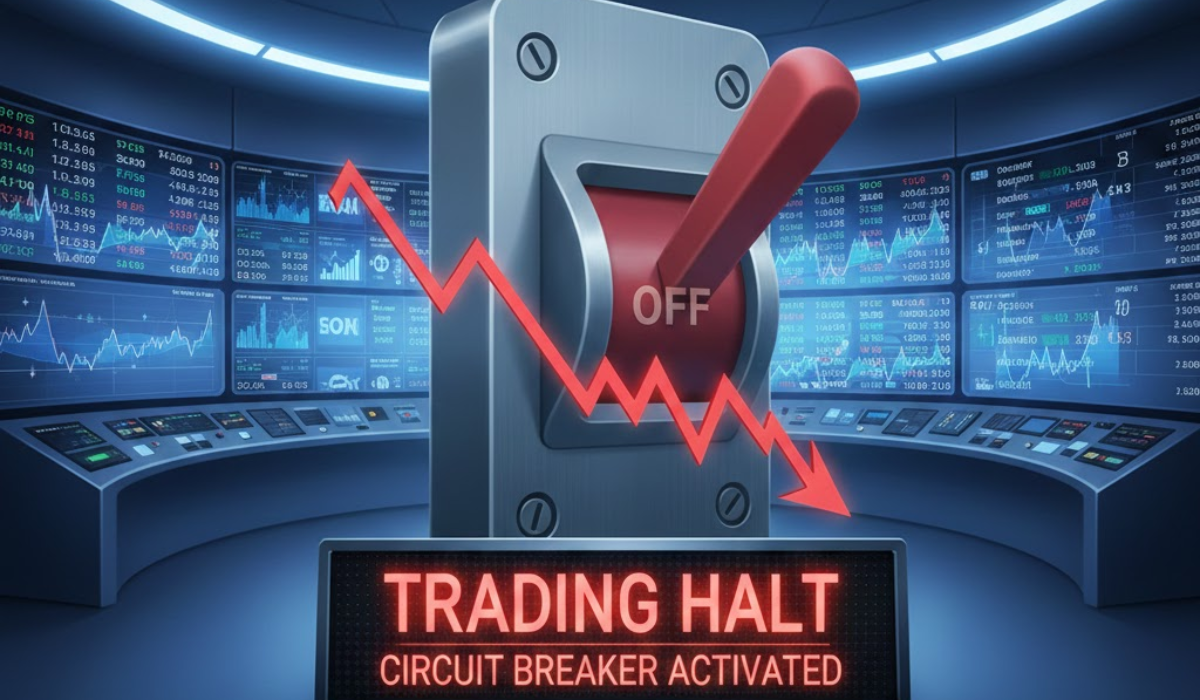
In the stock market, Circuit Breakers play an essential role as they assist in preventing panic selling, significant market crashes, and high fluctuation by temporarily halting trade, especially during turbulent times. Recently, in the U.S. stock market, the Circuit Breaker acts as a “safety valve” for the financial system, helping traders pause trading to allow price discovery and reduce disorderly markets. Let’s know Circuit Breaker in detail and also its influence on the U.S stock market.
What is a Circuit Breaker?
A Circuit Breaker in the Stock Market is described as a regulatory mechanism framed to halt trading temporarily, on the stock exchanges, when market indices encounter a sharp dip, aiming to decrease panic selling and excessive volatility. This safety mechanism helps investors and other market participants to process new data and prevent market dysfunction.
The main aim of the Circuit Breaker is to sustain the stability of the market and to reduce sudden price fluctuation that could generate systemic difficulties, ensuring accurate trading procedures by offering a “cooling off” period for investors. Furthermore, it mainly operates as an instant safeguard to secure against market crashes, even though it is not planned to handle the normal fluctuation of the market.
How Does a Circuit Breaker Work?
The work process of Circuit Breaker is mainly categorized into two types: Single-stock Circuit Breakers and Market-Wide Circuit Breakers (MWCB). A Single-stock Circuit Breaker halts individual stocks that move too sharply in either direction, and it can also be called Limit Up-Limit Down (LULD). Similarly, MWCB circuit breakers impact the whole market and are boosted by a decline in the S&P 500 Index.
In the U.S market, the Limit Up-Limit Down (LULD) plan applies to certain firms like Apple. The LULD plan establishes price bands, like limit down and limit up, for individual securities during a trading day. When a stock trades outside a certain price band for more than fifteen seconds, trading in that security is halted for five minutes. In the case of Market-Wide Circuit Breakers, the circuit breakers are managed under SEC Rule 80B, and their triggers are evaluated daily depending on the previous day’s ending price of the S&P 500.
Market Halts are divided into three levels, and they are provided in the table below.
| Level | Drop in S&P 500 | Outcome | Time Limitation |
|---|---|---|---|
| Level 1 | 7% | 15-minute halt | Before 3:25 PM ET |
| Level 2 | 13% | 15-minute halt | Before 3:25 PM |
| Level 3 | 20% | Trading stopped entirely for the day | Any time |
Circuit Breaker: History and Rationale
The term Circuit Breaker on October 19, 1987, was named “Black Monday.” The Dow Jones Industrial Average dipped by 22.6% on that day, and it is considered one of the highest one-day percentage falls in the history of the United States.
In 1987, there were no automatic halt mechanisms in the stock market, which resulted in potential flash crashes and heightened panic selling. This absence created major communication challenges for traders and slowed down the processing of orders in the stock market.
Hence, to overcome this issue in the stock market, a presidential commission named the Brady Commission was formed. The main aim of this commission, in association with Circuit Breaker, is to overcome market crashes and decrease additional price volatility by offering a time-out, especially during the panic-selling period.
At the initial time, the circuit breakers were triggered by a certain number of points that the Dow fell. As the market grew, the value of points went down, and percentages became a more persistent and efficient measure of a proportional market decline.
In 2013, the Securities and Exchange Commission (SEC) updated the rules to utilise the S&P 500, a stock market index comprising the 500 most popular companies as the benchmark. The current standardized three-level categorisation of the S&P 500 index includes: Level 1 (7% decline), Level 2 (13% decline), and Level 3 (20% decline) (Detailed description given in the above table). All these changes tend to modernize the circuit breaker to be more efficient in the scenario of high-speed electronic trading. Further, these modernizations ensure that the pauses are boosted by movements in a broadly accepted measure of the overall health of the stock market.
Conclusion
Circuit Breakers have an efficient role in the stock market, as they work as an emergency brake in the market to interrupt trading, especially during periods of extreme price volatility. This automatic mechanism helps prevent market crashes and ensures that the stock market functions in an orderly manner without negatively disrupting its continuity. Additionally, it allows both investors and traders proper time to deal with their financial loss and take appropriate action.
FAQ
The US stock market utilizes 3 levels depending on the S&P 500 index, including Level 1(7% decline), Level 2 (13% decline), and Level 3(20% decline)
When a halt occurs, the pending orders are held in limbo and stay active in the system until the halt is removed.
Yes, circuit breakers can surely be triggered by a market rise.
In the stock market, 3-5-7 is a risk management strategy, and it offers clear instructions for overall exposure, profit goals, and position sizing.
A circuit breaker does not pause a 24-hour “after-hours” trading session, but the futures market has its own rules and regulations that play as a surrogate halt for twenty-four-hour traders.


