

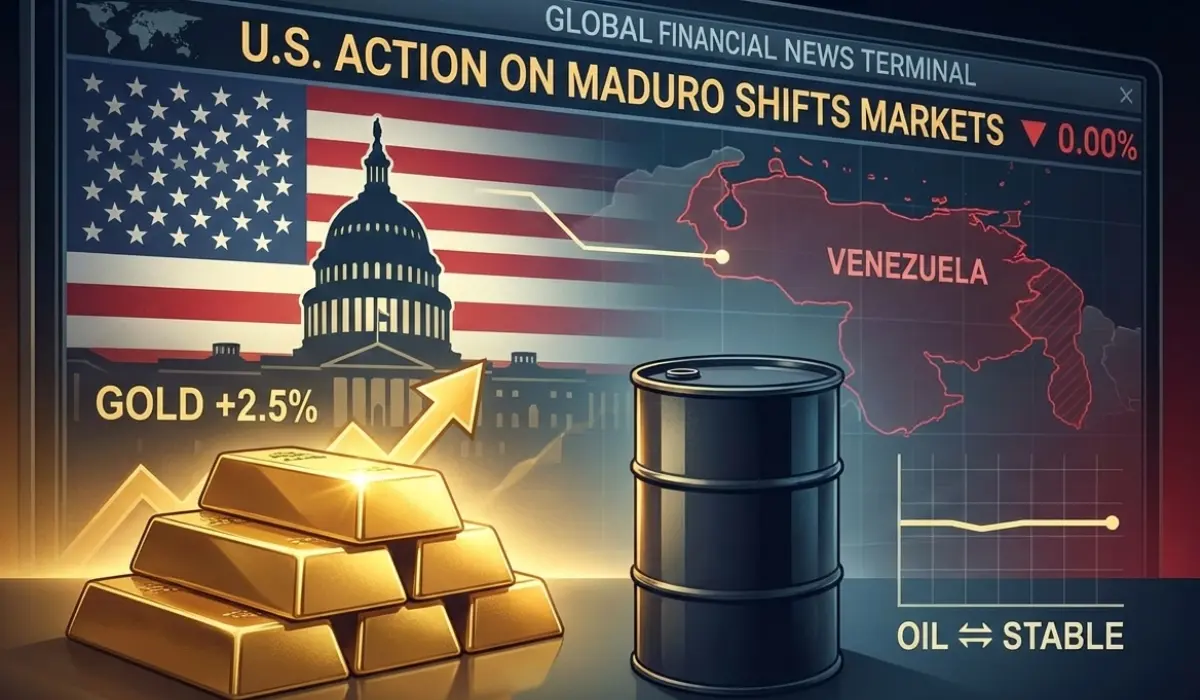
Global investors are on high alert after U.S. President Donald Trump ordered land strikes on Venezuela and captured the country’s President Nicolas Maduro and his wife on January 3. This has increased concerns about geopolitical risks in 2026 as the prices of precious metals have risen, while oil prices remain volatile.
Though the United States’ strategic military operation could unlock the once-richest Latin American nation’s vast oil reserves, boosting risk assets in the long term, it remains a drag on investor sentiment.
Gold, Silver Rise as Investors Seek Safe Havens After Maduro Arrest
During Monday’s morning session in Asia, gold rose about 1.8% to around $4,408 an ounce, while silver is up 3.5% to $75.38 an ounce. This surge comes as investors moved capital into “safe-haven” assets, fearing an escalation of the U.S.-Venezuela conflict. Both precious metals reached record highs last year before losing ground in the final days of 2025.
Gold recorded its best annual performance since 1979, rising more than 60% over the course of the year to hit an all-time high of $4,549.71 on December 26, 2025. Those gains were largely driven by factors including expectations of further interest rate cuts by the U.S. Federal Reserve, large purchases of gold bullion by global central banks, and investors’ concerns about geopolitical tensions and economic uncertainty.
Venezuela reportedly has the largest gold reserves among South American countries at 161 metric tonnes, which at current rates, could be worth nearly $22 billion.
Silver’s price action may have been a reaction to the volatility it experienced throughout the previous week. The metal continues to post significant price moves after surging 160% in 2025, recording its best yearly performance since 1979, driven by speculative inflows and industrial demand.
U.S. Oil Giants Invest Billions in Venezuela as Crude Prices Stay Stable
On Saturday, Trump said the U.S. would take control of Venezuela’s oil production, while Maduro, whom the federal government has repeatedly accused of operating a “narco-state” and rigging elections and considers an illegitimate president, was in a detention center in New York. This is the first time Washington has made a direct intervention in Latin America since the invasion of Panama in 1989.
Trump declared that the U.S. will temporarily “run” the country until a “safe, proper, and judicious transition” of power can be ensured. He also announced that major American oil companies would enter Venezuela, investing billions of dollars to repair its broken infrastructure and restart crude production to “start making money for the country”. However, the sanctions on the country’s oil exports remain in effect.
When the U.S. blocked sanctioned oil tankers from entering or leaving Venezuela in December, the price of oil edged above $62 a barrel, but since then, it has remained stable at $60-$61 per barrel. While Brent crude prices have declined between 0.5% to 1% to $60 a barrel, Brent crude futures rose to $60.89 a barrel after pairing earlier losses. U.S. West Texas Intermediate crude was trading at $57.42 a barrel.
Experts noted that oil markets are currently in oversupply, and Venezuela does not contribute much to the daily global output due to sanctions. However, with the U.S. potentially lifting its sanctions, the country could add more barrels to the market, which may further pressure oil prices.
Earlier in December, oil prices slumped to a four-year low, but rebounded after President Trump began to ramp up his rhetoric against Venezuela, as well as rising tensions between China and Taiwan. Venezuela has the world’s largest proven oil reserves, estimated at 303 billion barrels, worth approximately $17.3 trillion at current market prices. Even if the U.S. sells at half the market price, those reserves would still be worth nearly $8.7 trillion – a figure larger than the GDP of every country in the world except the United States and China, and nearly four times the size of the Japanese economy.
Experts argue that it would cost billions to fix Venezuela’s oil infrastructure, which has been in sharp decline since the early 2000s. The country’s oil production has been lacklustre for years and only accounts for less than 1% of the global oil supply. Most strategists believe it could take years to meaningfully boost Venezuelan output, which plummeted due to mismanagement and a lack of private investment as the government started to nationalize oil operations in the late 1970s, seizing assets from several foreign companies, including ExxonMobil and ConocoPhillips. Currently, Chevron is the only major American oil company operating in Venezuela.
GCC Markets Slip on Oil Drop as Asian Stocks Rise on U.S. AI Rally
Most stock markets in the GCC closed lower on Sunday, as they responded to Friday’s drop in oil prices, with investors weighing oversupply concerns against geopolitical risks. Meanwhile, markets in the Asia-Pacific region posted gains as investors were focused on global developments outside of Venezuela.
Japan’s Nikkei 225 was up 2.6% on the first day of trading of the year, with new data showing that domestic manufacturing activity stabilized in the final month of 2025. Major indexes in South Korea and China are also higher on Monday. These upticks reflect confidence that the fallout from the events that occurred over the weekend in South America will remain distant, with the share price gains across Asia reflecting an AI-led rally in the U.S. on Friday.


