

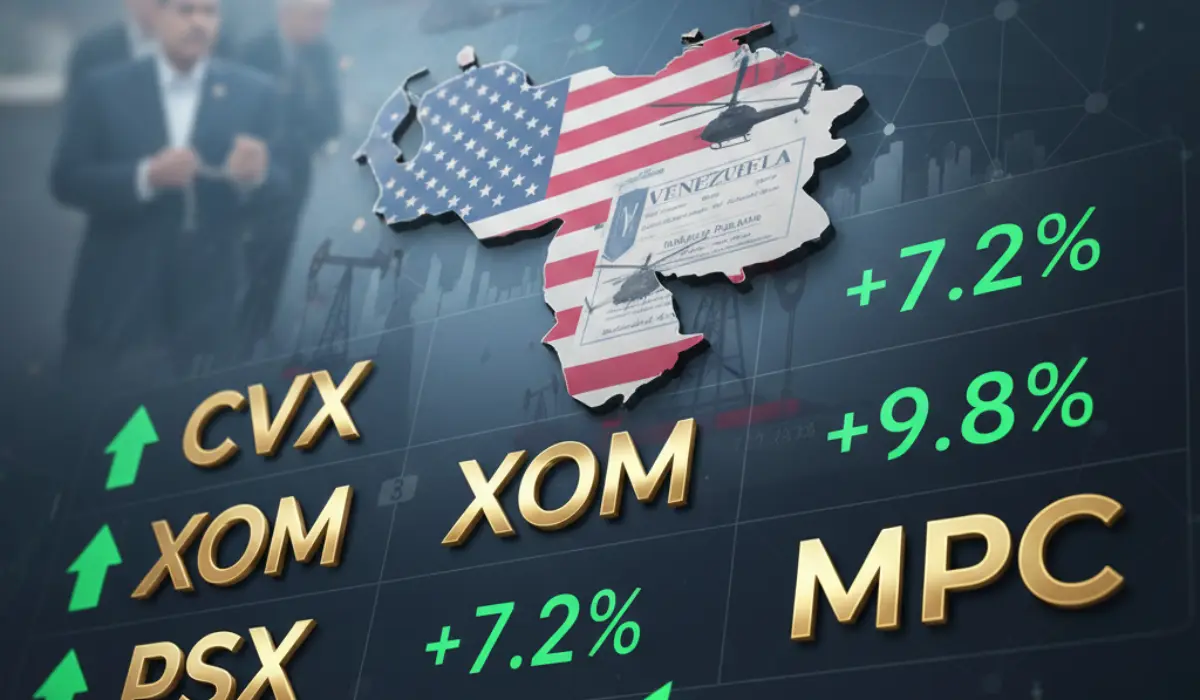
Shares of major US energy companies went sharply higher after US President Donald Trump announced the plan to take over Venezuela’s oil industry. He further said that the American companies would revitalize it after capturing the Venezuelan President, Nicolas Maduro.
Wall Street witnessed its stocks gaining ground on Monday, marking the first full week of 2026. The gains were broad, especially for energy companies and banks, and the rest of the industry ended up boosting the major indexes.
American Indexes Hit Record High
This move from the US resulted in the S&P 500 rising to 43.58 points, an increase of 0.6%, taking the values to 6,902.05, a benchmark index below its record set in late December. The Dow Jones Industrial Average rose to 594.79 points, rising by 1.2%, reaching 48,977.18, and hitting a new record. The Nasdaq composite climbed 160.19 points, approximately 0.7%, gaining 23,395.82.
Small company stocks showed a strong performance, outperforming other indexes, pointing towards a broader investor confidence. The Russell 2000 jumped by 1.6%. The overall increase in the US market has also influenced the European markets, leading to them gaining ground as well.
Disrepaired Oil Industry of Venezuela
Years of neglect and international sanctions have left the Venezuelan oil industry to degenerate. While some market analysts believe that the country could double or triple its current output, averaging 1.1 million barrels of oil a day, others see a longer journey ahead to reach the historic production levels.
“While the Trump administration has suggested large U.S. oil companies will go into Venezuela and spend billions to fix infrastructure, we believe political and other risks, along with current relatively low oil prices, could prevent this from happening anytime soon,” wrote Neal Dingmann of William Blair. He remarked that the material change to Venezuelan production will require a lot of time as well as infrastructure improvements worth millions of dollars.
Any investment made in the Venezuelan energy infrastructure currently would occur in a weaker global energy market. The US crude prices are down by 20% when compared to last year’s gains. Since June, the price of a barrel of benchmark US crude hasn’t climbed above $70, and since 2024 summer, the price hasn’t increased above $80 per barrel.
While JPMorgan predicts a short yet sharp dip in Venezuelan production, they also expect the market to make a swift recovery. According to JPMorgan, the production could reach as high as 1.3 million to 1.4 million barrels per day within two years of a political change. “With new investments and major institutional reforms, output could potentially expand to 2.5 mbd over the next decade,” the JPMorgan report states.
Outlook on Venezuela’s Oil Industry
Several factors impact Venezuelan oil production, including how quickly the government can transition, take hold, and earn the willingness of multinational oil companies to reenter their market. Venezuela produces heavy crude oil that is essential for diesel production, asphalt, as well as other heavy equipment fuels.
What Does This Mean For the US Stock Markets
The pending sanctions on oil from Venezuela and Russia, as well as America’s lighter crude oil’s inability to replace them, have resulted in a short supply of diesel worldwide.
At the opening bell, shares of the energy sector moved higher, especially those of companies with larger refinery operations. Big refineries like Valero, Marathon Petroleum, and Phillips 66 jumped between 5% and 6% during the market opening. The oilfield service companies that do drilling rose even higher. Companies like SLB and Halliburton showed an increase between 7% and 8%.
Other major oil exploration companies, such as ExxonMobil, Chevron, and ConocoPhillips, climbed to a value between 2% and 4%.
With U.S. energy firms set to discuss the possible chances of Venezuela’s oil recovery, and Wall Street watching the key economic data later this week, the energy sector’s recent performance is likely to remain at the focal point for investors navigating the balance between risks, geopolitical situations, and the future supply prospects.


