

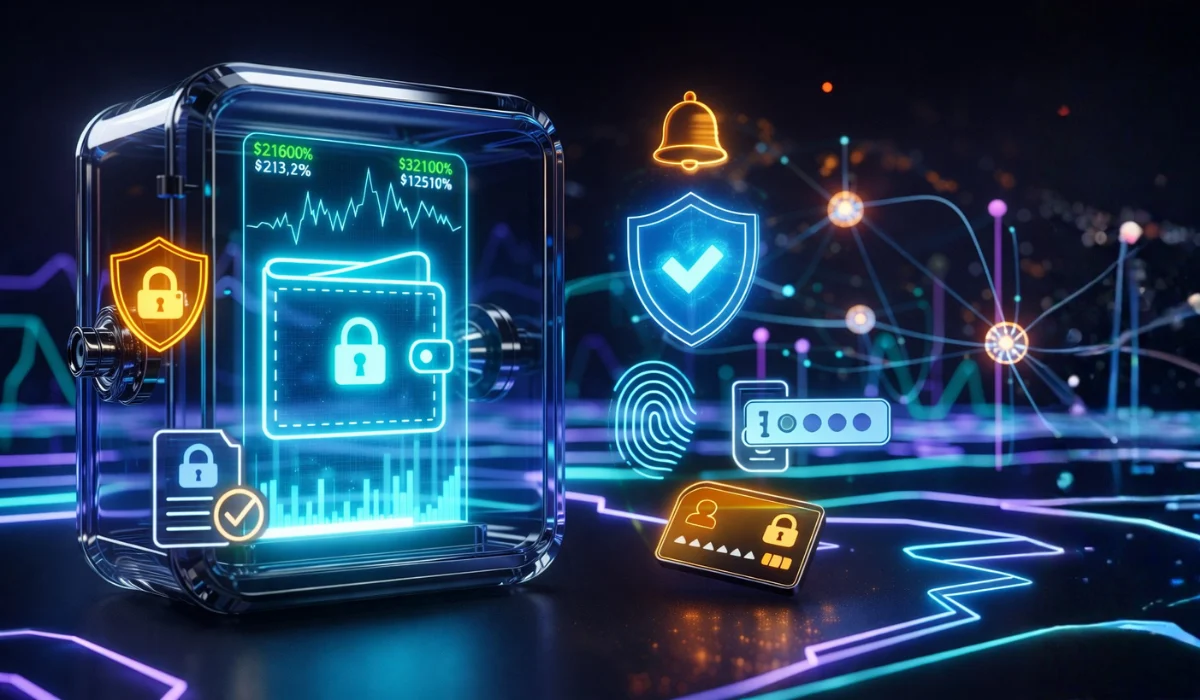
The rise in the number of digital currencies means that there is a need for multiple security measures that are capable of preventing external attacks from compromising the wallets that store these digital assets. Not all crypto wallets have the same amount of security; it is one of the key features that distinguishes between different types of wallets.
Security features should be the number one priority when choosing a wallet, since with evolving safety measures, the cybercriminals are also evolving. New methods are being devised to breach, manipulate, and attack wallets in an attempt to siphon the funds from their sources. To protect your funds from such attacks, it has become necessary to employ the strongest security measures available.
Securing The Private Key: Multiple Methods
1. Symmetric Encryption
Using the strongest encryption standard in the industry helps secure the private key, which is the most important part of a self-custody wallet. As of today, it is necessary to check if the wallet you are using uses the highest industry standard, like AES-256, which is one of the most widely accepted standards.
2. Post-Quantum Cryptography (PQC)
With the onset of 2026, newer and stronger encryption methods are being developed. PQC is one such method that is meant to offset traditional asymmetric encryption methods like RSA and ECC. CRYSTALS-Kyber is one of the leading PQC variants, which is designed to thwart decryption attempts made even through quantum computers.
Authentication Systems
The security of crypto wallets is increasing through different user authentication systems. The two main types of authentication methods available are 2-factor authentication and biometric authentication.
1. 2-Factor Authentication
In 2-factor authentication, a random key generator is used to generate a 2-factor code, which has to be entered to gain access to the wallet. This code is time-sensitive and will reset in a fixed period of time. Some popular 2-factor authentication tools include Google Authenticator, Microsoft Authenticator, Duo Mobile, etc.
2. Biometric Authentication
Biometric authentication involves a system making use of biometric sensors within the device used to access the wallet, such as a fingerprint sensor, facial recognition sensor, etc. While biometric authentication is a faster and hassle-free method that enables the user to make use of 2-factor authentication easily and quickly, it can be prone to system failures and AI spoofing. Moreover, if a user’s biometric data is compromised, it leads to an irreversible breach, as the user cannot alter their biometric parameters like fingerprints or retinal scans.
Protocols For Secure Communication
Crypto wallets cannot remain idle. They need to perform transactions, and in order to perform these transactions, a wallet needs to be able to communicate with relevant devices or systems. The absence of proper protocols for communication means that the communication itself can become an entry point for attackers.
1. TLS/SSL Encryption
This is one of the common communication protocols found in crypto wallets. They encrypt the communications from the wallet so that they can prevent external attacks trying to break in through the communication channel.
2. End-to-End Encryption
This protocol prevents attackers from reading your data when it is transmitted from one device to another. End-to-End encryption uses end-to-end encryption standards that encrypt your message on the side of the sender device and decrypt it only once it reaches the receiver device.
3. Protection Against Phishing
Phishing attacks are increasingly becoming popular due to their effectiveness on relatively inexperienced users. By copying how a message appears, phishing attacks try to reroute whoever initiates the transaction to the wrong destination to steal valuable information.
For the wallets of 2026 to be effective against phishing attacks, they must be able to verify the authenticity of the data being displayed. Whenever the wallet identifies incorrect data, it should be able to warn the user of a potential phishing attack.
Parting Thoughts
Safety is an essential aspect of day-to-day transactions in the crypto realm. By using a wallet that can offer the essential security features necessary to protect your funds, you are partaking in a larger initiative to make the crypto domain more secure. By identifying the significance of the threat, it becomes easier to deploy effective countermeasures.
Through different types of security features, crypto wallet users can safeguard their assets. In a world where attacks on even the most secure systems have become commonplace, having the highest security standards deployed to protect your funds is a matter that cannot be compromised on.
FAQs
Yes, if you lose your private key to an external person, they can siphon your assets. If you forget your seed phrase, you can be rendered incapable of accessing your assets, in essence, losing them.
Yes, the assets in your wallets are recorded on public ledgers called blockchains. They are visible not just to the IRS but to anyone using a block explorer. However, viewing your asset does not equate to having access to your assets.
Multi-Sig stands for multiple signatures; these are wallets that require more than two persons to approve transactions, hence the term, multiple signatures.
No, multi-sig wallets are best suited for large asset holdings like those of exchanges or big businesses, where multiple authorizations are required to move funds.
No, cold wallets are inherently more secure than browser wallets/software wallets/hot wallets since they store the private keys offline and are inaccessible to attackers.


