

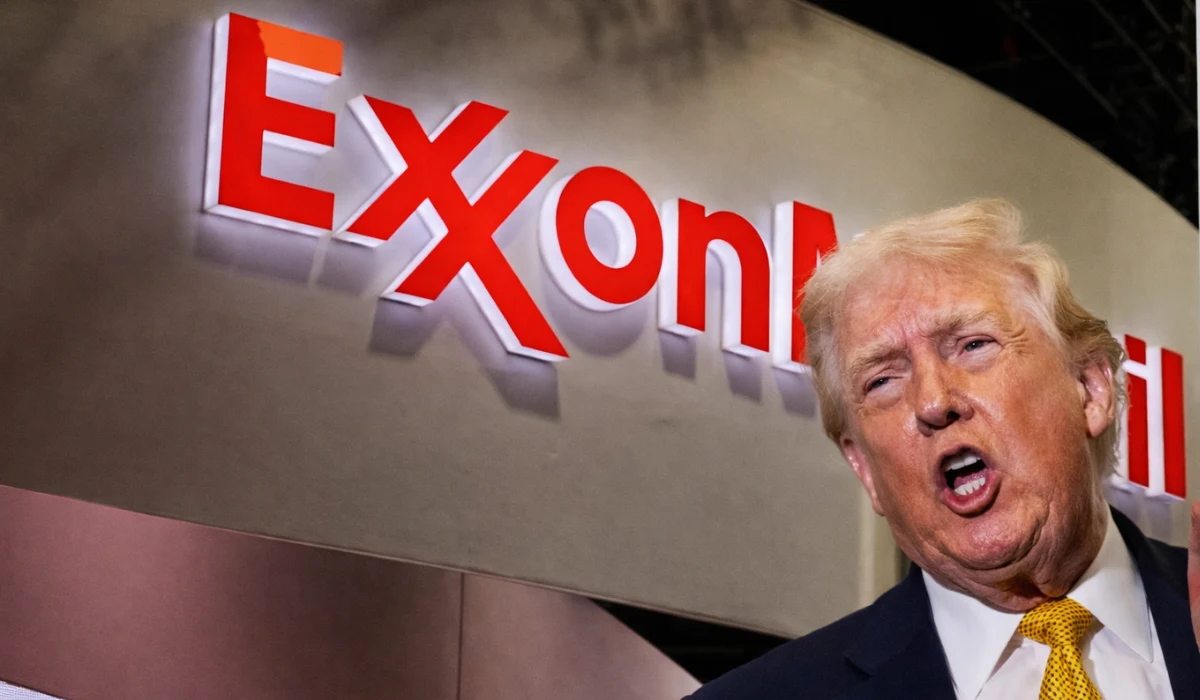
Despite Trump’s resentment regarding the company’s cautious stance on oil investments in the crisis-hit Venezuela, the US-based natural gas company ExxonMobil is firm on sending a technical assessment team to the country.
The differences of opinion between the oil company and the US president dates back to a January 10 White House gathering where President Trump, alongside top oil executives from ExxonMobil, ConocoPhillips, and Chevron, pushed for $100 billion in U.S. investments to revive Venezuela’s struggling oil sector. Trump pushed this decision as a step towards reviving Venezuela post the US-backed ousting of former President Nicolás Maduro.
However, ExxonMobil’s CEO Darren Woods took a cautious stance on this matter and highlighted Venezuela’s currently “uninvestable” status due to inadequate legal frameworks, uncertain hydrocarbon laws, and lack of investment protections. He stressed on the absence of these legal protections for nearly two decades since former president Hugo Chávez’s nationalizations stripped Exxon and ConocoPhillips of assets worth over $13 billion.
Trump reacted to Darren Woods’s stand by calling the company “too clever”. He voiced his displeasure at Darren Woods’s stance by stating that he “didn’t like Exxon’s response” and he was “inclined” to bar the oil giant from getting involved in Venezuelan operations in the future.
ExxonMobil’s Perspective on Venezuelan Investments, as Shared to Trump
Darren Woods addressed the White House gathering and openly stated the company’s stance on investing in Venezuela. He said that the company is still interested in investing in Venezuela and is ready to deploy a team within a few weeks if the Venezuelan government provides security guarantees and an invitation. Woods had expressed confidence in American governmental assistance to address issues like workforce security, contract sanctity, and policy reforms. He also emphasised Exxon’s integrated capabilities in production, refining, and trading to restore Petróleos de Venezuela, S.A. (PDVSA) output.
Woods said that while the status quo in Venezuela is good for a short term investment, the company is concerned about the long term investment prospects. Earlier in the 1940s, ExxonMobil had their assets seized twice by the Venezuelan government. That is why the company is cautious about a third attempt. Apart from ExxonMobil, industry experts like American Petroleum Institute President Mike Sommers have also expressed similar concerns, stating that while Venezuela’s vast resources were a major attraction, the unfavorable stance of the government and regulatory bodies was indeed a cause of concern.
Risks and Benefits of US firms Investing in Venezuela’s Oil Sector
US firms investing in Venezuela’s oil sector are poised to face huge challenges amid the vast potential on offer. This is especially so after the ousting of Nicolas Maduro and Trump’s push for $100 billion in reconstruction. Venezuela holds the world’s largest proven oil reserves at 303 billion barrels. The country holds a significant production capacity, potentially tripling output from under 1 million barrels per day if sanctions are lifted and infrastructure rebounds. US majors like ExxonMobil, Chevron, and services firms such as Halliburton could secure lucrative contracts for rebuilding PDVSA’s decayed assets, provided that the Venezuelan government provides adequate legal aid and sanctions.
However, there are some risks to investments, which cannot be overruled. The political instability under the incumbent interim government threatens asset seizures, with unresolved debts and weak rule of law deterring commitments. Operational hurdles include capital-intensive extra-heavy crude processing ($30–$40/barrel costs), diluted imports, aging infrastructure, refinery outages, and shortage of skilled labor, which will probably delay the returns on investments by years or decades. Moreover, competition from China-Russia joint ventures may add to the financial and security barriers.


