

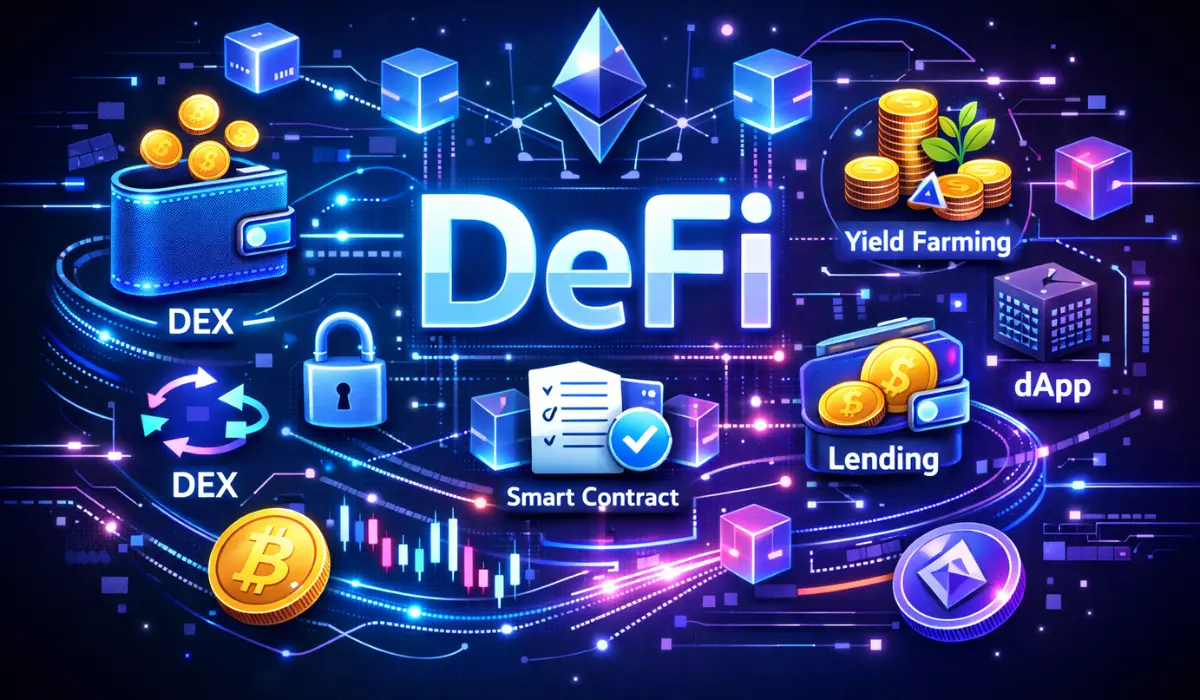
Decentralized Finance (DeFi) refers to an emerging digital ecosystem that enables users to send, purchase, and exchange financial assets without having to rely on banks, exchanges, or brokerages. DeFi offers an advanced way to make financial transactions by eliminating intermediaries. It uses blockchain technology to mitigate the need for intermediaries. It aims to reduce costs and speed up processes, even though it is in its development phase. DeFi comprises cryptocurrencies, blockchain technology, and software that allows users to transact financially with each other. This article will further explain everything you need to know about DeFi and how it works. So, keep reading to learn more.
What Is DeFi in Crypto? Everything You Need to Know
Decentralized finance, is an umbrella term for financial services on public blockchains. With DeFi, you can do most of the things that banks support, including lending, borrowing, earning interest, buying insurance, trading assets, and trading derivatives. The best part is that it is faster and does not require any kind of paperwork or a third party. As for why DeFi is important, it takes the basic premise of Bitcoin (digital money) and expands it. This creates an entire digital alternative to Wall Street, but without all the associated costs. DeFi has much potential to create more open, free, and fair financial markets that are accessible to anyone with an internet connection. Since DeFi is still an emerging field, it currently faces many challenges. Even though security remains the primary benefit of DeFi, it is also a major concern because the lack of government regulation makes it prone to scams and hacking.
Regarding how DeFi works, users engage with it through software called dApps (decentralized apps). Unlike conventional banks, there is no application to fill out or to open an account. The ways people engage with DeFi include lending out the crypto to earn interest and rewards every minute, and not just once per month. DeFi allows users to obtain a loan instantly without having to fill out paperwork. Additionally, it allows one to make peer-to-peer trades of certain crypto assets, as if one could buy and sell stocks without any brokerage. People use DeFi to save for the future by putting some of the crypto into savings account alternatives and earning better interest rates than they would typically get from a bank. With DeFi, one can make long or short bets on certain assets, and it acts as a crypto version of stock options or futures contracts.
Advantages and Downsides of Decentralized Finance (DeFi)
One of the main advantages of DeFi is that one does not need to apply for anything or open an account. You can attain access by creating a wallet. Additionally, you do not have to provide any personal information, such as your name or email address. Understand that DeFi is flexible, meaning one can move their assets anywhere at any time, without having to ask permission, or waiting for a long transfer to finish, or paying expensive fees. Keep in mind that the interest rates and rewards often update rapidly, as quickly as every 15 seconds, and can be higher than traditional Wall Street rates. Lastly, another key advantage is that everyone involved can see the full set of transactions. This is important because private corporations rarely grant that kind of transparency.
Regarding the downsides of DeFi, be mindful that fluctuating transaction rates on the Ethereum blockchain indicate that active trading can get expensive. Your investment could experience high volatility, depending on which dApps you use and how you use them. One of the key disadvantages is that you have to maintain your own records for tax purposes. Understand that the regulations can vary from region to region. The biggest risk of DeFi is that it is unregulated, meaning it has no FDIC backing or any other regulatory entity. This means it won’t protect your funds from error, major glitch, or cyber hack. It can cause your funds to disappear when faced with any unexpected circumstances. Additionally, the DeFi technology is new, which leaves no unified or comprehensive way to determine if any part of the DeFi system is operating at optimal capacity or is free from scams.
Conclusion
DeFi is an important aspect of crypto because it provides a radical new alternative to the traditional model of financial institutions. DeFi aims to do away with the intermediary powers or third parties that control and direct financial institutions. It allows individuals and organizations to utilize new technologies and transact directly with one another. It provides personal empowerment opportunities for individuals to get involved directly in how they exchange or conduct financial interactions. DeFi encourages digital financial inclusion that is not limited to a certain group of people who fulfill specific requirements. With DeFi, anyone from any background can participate and maintain control over their personal digital wallet, thereby benefiting those who are traditionally underbanked or underserved.


