

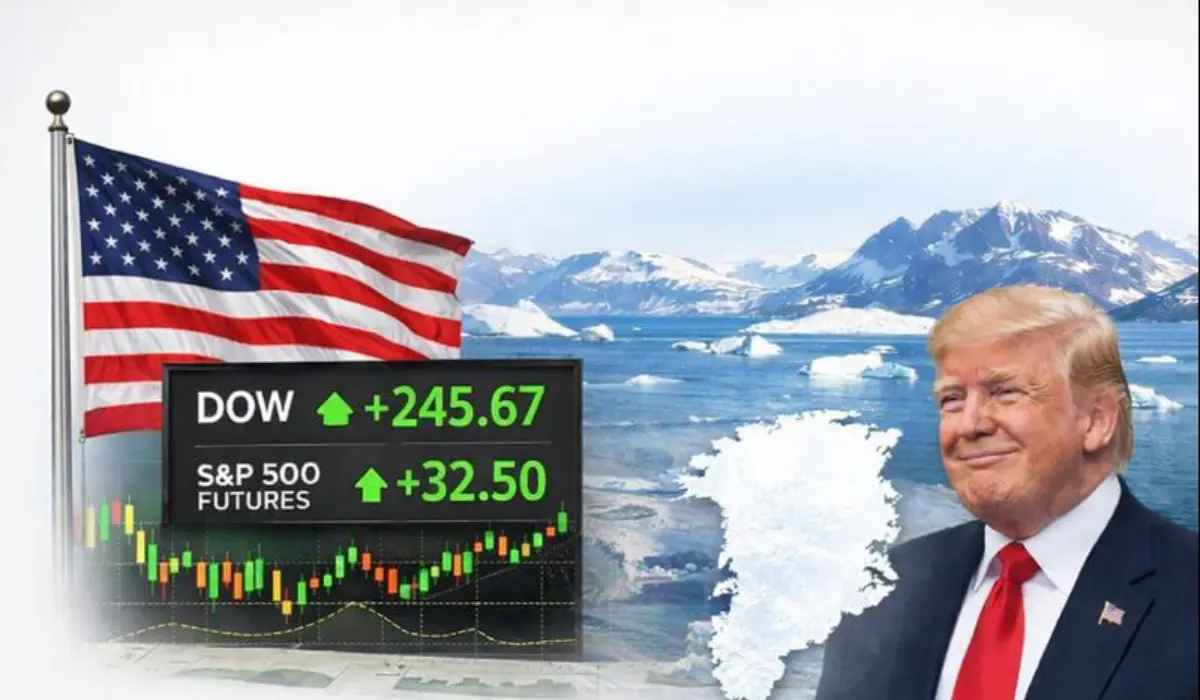
Dow Jones futures rose modestly after President Donald Trump announced a framework deal on Greenland, which eased the ongoing geopolitical tensions. This shift led to a strong rebound on Wall Street, with stocks recovering from earlier losses tied to tariff threats on Denmark, Finland, France, Germany, Sweden, the Netherlands, Britain, and Norway.
The US stock market has gained significantly. The Dow surged 589 points or 1.2% on January 21, 2026, while the S&P 500 and Nasdaq each rose about 1.2%, recovering from prior tariff-related selloffs. Futures extended gains, with Dow Jones futures climbing up by 0.1% to around 49,320 post-market and Nasdaq 100 futures up 0.3% to 25,550.
Trump’s Shift on the Greenland Issue
President Donald Trump announced a preliminary framework deal with NATO on Greenland during the Davos World Economic Forum on January 21, 2026, the first step in easing prior tensions over U.S. ambitions for rights over the territory.
The agreement covers U.S. and NATO access to Greenland’s mineral rights, especially rare earth elements critical for tech and defense, and involvement in the “Golden Dome” missile defense system to counter Russia and China in the Arctic. Trump described it as a complex long-term arrangement without altering Denmark’s sovereignty.
After coming up with the deal, Trump canceled the planned 10% tariffs on Denmark, Finland, France, Germany, Sweden, the Netherlands, Britain, and Norway. Tariffs were imposed on these countries as they had opposed the US taking control of Greenland.
Implications on the Market
The US president’s withdrawal of tariffs will have short and long-term effects on the market, the important one being the avoidance of a transatlantic trade war. Markets rebounded sharply, with the Dow surging 589 points on January 21, 2026, as tariff threats were lifted; European indexes like EUROSTOXX 50 stabilized, and safe-haven assets like gold eased from highs. Businesses avoided immediate cost hikes on €93 billion in the U.S.-EU trade flows, preserving supply chains for autos, minerals, and tech ahead of the February 1 deadlines.
The move fosters unity among the NATO nations on Arctic security and rare earth access without coercion, potentially stabilizing the U.S.-EU relations, which have remained strained since the 2025 tariff rounds. However, it signals that Trump’s leverage tactics work diplomatically, risking future escalations if Greenland talks falter; Europe may bolster anti-coercion tools like retaliatory tariffs or investment repatriation from U.S. bonds in such a case.
Trump’s withdrawal of the previously planned 10%-25% tariffs on eight European NATO allies stabilizes U.S. supply chains, which were reliant on €93 billion in annual imports from autos, machinery, chemicals, and rare earth precursors. Immediate avoidance of input cost spikes is expected to prevent disruptions in manufacturing sectors like automotive and aerospace, where European parts comprise 20-30% of U.S. assembly needs; inventories built up in anticipation now support steady production during Q1 2026 without re-sourcing rushes. Freight rates and logistics normalize as panic stockpiling halts, reducing delays seen in prior tariff episodes.
Producer prices for tariff-impacted goods such as German steel, Dutch semiconductors, and Swedish pharmaceuticals will remain flat instead of rising to 5%-15%, shielding margins for downstream U.S. firms like Boeing and Eli Lilly ahead of earnings season. Inflationary pressures from supply chain stress will also ease, with core PPI expected to hold near 2.1% through March.


