

Nvidia Corp. (NVDA) shares closed the trading week on a high note, buoyed by reports of a significant regulatory breakthrough in China as local firms are now allowed to import the state-of-the-art H200 chips, just as company CEO Jensen Huang arrived in Shanghai for a high-stakes tour of the country.
The dual developments suggest a thawing in the complex standoff over semiconductor trade between the US and China, offering investors renewed optimism about Nvidia’s access to one of its most critical markets.
Nvidia Shares Rise 1.5% After China Grants Initial Approval For H200 Chips
Nvidia stock rose approximately 1.5% during Friday’s session, closing at $187.67 | 209,266 sats, following reports that Chinese regulators have granted “in-principle approval” for domestic tech giants to begin procuring the American tech giant’s powerful H200 artificial intelligence chips.
According to reports, major domestic players, including Alibaba, Tencent, and ByteDance, have been given the green light to proceed with purchase negotiations. The market has welcomed the news of the potential reopening of a multi-billion-dollar revenue stream for Nvidia.
The path to Beijing’s approval has been fraught with tension. Earlier in January, the Trump administration officially cleared the advanced H200 processors for export to China, but with strict stipulations like a hefty 25% tariff on shipments and rigorous volume caps limiting the number of chips that can be imported into the country.
Despite Washington’s greelight, a stalemate ensued on the other side. Until this week, Chinese customs authorities had been blocking these shipments at the ports. This blockade was widely interpreted as a strategic delay, forcing domestic companies to evaluate homegrown alternatives while regulators weighed the impact of allowing the American hardware into the country. The new approval signals that Beijing has lifted its de facto ban, pragmatically allowing access to essential foreign technology to ensure its tech sector remains competitive.
Experts suggest the approval of H200 chips comes with strings attached, as reports indicate that China may require its tech firms to purchase a quota of domestic chips from suppliers like Huawei and Cambricon alongside their Nvidia orders. This “managed trade” scenario would allow the country to continue its AI development using top-of-the-line Nvidia hardware while simultaneously forcing revenue and adoption to its own semiconductor market.
However, for NVDA investors, the reopening of the semiconductor sales channel between the U.S. and China – even with tariffs and quotas – remains the dominant positive narrative and sentiment gauge.
Nvidia CEO Jensen Huang Visits China As Analysts See Diplomatic Thaw
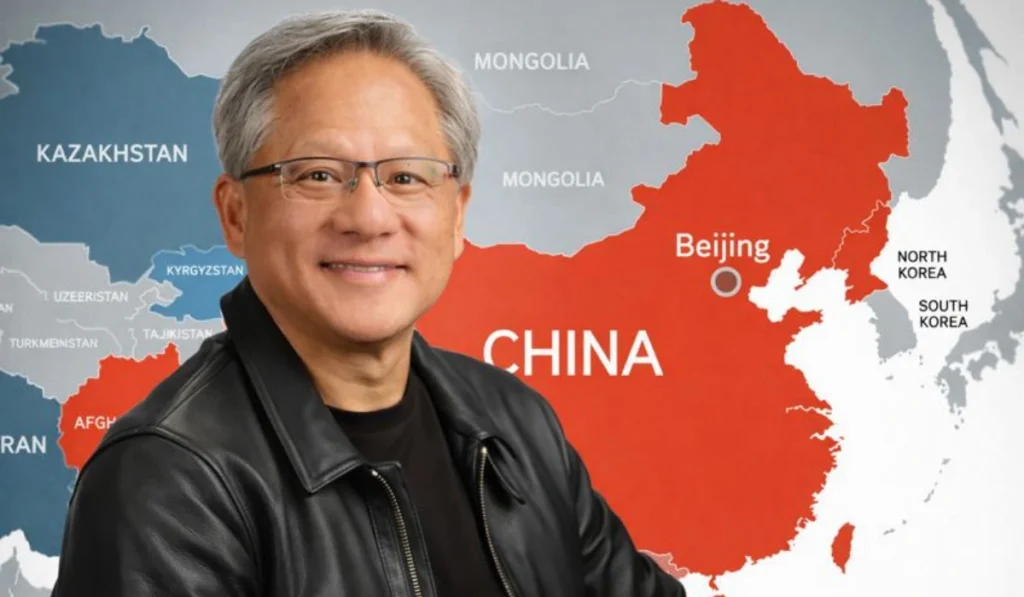
This regulatory breakthrough coincided with Nvidia CEO Jensen Huang’s arrival in Shanghai on Friday to attend Chinese New Year celebrations with local employees – a tradition the company’s co-founder has long maintained. The timing of his visit is viewed as strategic and serves as a significant vote of confidence in the Chinese market during a delicate period of global trade diplomacy.
According to sources familiar with his itinerary, the Shanghai stop is the beginning of a broader tour. Huang is expected to travel next to Beijing, the seat of regulatory power, and Shenzhen, a major hardware hub. In addition to employee events, he is expected to meet with key R&D teams and potentially solidify relationships with clients now cleared to purchase the H200 processors.
The insatiable demand for Nvidia’s H200 chip stems from its ability to solve the primary bottleneck in modern artificial intelligence: memory. While its predecessor, the H100, remains the gold standard for training AI models, the H200 is specifically engineered to excel at inference the actual running of those models to generate text, images, and data.
It features a massive 141 GB of next-generation HBM3e memory, nearly double the capacity of the H100, alongside a blistering 4.8 TB per second of memory bandwidth. This bigger and faster memory pipeline is critical for large language models (LLMs), which are often too large to fit efficiently on a standard chip.
The H200 allows tech giants to run massive models on fewer chips or process user queries significantly faster, thereby lowering the “cost per token” of AI services. By securing access to this critical hardware, Chinese tech firms can prevent a widening “compute gap” and ensure they can deploy complex AI applications at the same speed and scale as their U.S. counterparts.


