

The Dow Jones Industrial Average (DJIA) is one of the oldest and most widely followed stock market indices in America. It tracks the price of 30 blue-chip companies in the United States and indexes them to provide insight into the market conditions at a glance.
The DJIA is distinct from other indices, such as the S&P and the Nasdaq Composite, since it’s a price-weighted index that prioritizes stock prices more than company market capitalization. This means that smaller companies with higher stock prices can sit above bigger companies with smaller stock prices.
For example, Goldman Sachs, with a $284.8 billion market cap, tops the index, while Walmart, with a $940.24 billion market cap, is indexed at the 24th position in the DJIA. Note that the stock of Walmart is priced at around $118, while that of Goldman Sachs is priced at $949. This is a clear example of how Dow treats stock prices as a bigger factor in indexing.
Note: stock prices and index positions are from the day of writing the article and are subject to change
The 30 Companies in the Dow Jones Industrial Average
Here is a recent snapshot of the companies in the DJIA in descending order of their weight. The index is subject to change as the stock prices change.
| Company | Ticker | Sector | Weight (%) | Market cap (approx.) |
|---|---|---|---|---|
| The Goldman Sachs Group, Inc. | GS | Financials | 11.3% | ~$270bn |
| Caterpillar Inc. | CAT | Industrials | 7.4% | ~$270bn |
| Microsoft Corporation | MSFT | Technology | 6.2% | ~$3.6tn |
| American Express Company | AXP | Financials | 4.8% | ~$260bn |
| Visa Inc. | V | Financials | 4.5% | ~$600bn |
| The Home Depot, Inc. | HD | Consumer Discretionary | 4.4% | ~$350bn |
| UnitedHealth Group Incorporated | UNH | Health Care | 4.2% | ~$300bn |
| Amgen Inc. | AMGN | Health Care | 4.2% | ~$160bn |
| Sherwin-Williams | SHW | Materials | 4.2% | ~$80bn |
| JPMorgan Chase & Co. | JPM | Financials | 4.1% | ~$880bn |
| McDonald’s Corporation | MCD | Consumer Discretionary | 3.9% | ~$220bn |
| International Business Machines Corp. | IBM | Technology | 3.9% | ~$285bn |
| The Travelers Companies, Inc. | TRV | Financials (Insurance) | 3.7% | ~$65bn |
| Apple Inc. | AAPL | Technology | 3.5% | ~$4.0tn |
| Salesforce, Inc. | CRM | Technology | 3.4% | ~$250bn |
| Amazon.com, Inc. | AMZN | Consumer Discretionary | 3.0% | >$2.0tn |
| The Boeing Company | BA | Industrials | 2.8% | ~$165bn |
| Johnson & Johnson | JNJ | Health Care | 2.6% | ~$500bn |
| Honeywell International Inc. | HON | Industrials | 2.5% | ~$135bn |
| Nvidia Corporation | NVDA | Technology | 2.4% | >$2.5tn |
| 3M Company | MMM | Industrials | 2.0% | ~$85bn |
| Chevron Corporation | CVX | Energy | 1.9% | ~$300bn |
| The Procter & Gamble Company | PG | Consumer Staples | 1.8% | ~$340bn |
| The Walt Disney Company | DIS | Media/Communication | 1.5% | ~$200bn |
| Walmart Inc. | WMT | Consumer Staples | 1.4% | ~$900bn |
| Merck & Co., Inc. | MRK | Health Care | 1.4% | ~$265bn |
| Cisco Systems, Inc. | CSCO | Technology | 1.0% | ~$305bn |
| The Coca-Cola Company | KO | Consumer Staples | 0.9% | ~$300bn |
| Nike, Inc. | NKE | Consumer Discretionary | 0.8% | ~$75bn |
| Verizon Communications Inc. | VZ | Communication Services | 0.5% | ~$170bn |
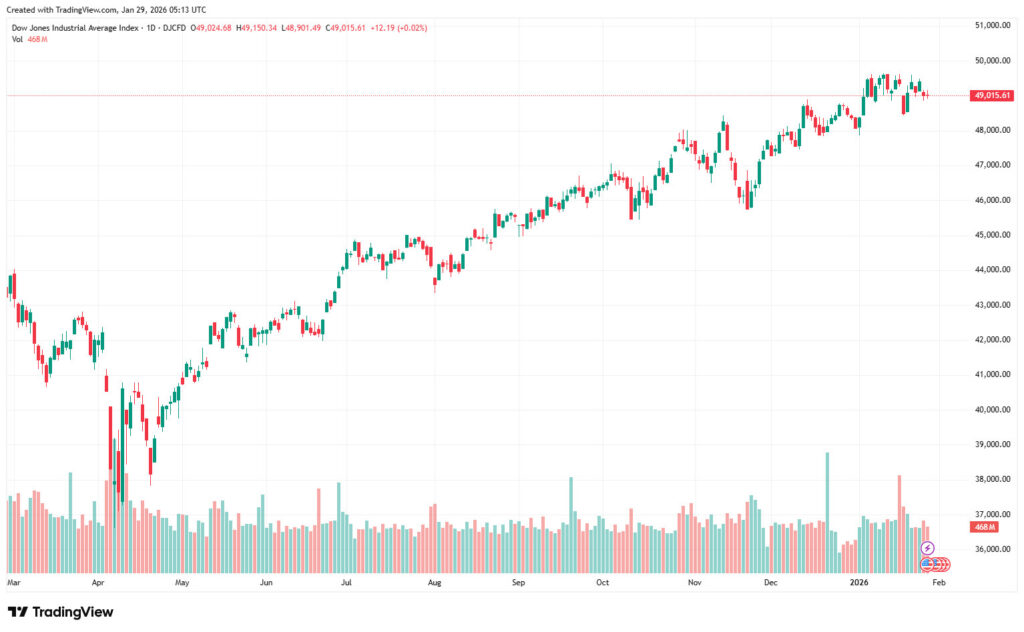
How is Dow Calculated
Dow is a price-weighted index where the stocks move up and down depending on their share price.
The core formula used in calculating the Dow index level is:
DJIA = (P₁ + P₂ + P₃ + … + P₃₀) ÷ D
The numbers from P1 to P30 represent the share prices of the 30 Dow stocks, and D is the Dow Divisor- a scaling factor that is adjusted over time.
A Brief History of Dow
Today, the Dow represents how big the American market is and how well the market is doing in general. Its history dates back to 1896, when Charles Dow, the editor of the Wall Street Journal, gathered prices of 12 industrial names, including coal, gas, oil, sugar, railroad, and tobacco. He added the 12 numbers together and divided the sum by 12, giving birth to the first-ever Dow number that changed how people thought about the market forever.
In 1916, the index captured the 20 biggest stocks, and in 1928, it expanded to a 30-stock format, which is used today. The stocks in the Dow changed over the years; events like World War II, and the great depression collapsed the numbers to the floor, and the post-war boom catapulted it above 1000 points. The Dow remained the most important number that reflected the U.S. economy’s performance.
Today, Dow is a shorthand for how good or how bad Wall Street is doing on any given day. Although Dow focused on industries in its inception, it has evolved into a more comprehensive index that reflects the growth of America’s services, finance, technology, and healthcare landscape.
How to invest in the Dow
The simplest way to invest in the Dow is to buy ETFs that track the Dow. Such ETFs often invest in all 30 companies in the Dow in ratios proportional to their weighted average. For example, SPDR Dow Jones Industrial Average ETF Trust is a fund that tracks and invests in the Dow. The fund has shown 12.90% growth in 2025 and an all-time growth of 521.48%.
There are also several other ETFs with Dow as their benchmark for resource allocation, such as Invesco Dow Jones Industrial Average Dividend ETF (DJD), which focuses on dividend income and hence prioritizes dividend yield over weights. The fund has shown a 12.42% YTD growth and 2.61% dividend yield. Hence, data says investing in funds that track the Dow is a concrete investment plan.
Conclusion
The Dow Jones Industrial Average continues to be a reliable rubric for every investor. The ETFs that track the Dow have also proven to be reasonably stable investment options compared to other funds. Apart from its utilitarian value, Dow remains the iconic shorthand for how the market is doing today.


