


To know if a stock is undervalued or overvalued, analyze key financial ratios like the Price-to-Earnings (P/E), Price-to-Book (P/B), and Price/Earnings-to-Growth (PEG) ratios. Try comparing with industry averages and the company’s historical performance. While a lower P/E or P/B often suggests undervaluation, a PEG below 1.0 suggests undervaluation relative to growth. Always understand the ‘why’ behind the numbers because high-growth companies naturally have higher valuations. This article further discusses what makes a stock undervalued or overvalued. So, keep reading to learn more.
How to Tell If a Stock Is Undervalued or Overvalued
Understanding whether a stock is undervalued or overvalued is crucial to identifying its intrinsic value versus its market price. This allows investors to buy low and sell high, thereby maximizing returns and minimizing risk. Proper analysis can help avoid buying overpriced shares, prevent losses, and guide investment decisions. Investors usually use fundamental analysis to compare a company’s market price against its intrinsic value, which is what the business is actually worth based on its assets, earnings, and growth. Here is a detailed explanation of the metrics that are used to spot undervalued and overvalued stocks, such as:
Valuation Ratios – The Quick Check
Ratios are the most common tools because they allow for comparison of a company against its competitors or its own historical average. There are three types of ratios, including:
- Price-to-Earnings (P/E) Ratio- Measures the stock price relative to its earnings per share. Low P/E indicates that stocks may be undervalued or that the market expects trouble. High P/E signals that stocks may be overvalued or that the market expects massive growth.
- Price-to-Book (P/B) Ratio- Compares market value to book value, which is total assets minus liabilities. A P/B under 1.0 often signals an undervalued stock, because one is paying less than the value of the company’s net assets.
- Price-to-Sales (P/S) Ratio- Useful for companies that are not profitable yet. It compares the stock price to annual revenue.
Intrinsic Value- The Discounted Cash Flow (DCF)
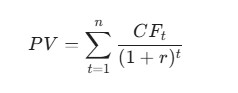
Assume a business is a machine that spits out cash. The DCF method calculates how much cash they will generate in the future and discounts it back to today’s dollars. The stocks are undervalued in case the DCF shows the company is worth $100 per share, but is trading at $70. It signals the stocks are overvalued when the DCF shows a value of $50, but is trading at $90.
The formula involves the sum of future cash flows (CF) divided by the discount rate (r):
Dividend Yield
The dividend can be a major clue for mature companies. If a stable company usually has a 3% dividend yield, but the stock price drops so much that the yield is now 6%, the stock might be undervalued, provided the company can still afford the payout.
Qualitative Signs- The Moat
It is important to look at the ‘Economic Moat’, as the numbers don’t tell the whole story. Economic Moat is said to be the competitive advantage that protects the company.
| Indicator | Likely Undervalued | Likely Overvalued |
|---|---|---|
| Market Sentiment | Fear, panic selling, or “boring” sector. | Hype, FOMO, or “everyone is buying.” |
| Growth Potential | Improving margins and new products. | Growth is slowing, but the price keeps rising. |
| Debt Levels | Manageable debt with high cash reserves. | Increasing debt used to fuel artificial growth. |
Common Mistakes Investors Make When Valuing Stocks

Common stock valuation mistakes include relying solely on P/E ratios, confusing a low share price with value, ignoring cash flow, overestimating growth, and using static, over-optimized tools. Investors seem to fail by equating low price with value, often neglecting qualitative factors like management quality, and overcomplicating formulas. To avoid these errors, one should focus on long-term cash generation and reasonable growth assumptions. Ensure you look at the company’s potential in 5-10 years rather than just the next quarter. Combine different valuation models to cross-verify results and conduct deep research on the company, industry, and management team without just relying on tips. Additionally, properly calculate the discount rate to account for company risk and focus on reasonable, conservative estimates.
Final Thoughts: How to Decide If a Stock Is Worth Buying
Before purchasing stocks, analyze their relative valuation and do not look at metrics in isolation. Always compare the P/E or P/B ratios to the company’s historical averages, its competitors, and the overall industry. Evaluate growth prospects because a high P/E is not always bad if the company is growing rapidly. On the other hand, a low P/E might be a value trap if growth is stalled. Lastly, check financial health, meaning you should examine debt levels and profitability to ensure the company is financially strong.


