

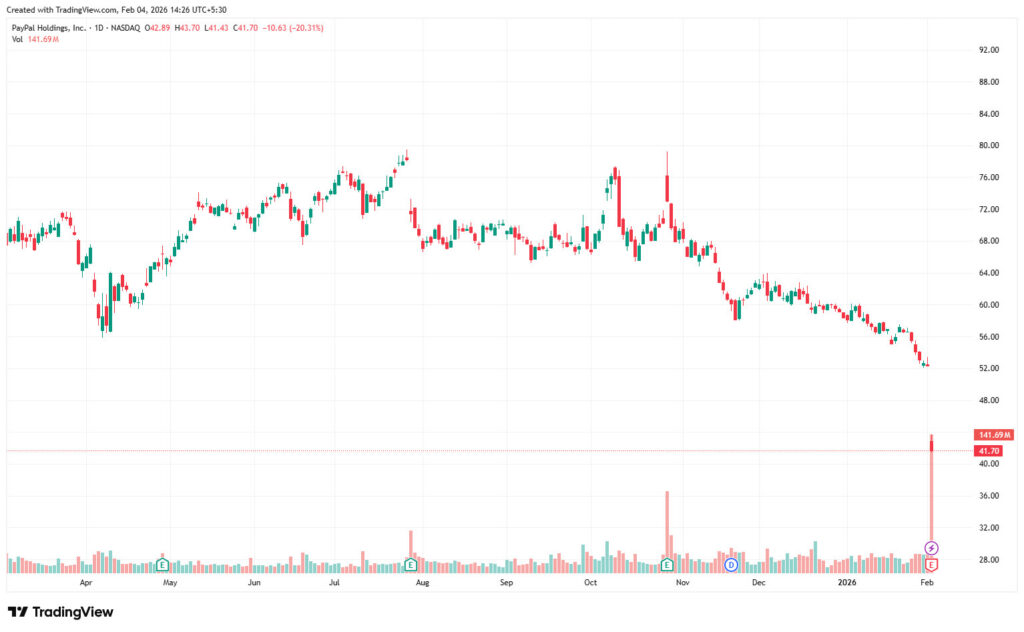
PayPal Holdings, Inc. (PYPL) suffered one of the most dramatic collapses in its public-market history, with shares plunging 20.3% in a single session. The crash marked a multi-year decline of nearly 86% from its peak market value. The near-historic sell-off followed a deeply disappointing Q4 2025 earnings report and the sudden replacement of CEO Alex Chriss, a leadership shake-up that blindsided investors and amplified volatility well beyond the earnings miss alone.
Earnings Miss and Weak 2026 Outlook Ignite Investor Panic
The fintech giant reported adjusted earnings per share of $1.23, missing Wall Street consensus estimates of $1.29, but it was PayPal’s 2026 guidance that truly rattled markets. Management projected slower transaction growth, margin pressure, and limited near-term upside, reinforcing fears that PayPal is losing momentum in a rapidly evolving digital payments ecosystem.
Wall Street analysts highlighted that the guidance implied subdued volume growth across key merchant categories in the United States retail, raising concerns about PayPal’s exposure to discretionary consumer spending amid broader macroeconomic uncertainty.
Branded Checkout Growth Collapse Raises Structural Concerns
A central flashpoint in the earnings report was Branded Checkout Growth, one of PayPal’s most closely watched performance indicators. Growth slowed to just 1%, far below historical norms and well under analyst expectations, triggering widespread concern that PayPal’s core checkout offering is losing relevance.
Jamie Miller, Interim CEO, stated,
“In 2025, PayPal delivered solid performance across multiple areas of the business. We grew revenue, transaction margin dollars, and earnings per share, underscoring the strength of our increasingly diversified platform. At the same time, our execution has not been where it needs to be, particularly in branded checkout.”
Analysts increasingly point to rising competition from Apple Pay and Google Pay, whose deep integration into smartphones, operating systems, and digital wallets continues to pressure PayPal’s market share. The slowdown suggests the challenge may be structural rather than cyclical, intensifying investor skepticism.
Sudden CEO Exit Adds Volatility Beyond the Numbers
While the earnings miss set the stage for a sell-off, market volatility surged after PayPal confirmed the immediate departure of CEO Alex Chriss. The company announced that Enrique Lores, the current CEO of HP Inc., will assume the top role effective March 1, with CFO Jamie Miller serving as interim CEO until then.
The abrupt leadership transition caught markets off guard. Analysts noted that the CEO change, rather than the earnings miss alone, acted as the primary catalyst for the stock’s outsized single-day decline.
Investors Brace for the Incoming “Lores Era”
Although Enrique Lores is credited with stabilizing HP Inc. through cost discipline and operational restructuring, investors are still assessing whether his background aligns with PayPal’s fintech growth challenges. The market is now pricing in uncertainty around strategy, execution speed, and competitive repositioning under the incoming “Lores Era.”
Several Wall Street firms downgraded PayPal shares following the announcement, arguing that leadership uncertainty compounds already-elevated execution risk.
For investors, the message was clear: the combination of slowing growth metrics, weak forward guidance, and a surprise CEO transition has forced a fundamental reassessment of PayPal’s long-term competitive position in an increasingly crowded digital payments war.


