

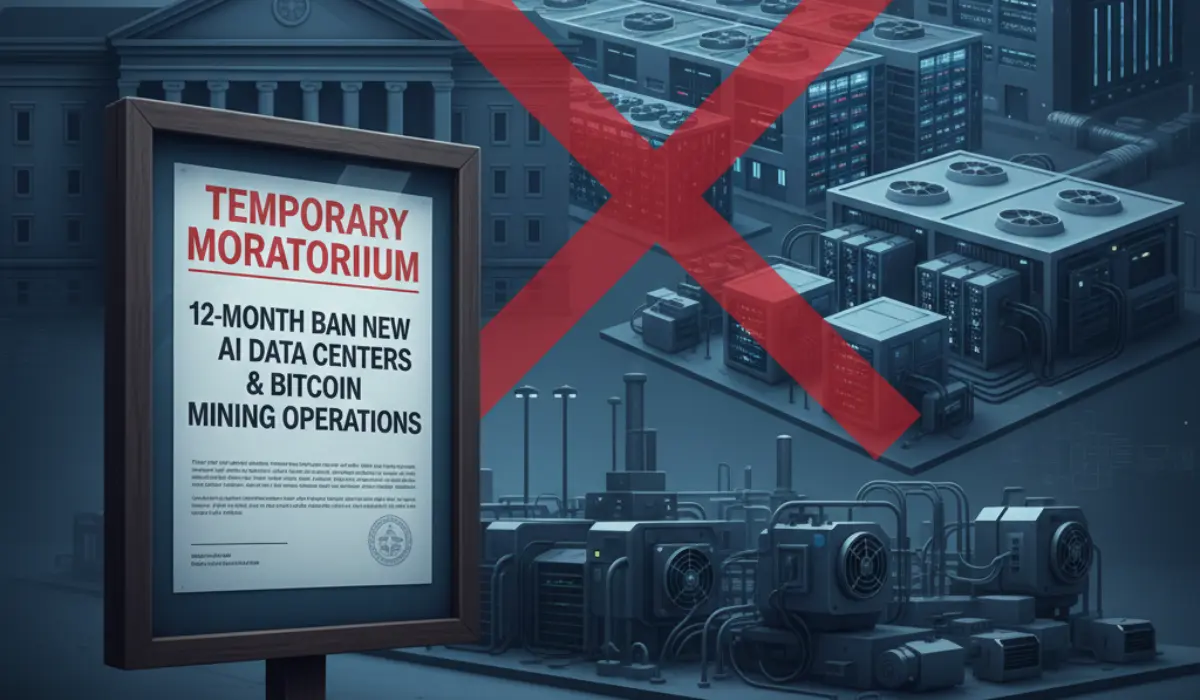
On Wednesday, residents of Chatham County, Georgia, sighed in relief after the county’s Board of Commissioners passed a 12-month moratorium on new AI data centers and cryptocurrency mining operations in the area.
The decision comes as the exponential growth of artificial intelligence and rising interest in crypto mining have accelerated the demand for large data centers across the United States. These facilities, essentially large warehouses housing thousands of computer servers, require immense amounts of electricity for operations and a substantial water supply for cooling.
The move was not a hard “no” to technology, but rather a “not so fast” to a sector that has been expanding faster than local power grids and zoning codes can keep up.
Chatham County Halts AI Data Centers, Crypto Mining for 12 Months
During the public hearing leading up to the vote, the atmosphere was a mix of scepticism and caution, as community advocates voiced concerns that these massive warehouses bring plenty of server racks but very few actual jobs. One resident summarized the frustration by stating that the county should not have to trade its quiet nights and affordable electricity for “digital ghost towns” that primarily serve companies thousands of miles away.
The Chatham Board of Commissioners’ decision was heavily influenced by the controversy surrounding the “New Hill Digital Campus” in the nearby town of Apex. The proposed 190-acre Apex data center became a lightning rod for opposition, with residents from the Jordan Pointe community famously organizing “red shirt” protests and gathering over 4,500 signatures to block the project. Apex Police Chief Ryan Johansen even raised alarms about public safety, noting that these “fortress-like” facilities are difficult for first responders to access and could become targets for demonstrations.
Opponents pointed out that the data center’s 300-megawatt power request is roughly a third of the output of the nearby Shearon Harris Nuclear Plant. The sheer scale of power consumption by these facilities can stress local electrical grids, potentially leading to increased energy costs for residents and businesses. Furthermore, the substantial water consumption for cooling systems raises concerns about water availability and sustainability in a region that is already facing water management challenges.
Residents also voiced fears about “silent killers,” referring to air pollutants from massive diesel backup generators and the blood-brain barrier-penetrating particulates they release. They also likened the constant hum of cooling fans to “living next to a perpetual jet engine.”
U.S. Counties Drawing Up Zoning Plans to Incorporate Massive Data Centers
Chatham County’s pause is part of a broader regional reckoning where local leaders are realizing their existing zoning laws are inadequate for such intensive industrial uses. In DeKalb County, commissioners recently extended their own moratorium until June 2026 after receiving a flood of concerns regarding the sight, sound, and setback of these facilities.
Similar measures have been seen in Thomas County, where officials passed a 12-month pause to protect citizens from potential 20% increases in electricity bills. Even Douglas and Coweta Counties, once considered hotspots for big tech, have moved to re-evaluate these developments to ensure they do not swallow up land intended for more diversified growth.
The 12-month window provides Chatham County with crucial breathing room to draft new ordinances that address the massive scale of power and water these facilities demand, as these operations can require millions of gallons of water for cooling. The Commissioners emphasized that this is a period of due diligence, giving the local government the power to demand noise mitigation and stricter water-recycling protocols before data centers and crypto mining facilities even break ground.
The issue has elevated to the state level, where House Bill 1012 seeks a state-wide moratorium until 2027.


