

The Tragic and Shocking Collapse of One of the World’s Great Post-War Institutions
Jan 8
Member-only
Save
You don’t have to look very hard to see it. Britain’s NHS is collapsing. Now, oddly, the very first thing a certain kind of Brit will do is…get angry…atme…for pointing it out. But it’s hardly just me saying it: Germany’sDie Weltis just one of many publications to have articles withheadlineslike “Great Britain: a health system facing collapse.”
The death of the NHS is a turning point for Britain — and for the world.Because the NHS, while you might not often think of it that way, was one of the modern world’s great institutions, a model, a pillar, and a pioneer. Think of the world we once took for granted. In the ashes of the last World War, a new set of social contracts, offering expansive rights and systems that people had never enjoyed before, in all of human histry, were born. And foremost among those was the NHS — one of the world’s great post-war quantum leaps of civilization itself.
So to see it die? We should all shudder. But are we? I get the sense that even Brits don’t really fully grasp what they’re losing, don’t seem to care enough, are numb by now. I’ll come back to the Big Picture, though. For now? Some, let’s shade in the littler one.
How bad is it? When I say the NHS is “dying,” is that just hyperbole, or what Brits like to call “scaremongering”? Let’s consider just a few simple facts.
According toOECD figures, France has 5.7 beds per 1,000 people, compared to the UK’s 2.4 and an OECD average of five… Patients with heart conditions are seen by a specialist within 28 days in Paris, with 70 the longest wait recorded elsewhere. In England, there are more than 340,000 people waiting for cardiology care, with about a third of those waiting longer than the maximum target time of four months. In France, the time between a cancer diagnosis and the start of treatment averages less than six weeks, while patients with potentially life-threatening conditions are typically seen by a consultant within six days of referral, half within two days. In England, 18,600 people given an urgent referral for suspected cancer last year waited at least 100 days to start treatment.
Those are shocking numbers. They point to a healthcare system in a state of collapse. Collapse here means something very, very simple.People can’t get basic healthcare anymore.Just getting an appointment to see a GP has become something of a running joke.
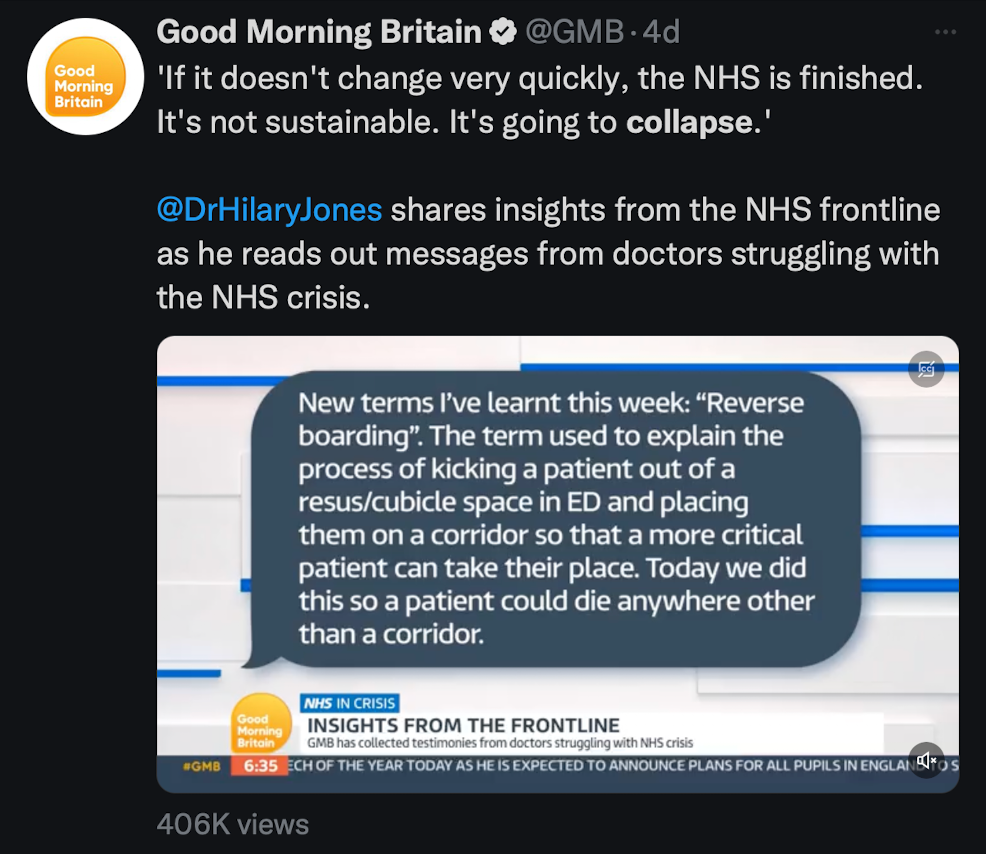
And then come the real horror stories. People waiting more than99 hours for a hospital bed, ambulances thatdon’t arrive, people taking their loved ones to the hospital on their ownstrapped to planks, the couple that’s kindlyofferedto take people to the hospital in their…car…because there are no ambulances, everyone from nurses to paramedicsstrikingbecause their incomes have fallen while they’re overworked while they have towatch people die.
And yes, people are dying. It was just last week that the head of the Royal College of Emergency Medicineestimatedthat up to 500 people a week are dying because they can’t get emergency care.500 people aweek? Adjusted for population, for a country Britain’s size, that’s a 9/11…every single week. We are talkingthatlevel of catastrophe.
And that’s just the emergency medicine part. Who knows how many more are dying because they can’t beds, basic medicine, treatment on time? Go ahead and guess.Double it. Now we’re up to a thousand people a week, or a 9/11every few days.
That is what a collapsing healthcare system means. It should make you shudder. And yet Brits aren’t shuddering, at least not nearly enough.They don’t understand what they’re losing.
What are they losing, exactly? Well, I’d say that “the idea” is to replace the NHS with American style “health insurance,” but that’s not just an idea anymore, it’s actuallyhappening.
NHS trusts with record waiting lists are promoting “quick and easy” private healthcare services at their own hospitals, offering patients the chance to jump year-long queues,the Observer can reveal. The premium treatments are being offered through private patient units owned and operated by NHS trusts and typically located on hospital premises. Procedures are often carried out by the same staff who would eventually treat patients if they stayed on the NHS waiting list.
LOL — did you get that? Literally the same resources — doctors, operating rooms, hospitals, right down to electricity and anaesthetic — are being used. Only now you can jump the queue…if you pay.I have no problem with private healthcare — none, I think it’s great, in fact — but when itreplacespublic healthcare, as in erases it, in a literal economic way, then, yes, thereisa problem. Because they are not substitutes for one another — they should only be, in economic terms, complements. Private healthcare, sure, by all means. But everyone shouldhavehealthcare.
And having to wait a year for basic procedures — or not being able to get an ambulance — is not having healthcare.It’s the promise of having healthcare, maybe, but it’s not the reality of it. In that sense, the NHS hasalreadycollapsed. It’s not some future state we’re talking about. It cannot deliver care to people right now, on any basic level anymore, really, hence, we’re already seeing skyrocketing excess deaths.
Now. How did all this come to be? Pretty simple, and I’m sure that many of you already know big parts of the answer. Britain elected a series of conservative governments, each more viciously focused on austerity than the last. They began tocut health spendingto the bone, because Britain’s Tories have always hated the NHS with a special animus, and we’ll come back to that.
Theanalysis also showsthat if UK spending per person had matched the EU14 average during that decade, then the UK would have spent an average of £227bn a year on health between 2010 and 2019 — £40bn higher than the actual average annual spending during this period of £187bn.
Over the same decade, the UK also had a lower level of capital investment in new buildings and equipment for health care compared with the EU14 countries. Between 2010 and 2019, the average health capital investment in the UK was £5.8bn a year. If the UK had matched other EU14 countries’ average investment in health capital (as a share of GDP) it would have invested £33bn more between 2010 and 2019 (about 55% higher than the actual investment during that period).
So Britain underinvested by about half.To make that concrete, over the last decade, Britain’s been doing shockingly crazy things, like closing hospitals. What kind of a modern, growing society…closes hospitals? That’s like, I don’t know, ripping down a highway, or burning a high-speed rail line, or throwing a Molotov cocktail into a university and giggling. To see societies do things like close hospitals is a danger signal: something is going very, very wrong either in the body politic, or in real economic terms. Either that society’s getting poorer, fast — or it’s falling for Big Lies.
That doing things like closing hospitals and reducing healthcare in general was crazily foolish was doubly true for Britain is true for an even bigger reason. Britain has anaging population. So now, LOL, we had a society of people growing old…that was closing hospitals…and slashing health investment at a record pace. That shouldn’t make sense to a first grader. And yet Britain kept on voting for governments like this, cheering all the way, as the NHS began to buckle and break, precisely because practically nobody, and I meanpractically nobody, from the opposition to its own failing intellectual class, was pointing out simple truths like this: how is a nation of people growing older going to cope without…hospitals…ambulances…nurses…doctors…healthcare? LOL…good luck with that.
And then came the killing blow.Brexit.What did Brexit do? Well, in Britain, you still can’t talk about it, but as many of us economistspointed out at the time, Brexit’sultimate pricewas probably going to be Britain’s great public goods, like the NHS. Why? Well, for one, those public goods run on imported labour — if you’re American, go ahead and imagine American healthcare without all those nice Indian and Asian doctors. In Britain, healthcare was powered by Europeans — from some of the world’s top surgeons, right down to an army of European nurses. And after Brexit? Theyall leftin a mass exodus. They were forced out is a better way to put it, because, well, Britain had become a society literally proudly “hostile” to anybody “foreign,” and you can read plenty of stories from European academics and doctors whodidn’t want to leave, who’d built their lives and careers in Britain, but had to, because, what choice did they have realistically?
So. One reason that Brexit was always going to cost Britain its great public goods was what economists call “human capital flight.” In Britain, they called it, proudly, getting rid of the dirty foreigners. But human capital is a form ofwealth. When we do stupid, stupid things, like make our societies hostile to talented people…we only end up poorer. Like Britain has, because now it doesn’t have the very labour force it needs tohavean NHS. TheNHS has about 150,000 vacancies. LOL,that’s about as many as Google. But Google’s willing to hire anybody from anywhere, as long as they’re talented.Britain isn’t. So those vacancies go perpetually unfilled. They can never be filled again, in the same way, because, well, apart from Europe, where else are you going to find that many well-trained people educated to that standard? Nowhere is the answer.
But there’s a deeper reason, too, that the price of Brexit was always going to be the NHS. What was Brexit going to do? Shrink the economy.The economy’salready 11% smallerthan it would’ve been otherwise. Maybe that doesn’t sound so bad, until I point out that the world economy shrank by 15% during…theGreat Depression.Bad? It’s catastrophic on a historic scale. Britain’s facing economic ruin, and you can see it in stories of people unable to pay the bills, feed their kids, afford the heat. But on a social scale? A smaller economy means that there’s less left over to fund generous public services, like, for example the NHS.
In that sense, let me say it again, the price of Brexit was always going to be Britain’s great public goods, like the NHS, because another word for Brexit is “austerity.”That’s where Britain is now…in a doom loop. A decade of vicious austerity led it to Brexit, and Brexit led it right back to austerity. LOL — has it ever been so clear, how foolish all this was? So there are Britain’s leaders, proposing even more austerity….because, well…now there’s little choice, but also, guess what…it’s what they wanted all along.
Now let’s come back to the Big Picture. What happened after the last World War. The worldchanged, my friends. It doesn’t do that often. But this time, it did. Europe did something remarkable — it rewrote constitutions so that it could, for the first time in human history, ever, period, full stop, offer everyone basics as human rights — healthcare, education, transport, media, even abstractions like dignity. Because it did that, it then spent decades developing the institutions and systems its social contracts became renowned for today — now Europeans enjoy everything from high-speed rail that can cross a continent in hours to healthcare anywhere on that continent to affordable education and so forth. The entire world is envious of that, because it is something to envy, to treasure and cherish. It is the apex of human civilization — in one human lifetime, Europe went from ashes to history’s highest living standards,ever. That was the European Miracle, and it’s one thegreat lessons of the 20th century.
America helped it, with the Marshall Plan. And then, ironically, America didn’t do any of the things Europe did. So today, Americans live vastly, and I mean vastly, worse lives than Europeans, precisely because they don’t have healthcare or education or transport or media as basic rights, and so they have to live on diets of junk news and junk food and little healthcare and a lack of education. The result is anation in perpetual crisis. America chose the wrong path after the war — that’s another lesson of the 20th century, that materialistic individualism and making everything a dog-eat-dog competition doesn’t work.
In the middle was Britain. And it built its own set of idiosyncratic institutions. Like the BBC — which was out there, until recently, broadcasting to the entire world, in its own languages, often. Or like the NHS — which was formed after brutal, bitter infighting, not just between liberal and conservative and socialist, but between even doctors and reformers. But at last it was founded, by a visionary called Aneurin Bevan, and it was one of the post-war world’s greatest innovations and institutions,period.
It was the first time that a nation had ever had healthcare for all. Just like that. Go to the doctor, and you’re taken care of. No questions asked. Poor, rich, old, young, Black, white, doesn’t matter. The NHS was the first true universal institution in human history. There had been attempts before, to provide an advanced public good like healthcare at a social scale — but they hadn’t come close to what the NHS had actually achieved.The NHS wasthe first time this had ever happened, that people received an advanced public good like healthcare, on the scale of a society, just like that — as a right.
That was a major, major accomplishment. Not just for Aneurin Bevan. Not just even for Britain. For all of us. For this thing called human civilization. Because suddenly,it raised the bar of what was possible. The NHS’s founding predated European social democracy’s systems and institutions by several decades, in fact — they didn’t quite come into their own until the 1960s and 1970s, when Europe’s heart began to beat, at least, after the war again. And in a very real sense, the NHS inspired and animated those European reformers and visionaries, that it could be done — this astonishing project of continental social democracy, of people having the basics of all kinds, as rights, in order to prevent the ignorance and poverty and ruin that would spark tomorrow’s conflicts and wars and hatreds.
As time went on, the NHS became a model for many other countries. If not to follow exactly, then at least partially. And so nations, like many in Asia, who were growing richer, made it their priority to have functioning healthcare systems first — understanding, in no small way thanks to the NHS, that itcouldbe done to begin with.
In all these senses, the NHS was a turning pointfor the world. For ourcivilization.Never before had anything remotely like it ever really happened — advanced healthcare, for all, in a society, as a right, no questions asked, universally, from the simplest forms, like medicine, to the most advanced, like the chemotherapy which hadn’t even been discovered yet, to the most necessary, like palliative care. And in that way, it raised the bar for an entire civilization, an entire world.This is what is possible.
And now the NHS isdying.How do you feel? Here’s how one of the few doctors who was around when it all began feels.
As Prime Minister Rishi Sunak yesterday met health leaders to discuss the latest winter nightmare of flu, Covid and bed-blocking,Prof Ellis asked: “What on earth has happened to my beloved NHS?
He said: “We do some great things in the NHS but now we can’t do the basics. If you were taken ill and needed to go to hospital, an ambulance came and took you. You were admitted and you were seen. I can’t believe we have patients dying because they’ve waited hours for an ambulance, or have to wait hours outside a hospital because there is no space in A&E.
“I shed a tear when I turn on the news and see what’s happening at some of our hospitals. We have had so much taken away from our hospitals that they can no longer cope.”
Prof Ellis told of his heartache at watching the crisis-ravaged health service plunge into further chaos after a decade of cuts.”
And then he says something which hits me right in the gut.
Prof Ellis added: “When the NHS was formed in 1948 we had very little to run it on. It was after the Second World War but we got by. Now look at us.
“We have this fantastic modern society but we can’t do the basics.”
It’s true, isn’t it? And therein lies the lesson. In those days, they created the modern world, with nothing. And these days? It’s being destroyed, by gleeful idiot-man-children, who don’t have a shred of understanding for have everything it gave to us.
Britain is now returning a pre-war social contract. Imagine that for a second. It’s going back to the way life was…before the last World War. No wonder living standards are plunging. And yet this is what the mania, the moral panic, the frenzy surrounding Brexit wasfor— returning, nostalgically, to a lost age of empire, all Bertie Wooster and Antiques Roadshow.
For the rest of us, though, the death of the NHS should be a warning.Its death rattle and keening banshee cry should chill us allto our very bones. Want togo backwards in time? Be careful. You might get what you wish for.
UmairJanuary 2023


