

Why We Need to Begin Asking If Our Civilization Is Going to Survive Capitalism in This Form
Oct 30
Member-only
Save
There’s a guy buried not so far from where I am now. In an old, old cemetery. He had Some Things to say about capitalism once upon a time, but these days, we can’t really say his name anymore. Where are we these days, with capitalism, anyways? How’s it doing as the paradigm we use to organize our planetary economy?
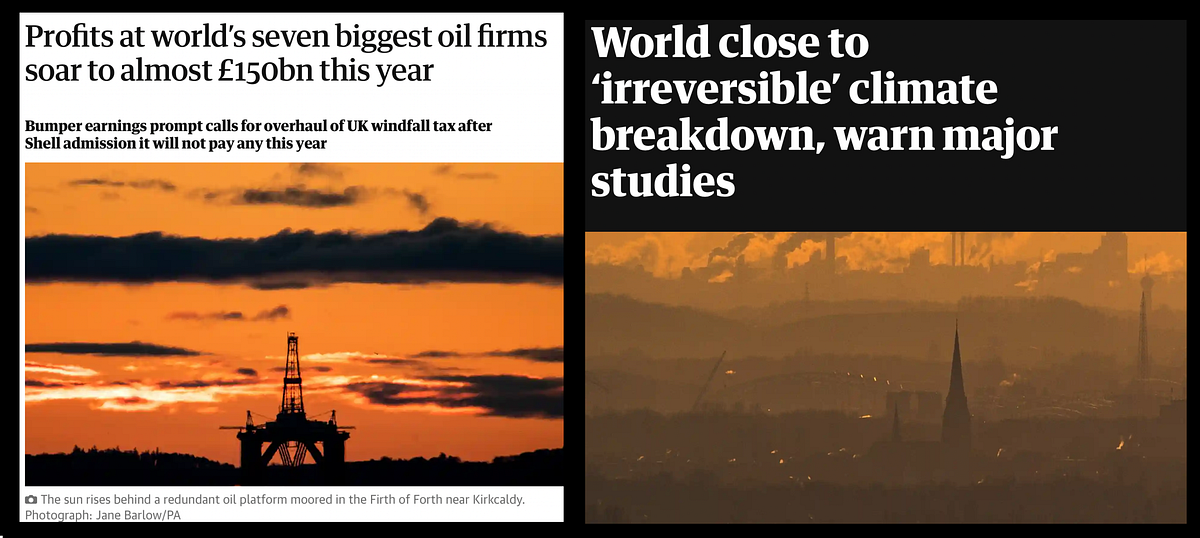
Here’s a quick reality check. Oil companies areon track to make eye-watering windfall profitsthis year, of almost $200 billion.Profits.While the mega-scale impacts of climate change hit nation after nation in genuinely catastrophic ways — and interest rates skyrocket, threatening recession, by way of people being plunged into poverty, unable to afford the debts they’ve accrued because, well, they haven’t been able to make ends meet — like the people formerly known as the American middle and working class, who now have maybe $5K in their bank accounts, while the average mortgage payment’s half that alone — for years now.
Make any sense to you? To anyone, outside of a lobbying firm or a fanatical “think tank”?
Meanwhile, one of the world’s communications platforms just got taken over by a billionaire, who wants to use it as a political plaything, reinstating the former President, and basically letting loose the fascists on the rest of the public square.
Doesn’t sound very good, does it?
The internet used to speak, wryly, about a thing called “late stage capitalism.”Wryly, because we’re all entrapped by it, encircled by it, enmeshed in it — and yet few of us really agree with it, except the kind of simpleton who says, “I’m a capitalist, dude!!” even though he’s…just a prole, living off a wage, not capital income, and never will remotely live off dividends, interests, or stocks in his life, nor will his kids.
But now we’re at a different stage. We’ve crossed a line, a threshold’s been broken.This isn’t “late stage capitalism” anymore — now it’s end stage capitalism.
What’s the difference? Well,a lot. What’s “late stage capitalism,” beyond an internet meme, anyways? It’s a concept basically popularized by left-wing thinkers, meaning,here’s a quotethat roughly does it justice:
The epoch of late capitalism emerging out of the Second World War, which has as its dominant features the multinational corporation, globalized markets and labor, mass consumption, and the space of liquid multinational flows of capital.
It’s more or less synonymous with neoliberalism. And sure, there are plenty of valid criticisms to make of it.
But where we are now is way,waybeyond this. Even this level of malignancy and folly and greed. We’re in a differentphaseof capitalism now entirely. What kind?
Now we’re in a stage of capitalism where the very institutions responsible for destroying life on planet earth and causing a mass extinction — one of only five previous ones in all of deep history, billions of years of it — aremaking record-breaking, eye-watering windfall profits.In other words, we’re now at the stage of capitalism where the most “valuable” activity in the economy is…ecocide.
LOL. How long do you think a civilization with an economylike thatcan survive? When the most profitable activity in the economy is destroying the planet…which of course provides the air, water, food, medicine, every other form of basic imaginable…what kind of a future is left?
That’s not a rhetorical question. It’s one that we need to actually think about, becausesomething is very wrong here.
Here’s another example. We’re now at a stage of capitalism where billionaires are getting so much richer by the year that it’s basically beyond human reckoning. We just kind of shrug now, because our minds go numb atfigures like the following. Jeff Bezos’s fortune grew from $18 billion to $134 billion. Elon Musks, from $2 billion to $221billion.
That much capital accumulation? By a handful of people?In ten years? While the average person gotpoorer?While the planet began to burn, and mega-scale impacts like floods and droughts and famines and fires hit entire countries, regions, continents? While Australia had a “Black Summer,” and Pakistan drowned, and India was forced to stop exporting wheat because its harvest withered in the killing heat? That much…in one decade…while…?
Those are staggering numbers. It’s true that capitalism has always enriched the richest most — why is the most of the world still poor, after all, or why has the American middle and working class fallen into penury? But this, again, is somethingdifferent.Because of course this is wealth that can’t be spent in ten human lifetimes, let alone a single one — but our civilizationisn’t going to last that long at this rate. So the rate of capital accumulation and concentration are now out of control, haywire, crazy town — capital is piling up and concentrating in a tiny number of hands to such a small, extreme degree that our civilization isn’t going to be around for anyoneto even spend it on anything.
That’s not just crazy town, it’scrazy town: it’s a “deadweight loss,” in economics terms, a broken system, which can’t allocate capital where it’s actuallyneeded. Which is where? Well,just yesterdayone of the latest UN reports concluded that we’re on track for something close to 3C of global warming, which means lights out for our civilization, long before the end of century.
We need to invest capital in preventing the end of our civilization. How much?Helpfully,that UN reportgave us an estimate, too. “A global transformation from a heavily fossil fuel- and unsustainable land use-dependent economy to a low-carbon economy is expected to require investments of at least US$4–6 trillion a year.” Sound like a lot? It is a lot, and yet even that estimate’s very, very low: “a relatively small (1.5–2 per cent) share of total financial assets managed, but significant (20–28 per cent) in terms of the additional annual resources to be allocated.” Where does that leave us?
The salient question at this juncture of human history, one that nobody much at least in power wants to ask, goes like this:has capitalism failed?I don’t mean that inthe way that internet trolls will think I do: that I’m taking away their right to start a gun shop or what have you. I mean as aglobal system.
So. The most profitable activity in this system right now isdestroying the planet. This system is now concentrating capital to such an extreme degree in such a tiny number of hands that our civilization will not survive long enough for anyone tospendit.
Can such a system really go on much longer? Can it be said to have “worked?”And no, to lash out with “communism killed a million people”isn’t an answer. Nobody is suggesting Soviet Leninism in response, except maybe Ted Cruz and his ilk in straw men caricatures.
Think about those two facts for a second — because they are facts. They’re examples of what Thomas Piketty — perhaps the other most brilliant economist of the 21st century apart from me (that’s a joke guys) simply calls “r,” following the Person Who Can’t be Named. “R” is the return on capital, and Piketty warned us a decade ago now in his seminal “Capital in the 21st Century” that R wastoo high. The rate of return on capital was too high, meaning that if you have money, you make too much money, leaving too little over for everything else — investing, for example, in democracy, in public goods and institutions, in clean energy, in clean manufacturing, in decarbonization and so forth.
Piketty’s warning appears to have been ultra prescient.It’s a shame that after he gave it, our media essentially blackballed him — when was the last time our publications interviewed him? The reason is that those in power probably understood the implications of saying “R” was too high: then you need things like, as Piketty proposed, wealth taxes, ways to take all that ultra-concentrated capital, in so few hands, and put it in back into useful, productive activities — not just profitable ones in the short terms, but ones which actually sustain and lengthen and reinforce the project of human civilization.
Does that make sense? Or is it too abstract? Let’s do a little math together. Don’t worry — it’s math any schoolkid can handle. Elon Musk amassed $200 billion in a decade. Jeff Bezos, $100 billion. Add another dozen billionaires, and you’realreadyat about $1 trillion. Now let’s add the windfall profits of the oil companies — that’s $200 billion this year alone.These are numbers which begin to matter.The UN’s estimate, remember, was that we need to put maybe $5 trillion of investment into reinventing and rebuilding our basic systems — food, energy, water, medicine, building, etcetera — per year. We’re already getting there — maybe a third of the way or so, just from wealth and windfall taxes alone.
Where would the rest come from? The uncomfortable truth is that we’d probably have to borrow it. From whom, though? Well,from the future. What is it called when we rebuild our basic systems? It’s called civilization surviving this century, possibly. Thepayoff is far, far greater than the expenditure. That’s called investment, and it’s what we’re doing if we put $5 trillion towards reinventing our basic systems and institutions for the things that we are not going to survive without, very shortly, and you can already see ominous intimations of it in the way food and energy prices have skyrocketed, or famines and droughts have broken out.
How much is a functioning civilization worth in 2050? In 2100?Morethan $5 trillion?Of course it is. Global GDP is about $90 trillion, depending on how you count it. The American economyaloneis $20 trillion. Soof coursehaving a functioning civilization is worth more than the $5 trillion it’d cost to create one. That part’s not in doubt. The part which is, if you haven’t gotten my point yet, is this.
Canwe raise $5 trillion to save our civilization? We know, obviously, that it’s worth it. Butcanwe manage it — given this particular system? Right about now, the answer is: nope.Hence, climate change is accelerating in heart-stopping ways, every season, mega-weather getting freakishly, frighteningly worse. Hence, we’ve entered the Age of Extinction, where life is dying off in ways not seen for billions of years. Hence, too, we’re beginning to pay the price, in inflation and billsrising at eye-watering ratesand falling real incomes.
The way that we have to judge the question “is capitalism a failure?” is very simple. Thinking people are going to have to ask this question, even if Americans don’t want it asked, because for a certain kind of America, being a “capitalist”even when they’re nothing of the sortis as integral to their identity just like being a “communist” was to Soviet Russians.
Will it allow us to raise $5 trillion to save our civilization from what’s now becoming increasingly obvious and imminent self-destruction? From an Extinction Event, a thing so grave that it operates on the timescales of millions of years?
That’snot justmewarning of it, by the way, it’s also the Secretary General of the UN and nearly every decent scientist in the world at this point?
The answer to that question is also very simple. This systemwon’tallow us to raise that level of capital. That capitaldoes not existfor these purposes, the activities involved in saving civilization. That’s because it’s concentrated already — in the hands of billionaires, in corporate windfall profits, earned by destroying the planet and civilizationalready.
There is no way to get it from there to here, from point A to point B, because that capital is being “made,” or cycling back into those accounts, anyways, by destroying the very thing we intend to save in the first place. Do you see the contradiction at work?
The system is eating itself.
And it’s eating everything else, along with it, too.The planet. Life on it. Democracy. Equality, truth, justice, freedom. All those things are now in steep, sharp decline, and that’s not my opinion either, it’s a set of easily verifiable empirical facts. All those are being eaten through —so thatcapital is accumulated and concentrated so intensely, so so much capital piles up in so few hands. Even if civilization will no longer be around for that capital to be used for anything at all, in the end, not even the luxury spending of billionaires.
The system is completely broken.It is now profiting the most, basically, from doom, and I don’t use that word often, but this time, I mean it. From polluting the skies and taking over what’s left of public spaces to trade them in for political favors by unleashing fascists and strip mining the soil.The most profitable activities in end stage capitalism are all ultra-intense forms of destruction: of the planet, of life on it, of democracy and its values of equality, truth, freedom, of economies, wholesale, by way of inequality and immobility.
How long can that system go on? It’s a step change, a phase shift, from mere late stage capitalism, which was about freeing capital to circle the world and trade so forth — a resonance which is echoed by the far right, by the way. This stage of capitalism — end stage capitalism — really isthe end.
Let me try to sum it up for you. It means that we can’t invest the relatively paltry $5 trillion — that’sless than 5% of our global GDP— we need to save our civilization from imminent collapse by way of this panoply of horrors we’re beginning to actually experience now, from pandemics to mega-floods to mega-fires to their ruinous effects on economies, like inflation and falling real incomes.
This system — at this stage — won’t allow us to put even a tiny 5% of our global output, which is whatweall maketogether, towards saving civilization.Because even that much is too much, since the only purpose of the system now is to concentrate absurd amounts of wealth into tiny numbers of hands, in the form of windfall profits and billionaire bank accounts, by destroying everything around usin the first place. In Piketty’s language, “R” is too high. In my language, the system is eating itself, and everything else too, including the planet and the future, because it needs everything and more — it won’t even allow 5% to be reinvested to save what it relies and depends on to stopitfrom collapsing, too. After all, when there’s nothing much left, what good exactly, is all the money? What will there be left that it can buy?Not much.
For a system not to able to save itself from collapse — even at marginal levels of investment, like 5% — is perhaps the clearest definition of a failed system there is.This is where we are. So you tell me: has capitalism failed? I know some of you won’t want the question asked. That’s just a form of denial, too.
Remember the dead guy, in the cemetery, up the street from me? He said that capitalism would end in a glorious socialist revolution. It was Karl Marx of course. And while he was wrong about the end, he was less wrong about theproblem. It was Marx who first raised the issue of capital accumulating too much — that’s where Piketty’s “R” comes from, and it’s why our media blackballs him now, too, having figured that much out. For Marx, capital accumulating too much would lead to financial crises — workers not having enough to spend, causing bank failures, and depressions, all of which, eventually, would topple the system.
He was almost right, and thenvery wrong. It happened in the 1920s — the great crash, and then in the 1930s, the Great Depression happened. But the working classes didn’t form a socialist utopia: they started a fascist world war.
What’s happening this time around? The system is eating itself, only worse.It’s not just eating a hole through the average person’s bank accounts — but through the planet, democracy, our economies, the idea of truth, justice, and freedom, making mockeries of them as billionaires treat what’s left of the public good like a plaything to be handed to…fascists. Who are resurging, forprecisely the reasons of the 1930s: widespread immiseration, growth that’s gone to the rich, middle and working classes living precarious, unstable lives. It’s happening all over again, and Marx was right-wrong this time, too.
This time, what capitalism’s eating through is everything. All of it. Right down to life on earth for billions of years.And in its wake isn’t emerging some kind of glorious socialist revolution, but fascism, redux, at the hands of billionaires, a fatal pact formed between those who’ve been the beneficiaries of too much “R”, the ultra rich becoming and backing demagogues, and too little “R”, the former working classes who feel betrayed and abandoned, seeing little improvement in their lot for too long now, and are seduced by hate, scapegoating vulnerable groups, aiming their rage, stupidly,downwards.
It’s not good. How does end stage capitalism, well,end?With fascism on a dying planet. Feel like that’s where we are? Now you know why — at least that’s what the theory would predict. Sound accurate to you? So you tell me: has capitalism failed, and is this The Big One?
UmairOctober 2022


