

Britain is Imploding as a Modern Society. Only Nobody’s Allowed to Admit It.
Oct 25, 2021
Member-only
Save
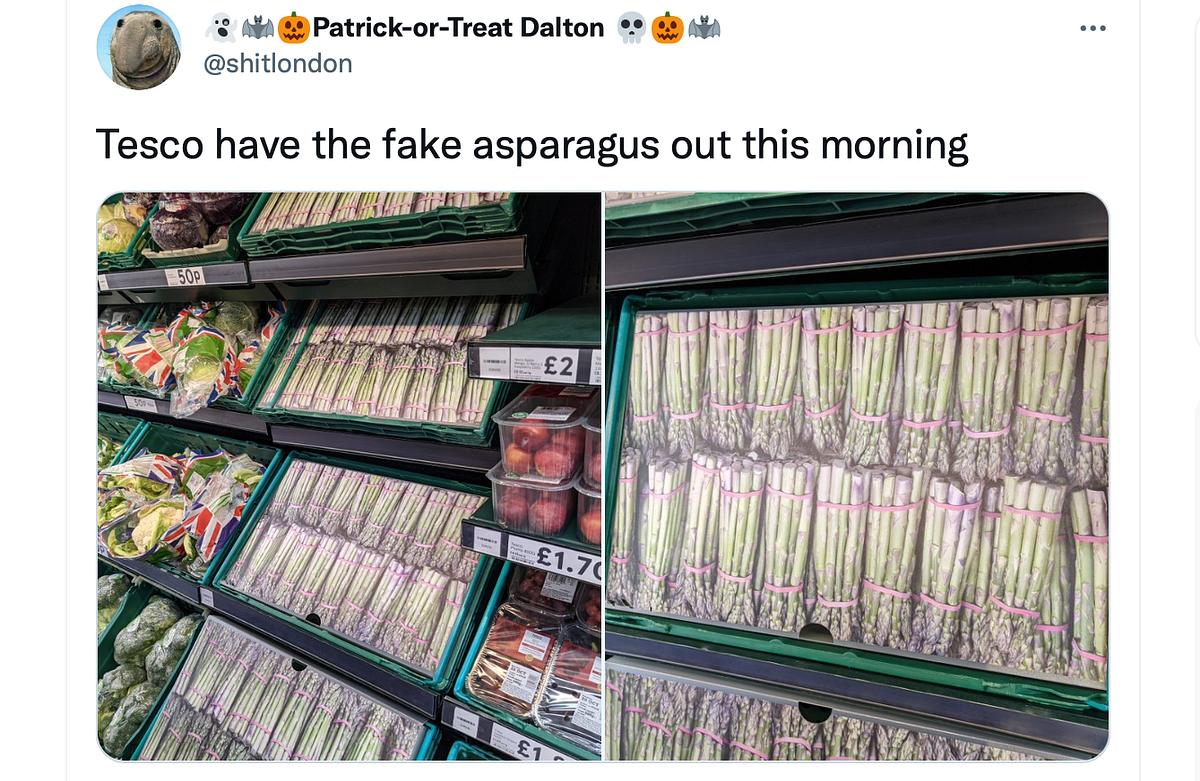
See that pic above? Take a guess about what it is. In fact, it’s so bizarre and ludicrous that I’ll give you three.
Have you heard of Potemkin villages? They were villages the Soviets would construct — fake ones — when Party Chiefs came around. They were all front, artifice, counterfeits. That pic above? It’s cardboard cutouts of…food…instead of real food. Get this:Britain now has Potemkin supermarkets. Brits can’t get food, at least not the way they’re accustomed to, or the way that most other not-failed-states can, and so supermarkets have resorted to puttingcardboard pictures of food on the shelves.
Soviet enough for you?
But maybe you’re a touch baffled. Why on earth can’t Britain get…food? I’m sure you’ve already guessed the answer: Brexit. Let’s keep going with what a breathtaking disaster Brexit has made of Britain.
If you think that pic’s bad, clickthis one. That’s a giant…sea…of raw sewage, aka sh*t. Why is it floating in the waterway? Because recently Britain’sconservative MPs decided to make it perfectly OK to dump raw sewagein rivers and creeks and lakes and the ocean. Why did they do that? Probably because they can’t get the chemicals needed to purify water anymore…becausethey come from (wait for it)Europe.
How…uh…sh*tty is this situation going to get? I don’t think even the Soviet Union dumped raw sewage in rivers and lakes. You have to look tohardcorefailed states for that level of ruin. If you don’t think that’s ruinous, by the way, imagine a giant blob of crap floating down the river inyourcity.
Shall we keep going. Doctors in Britain still can’t run blood tests properly.Why not? Becausethey can’t enough vials— the country’s run short. But what exactly can a doctor do without runningblood tests? Not much. Why did Britain run out of blood vials?Because of Brexit, of course. Which has made importing things somewhere from incredibly difficult to practically impossible.
Let’s stop and take stock. Brits can’t get food. Raw sewage floats down rivers because the chemicals needed to treat water are in short supply. Doctors can’t run blood tests.I’ve chosen those three examples for a reason. Those are three of the most basic goods and services in society: food, water, healthcare.
Let me put that in more formal terms: Brits are living through a catastrophic plunge in living standards. It’s the kind of catastrophic plunge which has little modern parallel. Cardboard cutouts offood? Not being able to treatwater? You’d have to go back to the Weimar Republic to encounter such levels of ruin. In modernity, the only remotely close parallel is the debt crises that Latin American and Asian countries used to suffer — which caused massive shutdowns in basic public services, and led to failed systems for basics, just like Britain’s experiencing now.
In that very real sense, it’s far from hyperbole or exaggeration that Britain is now a failing state.It cannot supply basics to its people, which is the mostbasic and elemental level of failure a state can have. We’re not talking about luxuries, remember — but the most basic necessities. The difference of course is that currency and debt crises were inflicted on Latin American and Asian nations — but Britain’s ruin is entirely self-inflicted.
There are so many Big Lies to unravelalreadyin this story of Britain’s collapse that we’d better take stock to crystallise a few. Big Lie number one: Britain’s doing just fine — levelling up. Truth: Britain’s experiencing a catastrophic plunge in living standards which has almostnomodern parallel. Big Lie number three: Brexit is no big deal. Truth: Britain is becoming a failing state, thanks to Brexit, a place which can’t supply its people basics.
All that’s justified by Big Lie number three: Brexit isn’t the problem — every nation’s experiencing the problems Britain is.
Where else can’t you get basics? Well, if you ask Brits, they’ll probably be surprised, many of them, that you’re even asking. That’s because they’ve been led to believe not being able to get basics, aka living in a failed state, isnormal.
Why and how are Brits being led to believe that living in a failed state is normal? Because they’re told that this is alsohow it is everywhere else.It’s not the fault of Brexit — how could it be, Brexit is about levelling up! — it’s the fault of a global “supply chain crisis.”
That’s Big Lie number three — it’s not Brexit, it’s a “supply chain crisis.” And astonishingly enough, this Big Lie emanates fromallof Britain’s power centres. Politicians won’t evensaythe word Brexit — even theopposition— much less demand accountability for it, much less inform Brits it is squarely what’s responsible for their catastrophic plunge. The BBC teaches Brits that Brexit isn’t to blame for their woes, but somehow, the entire global economy has been plunged into ruin. (The BBC, by the way, has also apparentlyedited out mentions of Brexitfrom the news.)
It’s flat untrue. The truth? Here I am, in a little town in America. It’s not a rich one, and it’s not a poor one. It’s just an average one. Guess what? There are no cardboard cutouts in the supermarkets. There are no shortages of food. The water’s doing just fine, thank you. There are no blobs of sh*t floating down the rivers and creeks weaving through the town. If I want a blood test, I just…go to the doctor. I have to pay extortionate American “health insurance,” true. Yet basic goods are not in shortage. Not even in America. Not in any other rich country. Notevenin most middle income or poor ones.
Brits are taught to think that everyone’s living through cardboard cutouts of food and no blood tests and so forth — that shortages of basics abound. It’s yet another Brexit Big Lie.
It’s true thatthere’s a global supply chain crisis. But it’s not for food and water treatment chemicals and blood test vials. It’s for microchips and timber and heavy metals. It is eminentlynotfor basics.
Why is Britain running short of basics? It has nothing whatsoever to do with a “global supply chain crisis.” That means that the singer I work with is waiting two months for a new microphone, instead of buying it today, it means that the desk I wanted I have to wait a month for now, it means that the gadget I wanted for my music studio is sold out at the moment. That’s got nothing —zero— to do with the shortages hitting Britain.
The shortages hitting Britain haveone cause. They are made of stuff that Britain used to importfrom Europe.Britain is a net importer. It imports everything from food to timber to blood vials to basic chemicals. Most of that camefrom Europe.
There was an eminently simple reason for that: because Europe was a massive trading bloc…right across the English Channel. Who else would you trade with, if not the nearest and most prosperous party?
But now trade with Europe has fallen by absolutely, utterly, catastrophic levels. Entire sectors have beenpractically wiped out— milk and cream and chicken exports fell by 90% or more. Reciprocally, plenty of European businesses simplystoppedtrading with Britain, because the costs are now too high. There’s too much paperwork. Too many tariffs. And even if you can get past those, well, who’s going to distribute your goods to Britain? Truck drivers won’t — it’s not worth their time to sit there in their trucks for a week at a now-backed up border control checkpoint, which didn’t used to exist. Hence, many truck drivers have simplystoppedgoing to Britain, cutting that leg of their journeys outaltogether.
That is why Brits can’t get basics anymore. Because of the hard truths of grade-school economics.Brexit has made it too expensive for Brits to get basics the way they were accustomed to — it caused a massive, massive supply shock for everything from food to chemicals to blood vials to carbon dioxide.And more is on the way.
You see, Brexit isn’t going anywhere. Right about now, there are plenty of European businesses who are just hanging onto their business with Britain by a thread. They are going to decide, over the coming weeks and months, that it simply isn’t worth it. Worse, that it’s flatlyimpossible. It takes distribution networks some time to fail. That is what Britain’s seeing now — truck drivers who can’t and won’t get goods through to Britain, huge backups at ports and border crossings, and so forth. Europe’s economic ties with Britain are going to be severed, and that process is going to roll on like a slow earthquake, for several years. The difficulties are only going to mount. Right now, there are distribution managers in Europe tearing their hair out trying to do their jobs, which is getting goods into the UK. A few months from now, there won’t be, because such a job won’t be economical to evendoanymore.
Brits aren’t being taught this most basic point of all. They’re being a told the Biggest Lie of Brexit — Brexit didn’t affect your quality of life, everyone on the planet is suffering just like you are.Wrong.False. Truth? Brexit did exactly what anyone sane said it was going to. It caused a massive shock to the economy, one so big a rich economyhasn’t seen anything remotely like itin modern times.
That shock caused Brits to get effectively, suddenly, massively poorer, because it raised the effective prices of basics to the point that Britain as a societycan’t afford them anymore.
The prices of basics have risen because thecostsof basics have. What costs are those?Well, we just reviewed them. The red tape of clearing goods into this new hostile, nationalistic Britain. If you can stomach that, then charging customers for tariffs and duties, which you, the European business owner, then have topay backto theBritishgovernment. Then there’s the difficult work of actually getting those goods into Britain, a task that’s getting more onerous by the day, as what was left of pre-Brexit distribution networks simply begins to splinter and fail.
Who can pay all those costs? The answer is: not too many European businesses, so many have simply stopped supplying Britain. They won’t do it — they can’t afford it.
In turn, prices have risen for Brits at a furious pace. So fast and furious that the Bank of England is already threatening to raise interests rates, because inflation has suddenly spiked. Of course, raising rates in this circumstance won’t do anything. Why not?
Because Brexit has raised costs — and therefore prices for Brits — permanently.Forever.All the costs we discussed above? Distribution, paperwork, bureaucracy, red tape, tariffs, duties — whew, that’s already a lot, and that’s an incomplete list. They are thereforevernow. Plenty of those costs willkeeprising. They will not fall, like distribution costs, which are going torise, as it gets more and more difficult to pack a whole truck full of goods meant for Britain.
Because those rises in costs are permanent, so the sudden furious way that prices are rising in Britain is,too.
Let me put that another way. Britain will now have to adjust to what economists call a “consumption basket” and “budget constraint.”A consumption basket is the set of things a society can afford. Britain can’t afford what it used to.Ever. Now hard choices will have to be made. Where will the water treatment chemicals come from? Well, something else will have to cut, and they’ll have to make a trip across an ocean — nobody knows, but the point is they’re going to be a lot more expensive. The same is true for more or less everything in the economy, from blood vials to the carbon dioxide in beer.
Let me make that viscerally clear. Britain can’t eveneat and drinkthe way it used to be able to. That is what food shortages really mean. Everyone sane warned of that, because Britain imported vast quantities of food and drink — right down to water treatment chemicals — from Europe. And now here’s the harsh reality. A society that can’t eat and drink the way it’s accustomed to. Shortage of carbon dioxide mean that pubs are short ofbeer. Then there’s the Potemkin cardboard cutouts on supermarket shelves. All that is here tostay.
Britain’s consumption basket has shrunk, suddenly and catastrophically. It used to be able to, for example, eat and drink like a modern country — the shelves full of basics, and nobody thought twice about not having them.Now it can’t afford that. The same is true across the economy. Britain’s shrunken consumption basket means that now it can’t afford the same levels of goods, from carbon dioxide to food to water treatment chemicals and so on. That means, in practice, higher prices.
Britain’s economy is adjusting to a new, post-Brexit equilibirium, where all the basics of life are going to be a lot more expensive, and that’s when you cangetthem, because now the costs of getting, importing, distributing, marketing, retailing them has suddenly gone stratospheric.This is what it means for a society to suddenly get catastrophically poorer.
That means, in turn, that Britain has a new budget constraint. It has to spend more on the things it once took for granted — the very same ones. Inflation means that Brits have to pay more basics, since they’re now in dramatically shorter supply, thanks to Brexit. But that very same inflation means that Brits now have less left over, as a society, with which to fund public goods, like the NHS and BBC and so forth. Hard choices will have to be made. Bread on tables, or public services? Gas in the tank, or functioning social systems — like, say,clean water? That is the next stage of Britain’s impoverishment — now, cuts will have to be made to its already struggling social institutions and systems, because Brits are paying dramatically more for thevery same basics they enjoyed yesterday.
So. How bad is Brexit, really? Well….
Who lives withshortages of foodandblobs of raw sewagein waterways? In the modern world, only poor countries do.Some would say only failing states do. If you go to, I don’t know, poor parts of Pakistan and India, then you’ll see place with raw sewage befouling waterways and shortages on shelves — precisely becausepeople can’t afford clean water and abundant food there. But there’s a difference. Poor countries didn’tchooseto be poor. They were left poor by centuries of colonisation and enslavement. Britain chose its own impoverishment and ruin.
Worse, it keeps on choosing it. Because Brits are fed a steady diet of Brexit Lies. And that bodes ill for the future, my friends.Because when a nation is reared on lies, it grows not just dull, obedient, and pliant — but wilfully blind, to the destruction of its very own prosperity, democracy, truth, and stability.Britain’s post-Brexit? Sudden shortages, runaway inflation, cardboard cutouts offoodin the supermarkets, raw sewage in the water? The way Brits are told to laugh it all off, as normal — and do? Cheering, making fools of themselves, believing they’ve levelled up — not all the way down intobecoming a third world country?
All that’s not an anomaly. That, my friend, is what the ruin of a nation looks like.
UmairOctober 2021


