

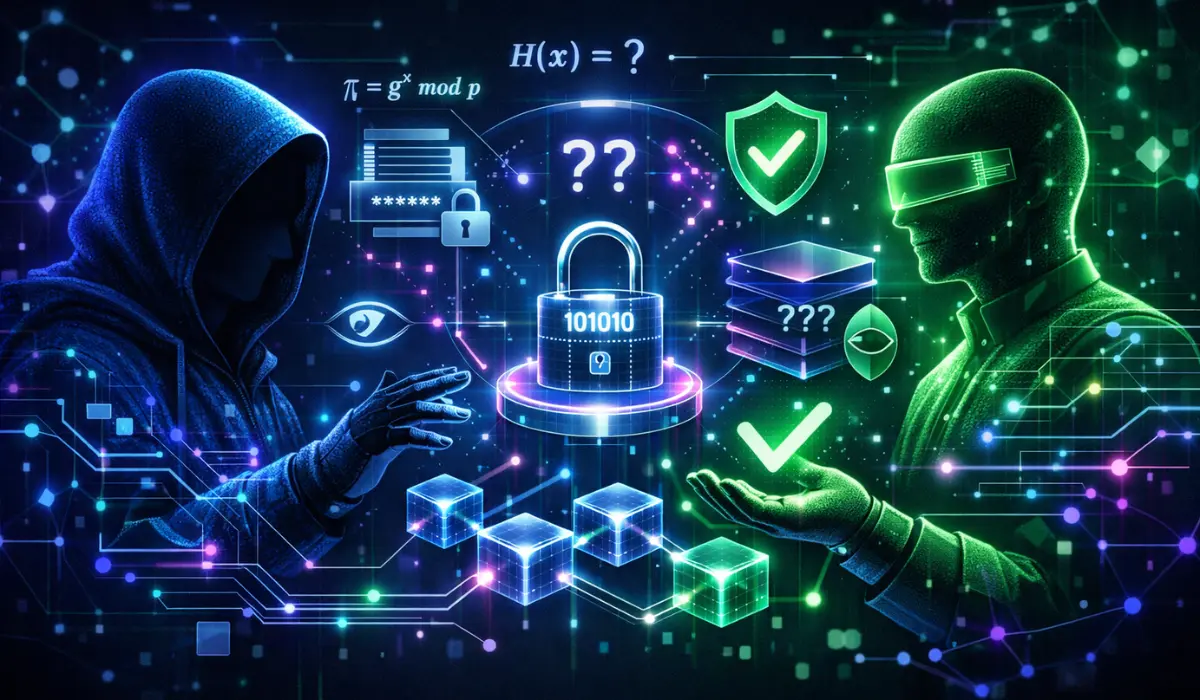
Security is the key factor in the crypto landscape, playing a significant role in ensuring the reliability and integrity of the digital assets. A key cryptographic protocol that underpins the security of the cryptocurrency ecosystem is the Zero-Knowledge Proof (ZKP). This approach supports secure validation of transactions without any data exposure, which significantly encourages a more trustworthy and safer digital environment.
This article will explore what Zero-Knowledge Proof (ZKP) is, how it works, and the Pros and Cons it presents, and its different applications in the crypto landscape. Let’s delve into it.
Zero-Knowledge Proof
Zero-Knowledge Proof (ZKP) is a cryptographic protocol that supports one group, “the prover,” to convince another group, “the verifier,” that a specific statement is true without exposing sensitive data beyond the validity of that statement itself. This cryptographic protocol confirms that the important data, including private transaction details, passwords, and biometric templates, remains confidential while still supporting verification of claims.
The concept of Zero-Knowledge Proof (ZKP) was initially introduced in 1985, and it is widely utilised in distinct applications. This protocol allows the prover to demonstrate the data of fact without revealing the fact itself, which ensures security and privacy in the process of verification. ZKP fills the gap between practical digital privacy and difficult mathematics. In the crypto landscape, ZKP is sometimes known as the “Holy Grail” of blockchain technology. By 2026, this cryptographic method will become the core solution for the 2 highest issues in the crypto landscape, such as scalability and privacy.
How Zero-Knowledge Proof Works
In the cryptocurrency landscape, ZKPs operate as a mathematical trust engine that promotes massive scalability and privacy. The working mechanism of ZKP enables a Prover to create a small digital certificate (validity proof) that ensures the authenticity of thousands of transactions without disclosing significant information within them.
Further, a Verifier, like the ETH blockchain, then examines this proof quickly and enables the network to manage huge traffic at near-zero cost while keeping identities and user balances entirely private. Zero-Knowledge Proof has shifted blockchains from slow, public ledgers to a quick, safe, and private international finance system.
Zero Knowledge utilises ZKPs to compress thousands of transactions into a single proof, which decreases gas charge while conserving cryptographic integrity. Additionally, non-interactive proofs, such as zk-SNARKs and zk-STARKs, are currently very popular. They enable the prover to make a mathematical certificate that can be verified quickly by anyone at any time without requiring a back-and-forth interaction.
Applications: Zero-Knowledge Proof
Zero-Knowledge Proofs have various applications across multiple domains, which boost security, efficiency, and privacy in digital transactions.
- Blockchain and Cryptocurrency
ZKP has an essential role in blockchain technology as it ensures privacy-preserving transactions. This cryptographic technique is utilized to facilitate confidential transactions shown in projects such as Aztec and Zcash, where details of the transaction remain private but documentable. Moreover, Zero-Knowledge Proofs are significant to Decentralized Finance (DeFi), assisting in noticing data protection problems and regulatory concerns that impact institutional adoption. Further networks like Ethereum utilize ZK-Rollups to tie thousands of transactions into a single area, and this helps the network to process more than 10,000 transactions within seconds by keeping fees near zero.
2. Voting System
Zero-Knowledge Proofs enable safe and anonymous voting by helping voters to prove their capability without disclosing their sensitive data. In the voting system, this cryptographic technique ensures integrity and privacy by supporting voters to certify that their vote was counted and cast accurately without exposing the content of the vote. This application is significant in the case of democratic process and decentralized governance.
3. Financial System
ZPKs encourage privacy by supporting transactions to be validated without revealing important data like identities and amounts involved. This cryptographic technique enables regulatory compliance by facilitating companies to prove adherence with AML (Anti-Money Laundering) and KYC (Know Your Customer) needs without disclosing underlying information.
4. Identity Verification
In digital Identity Verification,Zero-Knowledge Proofs help individuals to prove their identity or certain features without exposing personal data. This cryptographic technique also enables secure, password-less authentication systems where users can validate credentials without disclosing them, which increases security against phishing attacks and fraudulent activities.
5. Supply Chain Management
In supply chains, Zero-Knowledge Proofs support proof of origin and legitimacy of products without disclosing essential data. It increases faith among stakeholders while securing the proprietary data.
Pros and Cons
ZKPs support a prover to check the authenticity of a statement to a verifier without exposing the personal information. Let’s analyse some of the merits and demerits of the Zero-Knowledge Proof in the table below.
| Pros | Cons |
|---|---|
| A cryptographic technique guarantees that only valid transactions are recognised, and it evades the necessity for trusted mediators. | Securities exist with difficult mathematical expectations, and their quantum computing provides a forthcoming threat to present ZKP schemes. |
| Decrease attack surfaces by reducing exposure to personal data. | High development costs and difficulties may reduce adoption among startups or smaller units. |
| Enable quick transactions finality while sustaining the integrity of the cryptographic. | Needs specialized hardware for the best proof computation, influencing scalability if inefficient. |
| Creating and verifying proof, mainly zk-SNARKS, that can be resource-sensitive. | Developers and users encounter risk in comprehending the mechanics of Zero-Knowledge Proof, impacting adoption without efficient tooling or education. |
| Provides innovation in supply chain verification, digital finance, secure voting, and identity systems. | The security of the whole network diminished if a small mistake happened in the setup parameter. |
Final Line
Zero-Knowledge Proofs are a transformative technology that is restructuring the way privacy and digital trust are formulated in the cryptocurrency ecosystem. The rapid adoption of blockchain, with ZK solutions, is assisting in scaling the landscape and enhancing user privacy. Moreover, ZKPs effectively balance security and privacy, making this cryptographic technique highly valuable in public blockchains where transaction transparency can compromise the confidentiality of users. By 2026, ZKPs are expected to become the silent protectors of the web, demonstrating that in a digital landscape, it is not essential to watch everything to trust that it is true.
Frequently Asked Questions
Zero-Knowledge Proofs are utilised to examine data without disclosing the actual information, enabling privacy-preserving identity verification and secure transactions in blockchain.
The practical examples of Zero-Knowledge Proof (ZKP) are Ethereum Layer-2 Scaling solutions, Secure Voting and Governance, Privacy-Preserving Transactions, Digital Identity and authentication, and Zero-Knowledge Machine Learning (zKML).
Yes, Zero-Knowledge Proofs (ZKPs) are real and also mathematically rigorous constructs with rising practical adoption.
In the crypto landscape, ZKPs support blockchain technology by allowing it to show results without disclosing the data. This advancement creates a new paradigm for efficient, private, safe cryptocurrency networks.


