

A bonding curve is a smart contract-based, mathematical model that defines a token’s price based on its supply. It plays a key role in DeFi, automating pricing and liquidity mechanisms for tokens. As demand increases and more tokens are bought, the price rises along a predefined curve; selling burns tokens and lowers the price. It ensures automatic liquidity and price discovery for decentralized projects.This article discusses how the bonding curve works in crypto, its types, advantages, risks, and challenges. So, keep reading to learn more.
How Bonding Curves Work
The bonding curve is represented by a mathematical equation, and this equation is what determines how the token’s price changes as its supply fluctuates. As tokens are purchased and minted, the circulating supply increases, driving the price up the curve. Conversely, selling tokens burns them, reducing the supply and lowering the price. This mechanism ensures a predictable and automated response during changes in supply and demand.
Bonding curves utilize various shapes, such as linear, logarithmic, and exponential, each of which shapes the token’s economy differently. If a project issues a new cryptocurrency using a bonding curve, the price of the first token is relatively low because the circulating supply is at its minimum. This ensures liquidity because tokens can always be bought or sold at a price determined by the curve, without needing a buyer or seller on the other end.
Types Of Bonding Curves in DeFi
Linear Bonding Curves
Linear bonding curves are the simplest mathematical model, and in this model, the price of a token increases in direct proportion to the number of tokens that are sold. This adds to the total supply of tokens in circulation. Once every token is sold or minted, the price increases by a predetermined, fixed amount.
Exponential Bonding Curves
In an exponential bonding curve, the price of a token at any given time depends mainly on the supply in circulation. In case the tokens are purchased at a double rate, the prices would be more than double, which means they can become much more expensive quickly. Exponential curves reward early buyers the most, who often sell their tokens when demand increases. So, those who wish to encourage early participation can employ this curve.
Logarithmic Bonding Curves
Logarithmic bonding curves cause price tokens to rise quickly, just as more tokens are minted. When the supply continues to expand, the prices begin to slow down, and it benefits early traders the most, as the initial spike gradually levels off. A logarithmic curve provides liquidity to a project through the first buyers who are looking forward to making a quick, early profit.
Bonding Curves vs Automated Market Makers (AMMs)
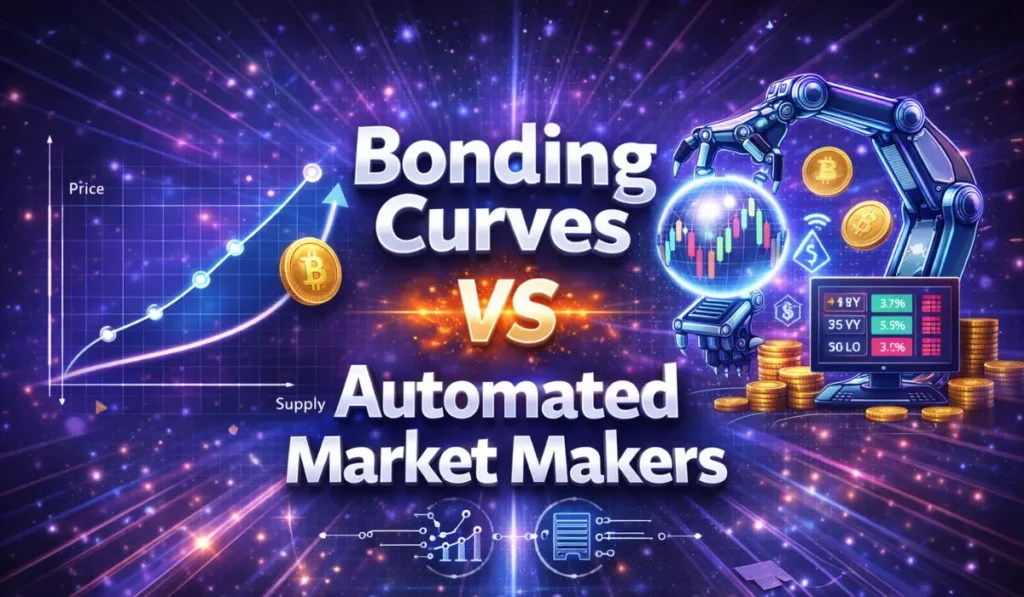
Bonding curves are said to be the backbone of many Automated Market Makers (AMMs) in DeFi. Many platforms use the constant product formula, more like a type of bonding curve, to maintain liquidity in trading pairs. This allows decentralized trading without traditional order books, thus reducing friction in token exchanges. Bonding curves are a specialized type of AMM that sets token prices based on a deterministic formula tied directly to the token’s supply. While traditional AMMs use liquidity pools of two tokens to manage trading, bonding curves often facilitate direct minting/burning of a token against a reserve. This provides automated, continuous liquidity.
Advantages Of Bonding Curves In DeFi
Bonding curves in DeFi provide automated, transparent, and continuous liquidity, allowing tokens to be minted or burned through smart contracts based on a set price-supply formula. Its key benefits include providing instant liquidity without needing traditional market makers, fair token distribution to reduce manipulation, and instant fundraising. In addition, bonding curves help establish a more stable market environment by setting a clear, predictable relationship between price and supply.
Why Bonding Curves Matter For Token Launches
Bonding curves are vital for token launches as they provide immediate, automated liquidity and algorithmic price discovery without having to rely on centralized market makers. They focus on creating a direct, math-based relationship between token supply and price, ensuring fair, transparent, and continuous trading while incentivizing early adoption. Bonding curves are considered essential for modern, decentralized launches, providing a structured, sustainable, and fair approach to tokenomics.
Final Thoughts
As DeFi matures, bonding curves are poised to undergo significant transformations. The bonding curve plays a key role in the cryptocurrency market. Many cryptocurrencies are of limited quantity, and this scarcity is what provides cryptocurrencies with their value. Rather than ensuring price stability, bonding curves provide a transparent and predictable framework for how price reacts to supply changes.
FAQs
Bonding curves are generally considered very good for crypto, as they act as a powerful, automated, and transparent mechanism for decentralized liquidity, price discovery, and token launches.
Yes, you can sell tokens back to a bonding curve at any time. When you sell, the token supply decreases and the price drops, ensuring continuous liquidity without needing an exchange.
On pump.fun, a bonding curve is an automated, mathematical formula that dictates a memecoin’s price based on its supply.


