


ROE (Return on Equity) is the measurement of a company’s financial performance. It is said to be the gauge of a corporation’s profitability and its efficiency in generating those profits. A higher ROE means the company’s management is capable of generating income and growth from its equity financing.
It serves as a key financial metric that reveals how many dollars of profit are created for every dollar of shareholder investment. This article further discusses why ROE matters, how it works, and how to calculate it. So, keep reading to learn more.
ROE Formula And How To Calculate It
ROE is expressed as a percentage, and it is advisable to calculate it based on average equity over a period due to the mismatch between the income statement and the balance sheet. To calculate return on equity (ROE), compare the proportion of net income to shareholder equity. The equation is as follows:
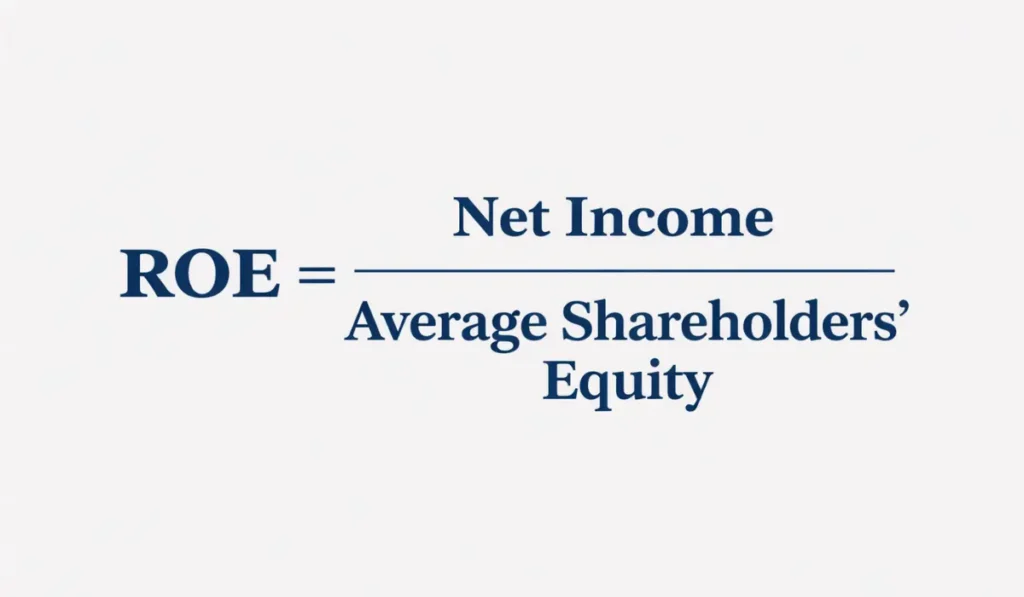
Net income is calculated by taking the difference between the net revenue and all expenses, including taxes and interest. It is considered the most conservative measurement to analyze, as it deducts more expenses than profitability measurements, like operating income or gross income. To calculate the average shareholders’ equity, add equity at the beginning of the period.
Note that the beginning and end of the period should coincide with the period during which the net income is earned. You can find the net income of the last full fiscal year on the income statement. It is the sum of financial activity over a year.
A shareholder’s equity comes from the balance sheet, which is a running balance of a company’s entire history of changes in assets and liabilities. An analyst should always take an average equity balance since net income is earned over a period of time, and shareholders’ equity is a balance sheet account that often reports on a single specific period. This is mostly done by taking the average of the beginning and ending equity balances.
What Is A Good Return On Equity?
A good ROE generally falls between 15% and 20%, indicating how a company efficiently generates profit from shareholders’ funds. Anything over 20% is considered exceptional. A healthy ROE depends heavily on industry norms, as capital-intensive sectors may have lower, more stable figures compared to high-growth sectors. It is crucial to remember that consistency over 5-7 years is more important than a single high-value year. While this is the case of a good ROE, a negative ROE may indicate the company is losing money.
High ROE And Low ROE: What’s The Difference?
High ROE signifies that a company efficiently generates high profits relative to shareholder equity, suggesting strong, sustainable management. On the other hand, low ROE indicates inefficient capital use, poor profitability, or potential business struggles.
Even though high ROE is generally desirable, it can be inflated by excessive debt (low equity), necessitating comparisons within the same industry. High ROE, which is 15% to 20%, indicates strong, consistent management that creates value.
Low ROE means a company cannot effectively convert investments into profit. A high and consistent ROE reflects competitive advantage and good capital allocation. A low ROE can act as a red flag, indicating poor management or underperformance.
How To Improve Return On Equity
Improving ROE involves boosting net income, increasing asset turnover, or optimizing financial leverage (debt). Key strategies include raising profit margins through price increases or cost reductions, thereby enhancing operational efficiency to improve asset turnover. You can also use debt for share buybacks to reduce the equity base, though it increases financial risk. While there are many ways to improve ROE, there are certain key considerations one should be aware of.
High debt increases financial risk and interest payments. This can decrease net income if not managed carefully. Improving ROE through operational efficiency (profits or turnover) is generally more sustainable than solely relying on financial leverage. Lastly, ROE can be analyzed using the DuPont analysis, which breaks it down into net profit margin, asset turnover, and financial leverage.
When ROE Can Be Misleading
ROE can be misleading when high debt levels, massive share buybacks, or non-recurring, one-time profits artificially inflate the figure without reflecting true, sustainable operational efficiency. A high ROE often masks underlying financial risk or engineering rather than superior business performance. To avoid being misled, investors should compare ROE against competitors, check debt levels, and look at Return on Invested Capital (ROIC) to measure true value creation.
Final Thoughts
ROE is a key financial metric used to measure a corporation’s profitability by revealing how much net income is generated for every dollar of shareholders’ equity. ROE matters because investors use it to compare a company’s profitability against competitors in the same industry. In addition, it can be used to estimate a stock’s growth rate and dividends.
A high ROE signals superior management efficiency, and a low ROE means a company cannot effectively convert investments into profit. A higher, stable ROE is generally preferred as it indicates efficient growth management.
FAQs
- Is a high or low ROE better?
Generally, a high ROE is better, indicating a company efficiently uses shareholder funds for profit (15-20% often strong).
- Which ROE is good to buy stock?
A Return on Equity (ROE) of 15% to 20% or higher is generally considered good, but a consistent, high ROE over several years is often better than a one-time high figure.
- What are some common ROE mistakes?
Indeed, ROE is a powerful financial metric, but relying on it blindly can lead to poor investment decisions because a high ROE does not always indicate a healthy company.


