

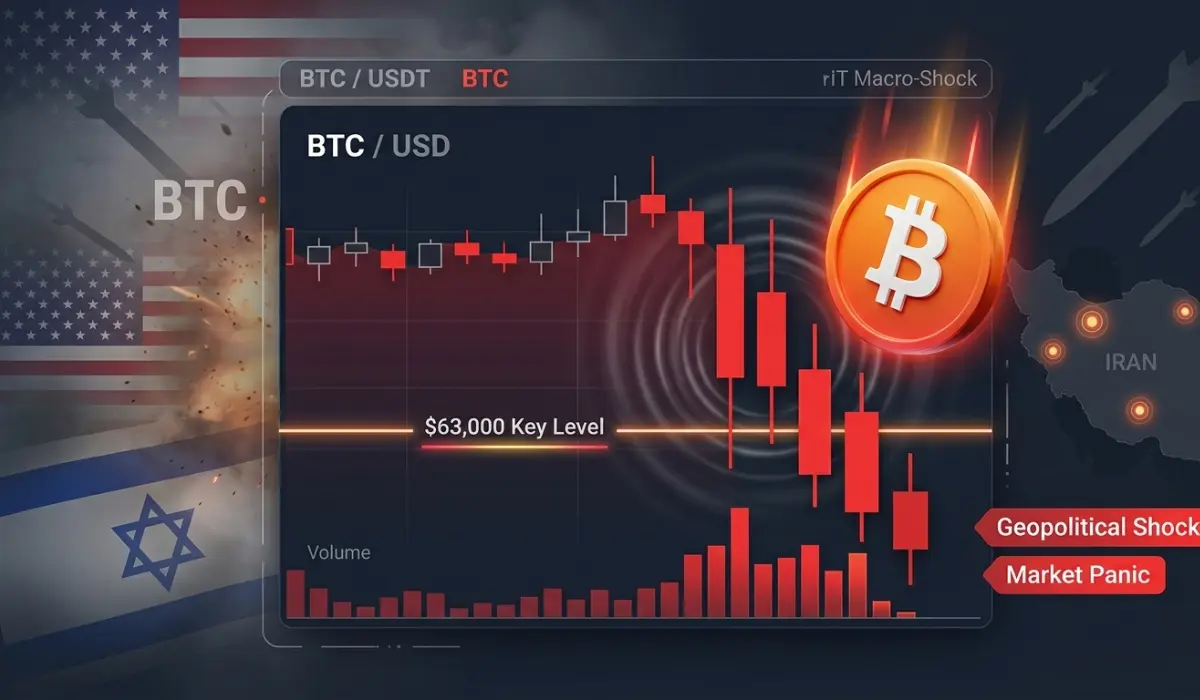
Global financial markets were thrust into a state of high volatility on Saturday, February 28, as a coordinated military operation by the United States and Israel against Iran triggered a massive “risk-off” liquidation across both traditional and digital asset classes.
As a result, Bitcoin (BTC) failed to sustain its upward momentum, sliding sharply from the $67,000 range to a low of approximately $63,000, a 3% decline, within hours of the first reports of explosions in Tehran. This brings the alpha cryptocurrency to its lowest level since the February 5 crash, when it briefly dipped below $60,000.
US and Israel Strike Iran; Trump Urges Iranians to Seize Government
The military escalation, which officials have characterized as a pre-emptive strike, began in the early hours of Saturday morning. The Israel Defense Forces (IDF) confirmed the commencement of “Operation Shield of Judah,” a large-scale aerial campaign targeting strategic military infrastructure and nuclear-related sites across several Iranian provinces, including Isfahan, Qom, and Karaj. Israeli Defense Minister Israel Katz stated that the operation was necessary to neutralize “imminent and existential threats” to the state of Israel.
Simultaneously, in a video address from the White House, U.S. President Donald Trump confirmed that the United States had initiated “major combat operations” alongside its ally, Israel. The President emphasized that the objective of the mission was to permanently dismantle the Iranian regime’s nuclear capabilities and retaliate for recent regional provocations. He finished the statement by calling on the Iranian people to take control of the incumbent government.
“When we are finished, take over your government; it will be yours to take,” Trump said. “This will be, probably, your only chance for generations. For many years, you have asked for America’s help, but you never got it.”
Reports of strikes near the offices of Supreme Leader Ayatollah Ali Khamenei in Tehran further heightened fears of a total regional war, prompting Iran and Iraq to immediately close their respective airspaces.
Extreme Fear Grips Crypto as Bitcoin Falls After US‑Israel Iran Strike
With U.S. stock market futures yet to open, the reaction in the crypto market was swift and severe. Data from Coinglass showed over $100 million in liquidations across major exchanges, including Coinbase and Binance, within 15 minutes of the attack.
Bitcoin’s decline was largely driven by the fact that it was one of the only large, liquid assets available for traders to sell since it trades 24 hours a day, 7 days a week, while equity and bond markets are closed on weekends. The result is that BTC often acts as a pressure valve for broader risk-off sentiment whenever geopolitical risk spikes outside of traditional market hours, absorbing selling that would otherwise spread across equities, commodities, and currencies if those markets were open.
The apex crypto’s decline to the $63,000 range represents a roughly 6% drop, a move that analysts suggest reflects a clear preference for immediate liquidity over speculative assets during times of kinetic warfare. The ‘Crypto Fear & Greed Index’ plummeted to an “Extreme Fear” reading of 11.
With core support levels still holding on for the BTC/USD pair, the fresh escalation comes at a key time for traders as the final hours tick down to the February monthly close. The pair is now due to seal its fifth consecutive month of losses – a phenomenon that has not occurred in seven years.
While digital assets struggled, traditional safe-haven assets saw an inverse reaction. Spot gold and silver prices surged as investors moved capital into physical commodities. Financial analysts expect a significant “gap-up” in precious metals and energy markets when traditional stock exchanges open on Monday morning.
At the time of writing, Bitcoin (BTC) is trading at $63,540 – down 6.61% in 24 hours.


