

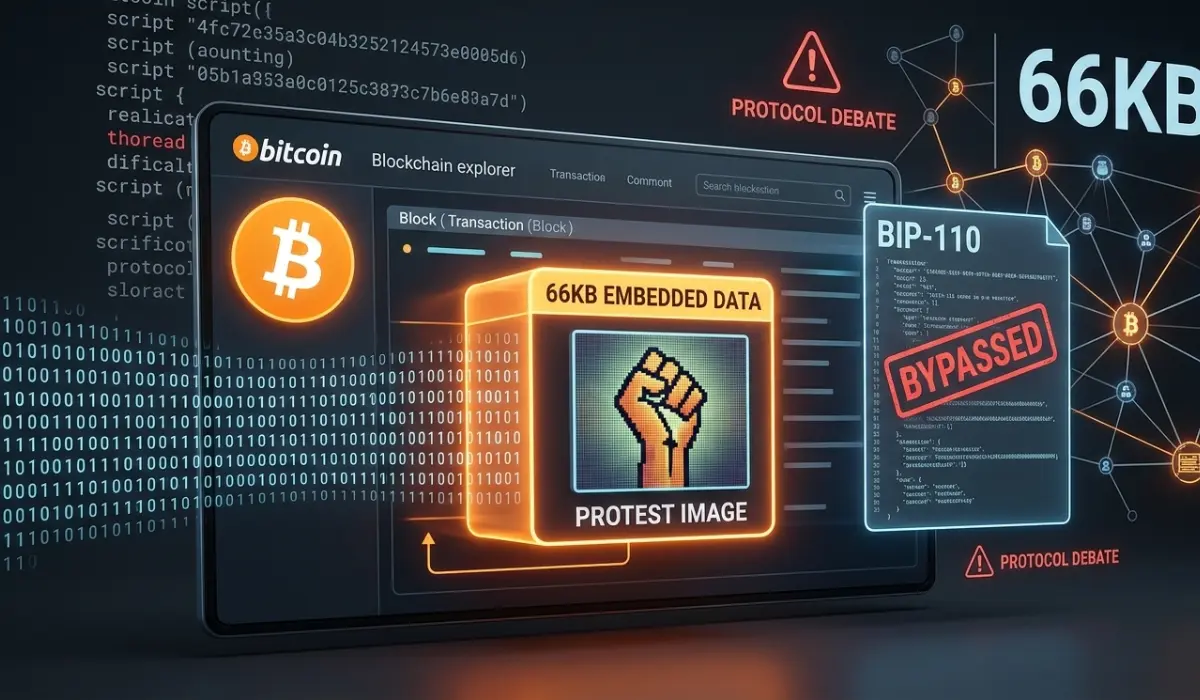
In a move that has reignited the long-standing civil war over the purpose of the Bitcoin blockchain, a prominent Slovak developer has successfully embedded a 64-kilobyte image directly into a single transaction.
The experiment, conducted by Martin Habovštiak — a respected maintainer of the RustBitcoin library — was not a pursuit of digital art, but a targeted technical protest against proposed censorship measures currently being debated within the Bitcoin Core community.
Slovak Dev Skips OP_RETURN/OP_IF to Embed Bitcoin Image
The transaction, confirmed on Friday, utilized a sophisticated technical magic trick to bypass nearly every known filter designed to prevent non-financial data from being stored on-chain. While the Ordinals protocol previously popularized “inscriptions” using Taproot “envelopes,” Habovštiak’s method was notably different.
He avoided the standard OP_RETURN opcode, which is typically limited to 80 bytes, and steered clear of the OP_IF logic gates that many node operators use to identify and block large data pushes. Instead, he utilized the older SegWit v0 witness space, effectively hiding the image data as a standard, valid transaction to most network nodes.
The primary target of this stunt was Bitcoin Improvement Proposal (BIP) 110, a controversial soft-fork proposal spearheaded by Bitcoin developer Luke Dashjr. Formerly known as BIP-444, it seeks to restrict arbitrary data from the blockchain, which proponents argue constitutes “spam” that increases the cost of running a node and creates potential legal liabilities for miners. Meanwhile, the 64KB TIFF file embedded by Habovštiak was a picture of Dashjr crying, intended to symbolize the developer’s frustration with what he perceives as a move toward technical censorship.
Habovštiak’s experiment aimed to prove a fundamental philosophical point: that Bitcoin is a permissionless ledger where “code is law,” and that technical restrictions are ultimately futile against a determined developer.
By successfully placing the image on-chain without using the tools BIP-110 aims to block, Habovštiak demonstrated that even if the soft fork were active, developers would likely find workarounds. He further claimed that a “BIP-110 compliant” version of the same data would actually require significantly more on-chain space, potentially exacerbating the very “bloat” the proposal seeks to eliminate.
Habovštiak Refuses to Share Image-Embedding Code, Rebukes “Spam”
The reaction within the Bitcoin community has been sharply divided. Supporters of the “small block” philosophy and the Bitcoin Knots client, led by Dashjr, dismissed the experiment as a sophisticated form of vandalism. They argue that such stunts justify the need for even stricter network filters to preserve Bitcoin’s primary function as a peer-to-peer electronic cash system. Conversely, advocates for an open protocol cheered the move, viewing it as a vital stress test to prove Bitcoin’s resilience against centralized gatekeeping.
Despite the success of the embed, Habovštiak has stated he has no intention of releasing the specific code used to create the transaction. He has described himself as an opponent of blockchain spam in principle but noted that his commitment to “technical truth” outweighed his distaste for on-chain images.
“There’s something I hate much more than spam: Untruths. I tried arguing about this in the past, showed a contiguous image encoded to fit into the witness, and yet, the Knots supporters are still saying the same stuff over and over,” he wrote in an X post.
As the debate over BIP-110 continues, this 64 KB image stands as a permanent fixture on the Bitcoin ledger — a digital monument to the ongoing tension between those who wish to keep Bitcoin “purely financial” and those who believe its permissionless nature is its most sacred attribute.
At the time of writing, Bitcoin (BTC) is trading at $66,473 – down 0.36% in 24 hours.


