

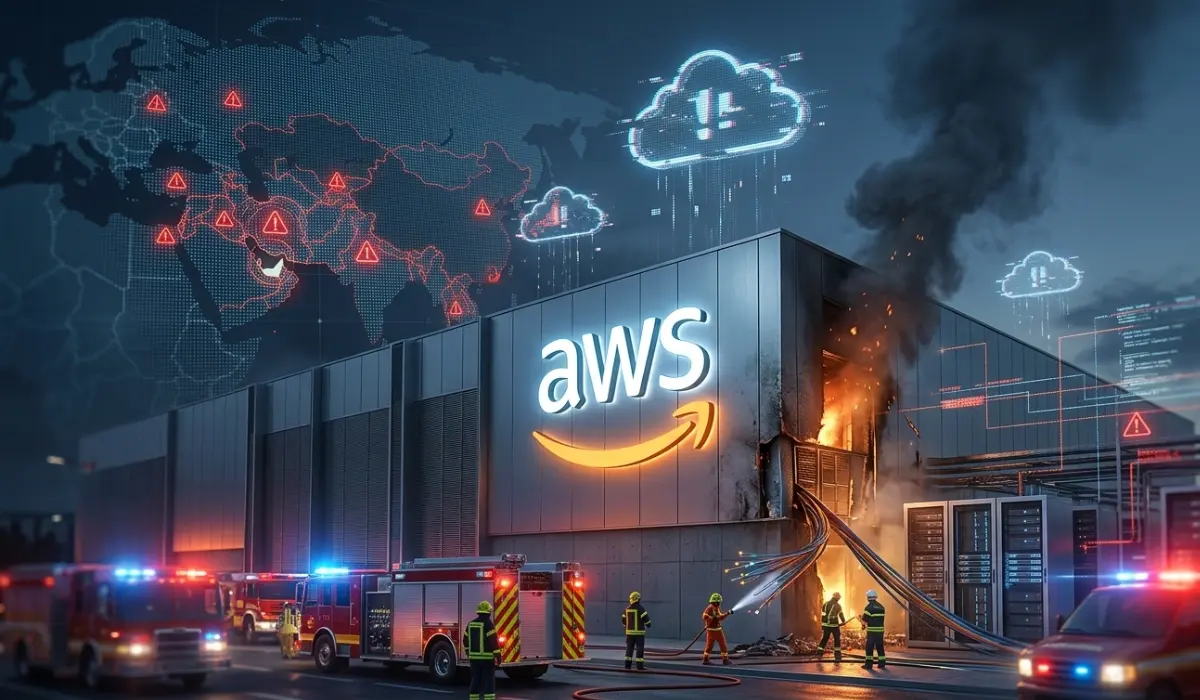
Amazon Web Services (AWS) is currently battling a significant infrastructure emergency in the Middle East following a rare physical disruption to its cloud hardware.
On Sunday, unidentified objects struck an AWS data center in the United Arab Emirates (UAE), triggering a power failure and a subsequent fire that has sent ripples through the regional digital economy.
Iran Missile Strikes Hit UAE Amazon Data Centers, Disrupting Cloud
According to AWS, the incident occurred at approximately 4:30 AM PST on March 1, within the ME-CENTRAL-1 region, with one of its Availability Zones – mec1-az2 – being impacted by objects that struck the data center. Internal status reports and local authorities stated that the impact caused immediate electrical sparking, igniting a structural fire.
In a desperate bid to contain the blaze and ensure the safety of first responders, the local fire department ordered a total shutdown of the facility’s utility power and its redundant backup generators.
This forced blackout resulted in a total dark scenario for the affected zone, leading to massive error rates and latencies for core AWS services, including Amazon EC2 (Elastic Compute Cloud), S3 (Simple Storage Service), DynamoDB, and RDS (Relational Database Service). By Monday morning, the crisis deepened as AWS confirmed that a secondary power issue had begun affecting a separate zone,mec1-az3, further complicating recovery efforts for thousands of enterprise customers who rely on the UAE region for low-latency connectivity.
Amazon Reports Bahrain Power Issues; Cloud Disruptions Spread
The disruption was not contained solely within the UAE. Reports surfaced that the ME-SOUTH-1 region in Bahrain also experienced intermittent connectivity issues and power fluctuations. While AWS has not explicitly linked the issues in Bahrain to the physical strike in the UAE, the timing suggests a broader regional infrastructure strain.
The “objects” mentioned in official AWS status updates have not been formally identified by the company, but the geopolitical context is impossible to ignore.
The strike coincided with a massive regional escalation; over the same weekend, the UAE Ministry of Defence reported the interception of hundreds of drones and missiles following a series of military exchanges between the U.S., Israel, and Iran. If confirmed as a deliberate military or insurgent strike, this would mark the first time a commercial “hyperscale” data center has been physically targeted in a modern conflict — a move that security analysts at the Council on Foreign Relations (CFR) warn could redefine the risks of global cloud dependency.
For the thousands of businesses impacted, the long tail of recovery has begun. AWS technicians are working alongside local utility providers to stabilize the power grid before the complex process of rebooting tens of thousands of physical servers can begin.
The company has emphasized that customers who followed best practices by deploying applications across multiple, geographically separated Availability Zones remained largely operational, though those localized to the affected UAE zones face prolonged downtime.
As of Monday afternoon, AWS has not provided a definitive Estimated Time of Recovery (ETR) for the mec1-az2 zone, citing the need for extensive safety inspections of the electrical switchgear following the fire. Customers are being urged to connect to alternate global regions, such as Europe or North America, to maintain service continuity. For now, the resilience test posed by this unprecedented event continues to challenge the stability of the Middle East’s digital backbone.


