

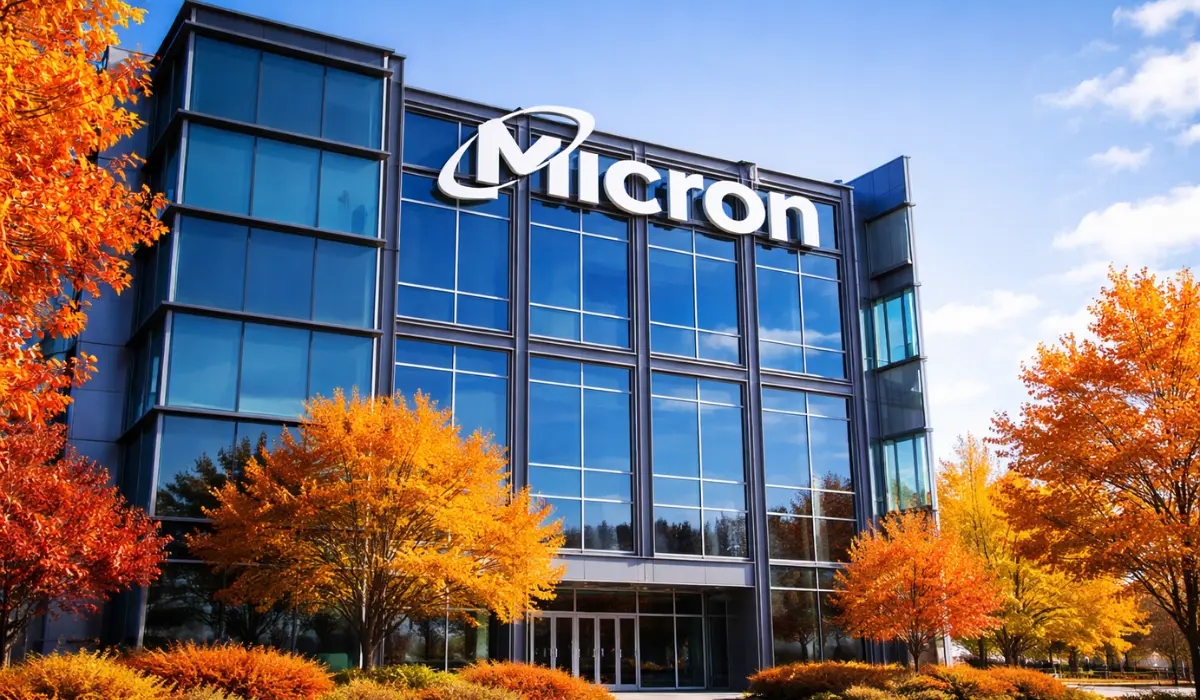
As the closing bell approaches on Wall Street today, all eyes are fixed on Micron Technology (MU). The memory chip titan is set to report its fiscal second-quarter 2026 earnings in a high-stakes moment that will either validate its meteoric 62% year-to-date surge or signal that the AI-driven ‘memory supercycle’ has pushed valuations too far, too fast.
Bullish Analyst Ratings Meet Stretched Valuations
Micron enters today’s session as one of the top performers in the Semiconductor Sector, riding a wave of optimism that has seen its stock price more than triple over the past year. Just last week, Wedbush Securities underscored this bullish sentiment by aggressively raising its price target for Micron to $500, citing unprecedented pricing power in the DRAM and NAND Flash markets.
However, the rally has hit a wall of scepticism regarding its valuation. With the stock trading at a forward Price-to-Earnings (P/E) ratio that has expanded significantly alongside its price, some institutional investors are questioning whether the AI premium is fully baked in. Critics argue that any result short of a beat and raise could trigger a sharp correction, testing the resolve of the recent wave of buyers.
The HBM4 Factor and the NVIDIA Partnership
The primary catalyst for Micron’s dominance is its leadership in High Bandwidth Memory (HBM). On March 16, just 48 hours before this earnings report, Micron confirmed it has begun volume shipments of its 12-high, 36GB HBM4 chips. These components are specifically designed for NVIDIA’s next-generation Vera Rubin AI platform.
CEO Sanjay Mehrotra previously noted that Micron’s entire HBM supply for 2026 is already sold out under multi-year contracts, providing a level of revenue visibility rarely seen in the historically volatile memory industry. This structural shift from quarterly negotiations to long-term agreements has fundamentally altered the economic concept of the memory cycle, leading many to believe that the boom-and-bust days are over.
Earnings Test: What to Watch for in the Results
As Micron Technology approaches its pivotal earnings release, Wall Street consensus is bracing for monster numbers that could redefine the company’s financial trajectory. Analysts are currently expecting Earnings Per Share (EPS) to land near $8.69 on revenues of approximately $19.15 billion, representing a staggering 137% increase in the top line compared to the same quarter last year. This anticipated surge is primarily driven by the insatiable demand for AI-specific memory, which has shifted Micron from a cyclical commodity player to a high-margin structural growth engine within the semiconductor sector.
Beyond the headline figures, several key metrics will determine if the stock can sustain its current valuation. Investors are laser-focused on Gross Margin Expansion, with management previously guiding for a non-GAAP gross margin of 68%, a figure that would represent peak historical profitability for the company. Closely tied to this is DRAM Pricing Power; with DRAM prices projected to have risen as much as 62% in the first quarter of 2026 alone, the market is looking for confirmation that these price hikes are sticking and that the ‘memory supercycle’ remains in full swing.
Finally, the report will be scrutinised for signs of double-ordering in Inventory Levels. While the current sold-out status of HBM supply through 2026 is a major bullish signal, a primary concern for bears remains whether customers are over-ordering to secure the limited supply, which could eventually lead to an industry-wide glut. If Micron can prove that current demand is organic and sustainable, it will likely pass this earnings test and solidify its position as the premier memory provider for the AI era.
Outlook: A Bellwether for the Tech Economy
As a critical supplier to data centers, automotive, and industrial IoT, Micron is viewed as a global economic bellwether. If Micron can prove that its valuation is supported by sustainable, high-margin AI demand, it could ignite the next leg of the rally for the broader SOXX (Semiconductor ETF). If not, the earnings test may prove to be the ceiling for a stock that has defined the 2026 tech bull market.


