

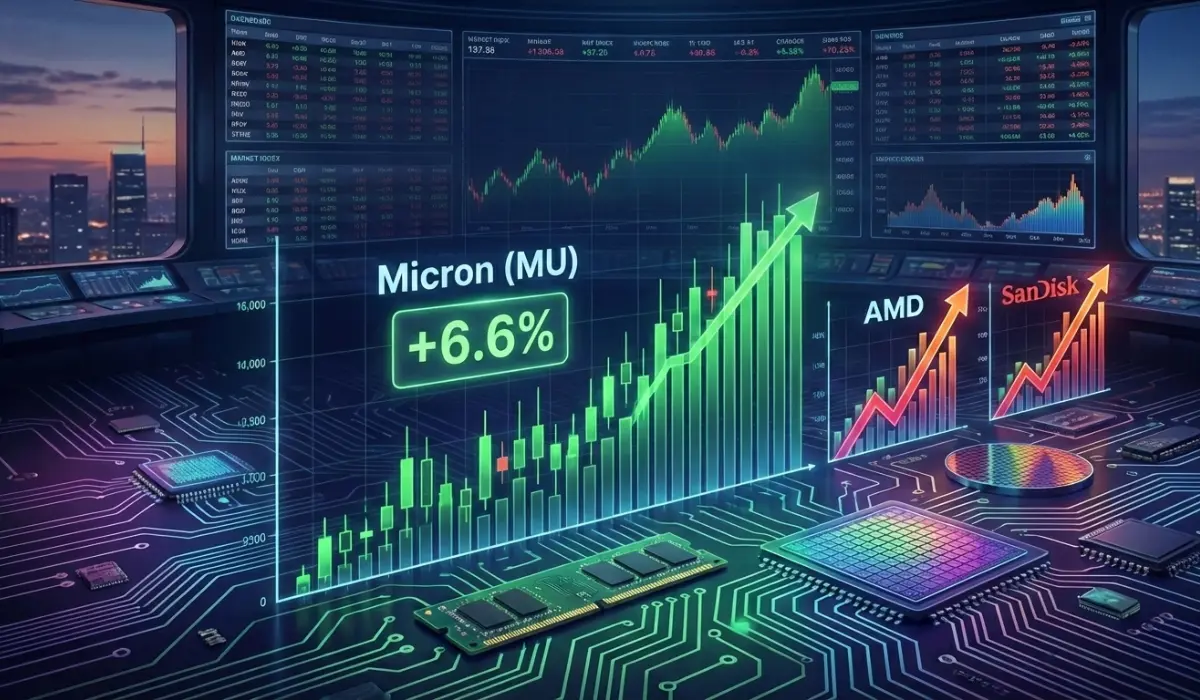
Micron Technology Inc. (MU) shares rose on Wednesday but still underperformed key semiconductor peers, as investors rotated toward companies showing stronger momentum and clearer near-term catalysts. Despite a solid daily gain of 6.6%, Micron lagged behind more aggressive moves from Advanced Micro Devices (AMD) and Sandisk (SNDK). Micron Technology, Inc. (MU) closed at $389.11, rising $24.11, or 6.61%. Meanwhile, Advanced Micro Devices, Inc. (AMD) closed at $249.80, gaining $17.88, or 7.71%, at 4:00:02 p.m. EST, while Sandisk Corporation (SNDK) closed at $501.29, 10.63% up.
The relative underperformance comes as Micron trades near a critical technical and psychological level. The stock is hovering just below $400, a zone many analysts describe as a “stalled breakout,” where buying enthusiasm has met increased profit-taking and resistance.
Daily Gains Mask Relative Weakness
On the surface, Micron’s Wednesday performance appeared constructive, with shares closing at $389.11. However, compared with AMD and Sandisk, Micron’s gains were more muted. Sandisk, in particular, has emerged as a momentum leader in recent sessions, benefiting from an SSD shortage narrative that has driven faster daily percentage gains than MU.
From a valuation perspective, Micron trades at a forward price-to-earnings ratio of about 34.7x, slightly above AMD’s 33.1x and well above Sandisk’s 28.4x. For some investors, that premium has become harder to justify amid concerns that Micron’s next leg higher depends on flawless execution in an increasingly capital-intensive cycle.
HBM Strength Meets a “Memory Wall”
Fundamentally, Micron remains at the center of the AI infrastructure buildout, largely due to its leadership in High Bandwidth Memory (HBM). HBM is widely viewed as a critical bottleneck or “memory wall” for AI accelerators, and Micron’s progress in sampling next-generation HBM4 and HBM4E has been closely watched across the industry.
Analysts note that the transition to HBM4 and HBM4E tightens supply further, as these products require significant trade-offs versus conventional DRAM capacity. Barclays and Stifel have both upgraded Micron price targets, citing strong pricing power and limited near-term competition as SK Hynix and others ramp capacity. On January 15, 2026, Barclays analyst Tom O’Malley increased Micron Technology’s (MU) price target to $450 from $275 and reiterated an Overweight rating on the stock.
Even so, optimism around HBM has not fully offset broader market caution, particularly as Micron’s stock approaches major resistance levels.
Capital Spending Raises Execution Questions
A key overhang for Micron is its newly announced$20 billion capital expenditure plan for fiscal 2026. While the investment is seen as necessary to capitalize on the so-called “memory supercycle,” it also introduces execution and margin risks that peers like AMD largely avoid.
AMD operates a fabless model, allowing it to scale server CPU and AI accelerator offerings without committing tens of billions of dollars to fabrication infrastructure. That contrast has not gone unnoticed by investors, especially as AMD has been labeled a “Top Pick for 2026” by several analysts following recent board changes and continued strength in server CPUs.
Micron’s spending plans are partially offset by roughly $6 billion in direct federal support under the US CHIPS Act for its New York project, but the scale of investment still weighs on sentiment in the near term.
Profit-Taking and Insider Selling Add Pressure
Another factor contributing to Wednesday’s relative underperformance is tactical profit-taking. Micron recently crossed the $365 level, a major milestone, before stalling near $400. Such round-number resistance often prompts investors to rotate capital into faster-moving alternatives like AMD or Sandisk.
Adding to caution, disclosures show cluster selling by Micron insiders. Micron CEO Sanjay Mehrotra sold a portion of his holdings in late 2025, including $5.13 million in October and more than $2.4 million in September, while Chief Accounting Officer Scott R. Allen sold $675,000 worth of shares in January 2026, and Chief Financial Officer Mark J. Murphy reported stock sales in July 2025.
Strategic Focus Narrows Optionality
Finally, Micron’s strategic decision to exit the Crucial consumer brand by February 2026 has drawn mixed reactions. The move is designed to maximize margins and sharpen Micron’s enterprise focus, but it also removes a diversification buffer in retail and gaming markets. Those are areas where AMD is currently thriving, buoyed by products such as the Ryzen 7 9850X3D.
Commenting on the move, Sumit Sadana, EVP and Chief Business Officer at Micron Technology, said, “The AI-driven growth in the data center has led to a surge in demand for memory and storage. Micron has made the difficult decision to exit the Crucial consumer business in order to improve supply and support for our larger, strategic customers in faster-growing segments”.
As a result, Micron remains fundamentally strong but comparatively slower-moving. Until it can decisively clear the $400 level or deliver a fresh catalyst beyond HBM sampling, MU shares may continue to trail more momentum-driven competitors, even on days when the broader semiconductor sector rallies. Moreover, the geopolitical tensions over the Greenland issue add another layer of uncertainty.


