

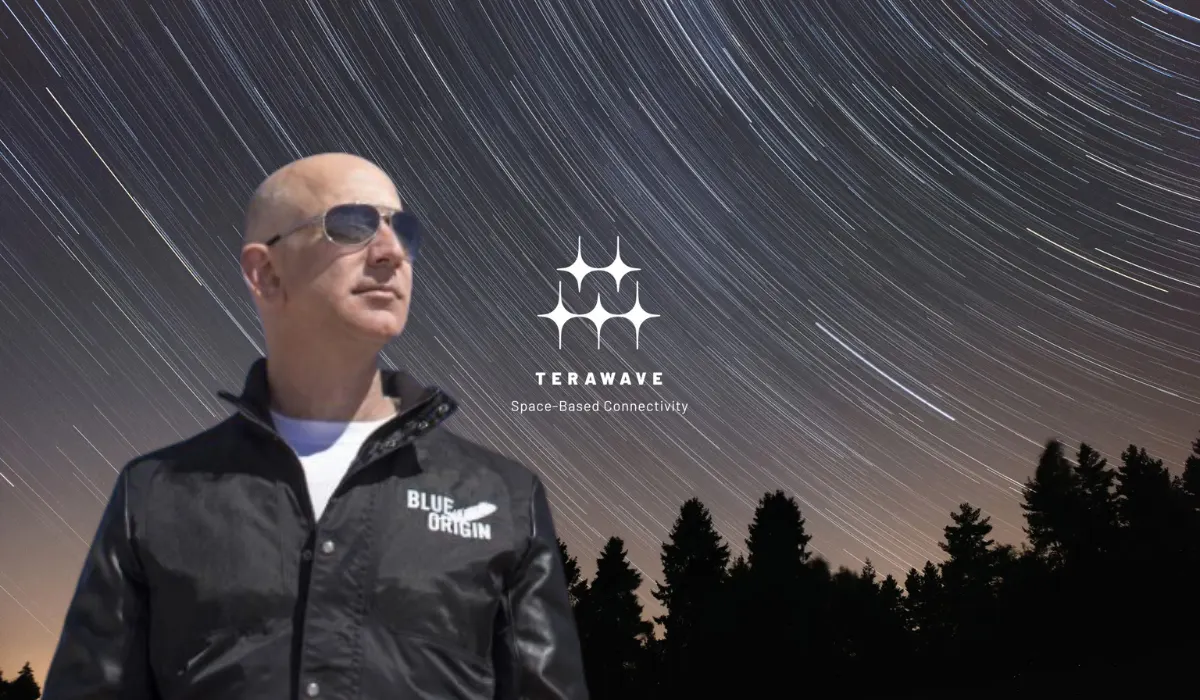
Blue Origin, the space company founded by Jeff Bezos, has announced plans for a new satellite network designed to compete directly with Elon Musk’s Starlink, marking a significant escalation in the billionaire-led race to dominate space-based communications infrastructure. The proposed network, branded TeraWave, is positioned not as a consumer broadband service, but as a high-capacity orbital backbone capable of delivering speeds of up to 6 terabits per second (Tbps).
“This network will service tens of thousands of enterprise, data center, and government users who require reliable connectivity for critical operations. The TeraWave architecture consists of 5,408 optically interconnected satellites in LEO and MEO, reaching remote, rural, and suburban areas where diverse fiber paths are costly, technically infeasible, or slow to deploy, while providing additional route diversity and strengthening overall network resilience”, the company posted on X.
The announcement signals a strategic shift for Blue Origin, which has historically focused on launch systems and space exploration. With TeraWave, the company is moving decisively into space-based infrastructure, targeting governments, hyperscale data centers, and defense customers rather than individual households.
Starlink, operated by SpaceX, remains the benchmark in satellite internet, with thousands of satellites already providing consumer broadband worldwide. Blue Origin’s TeraWave, however, is aimed at a different tier of the market. While Starlink focuses on last-mile connectivity to user terminals, TeraWave is designed as a high-throughput orbital data backbone, directly competing with SpaceX’s government- and military-focused Starshield network.
Jeff Bezos, who also oversees Amazon’s broader satellite ambitions, framed the initiative as essential to the next phase of global data infrastructure. Elon Musk, whose SpaceX has enjoyed a first-mover advantage, has not publicly commented, but the competitive narrative between the two tech founders is intensifying.
The “Two-Bezos” Network Strategy
The announcement has raised questions about why Bezos is backing two satellite networks. Industry analysts describe the approach as a “multi-layered orbital strategy.” Amazon’s Leo network, formerly known as Project Kuiper, targets consumers, rural broadband, and small businesses.
TeraWave, by contrast, is also designed for a completely different use case. It targets data centers, government backbones, and ultra-high-capacity optical hubs that require massive bandwidth and ultra-low latency. Blue Origin executives emphasized that the two networks are complementary rather than competitive, with Leo handling consumer access and TeraWave serving as the high-speed spine connecting major nodes in orbit and on Earth.
At the heart of TeraWave is its use of optical and laser-based inter-satellite links, rather than traditional radio frequency (RF) communications. While Starlink relies heavily on RF for connections to user dishes, TeraWave is sampling optical inter-satellite links (OISL) across its entire backbone, reducing signal congestion and dramatically increasing throughput.
New Glenn and Regulatory Filings
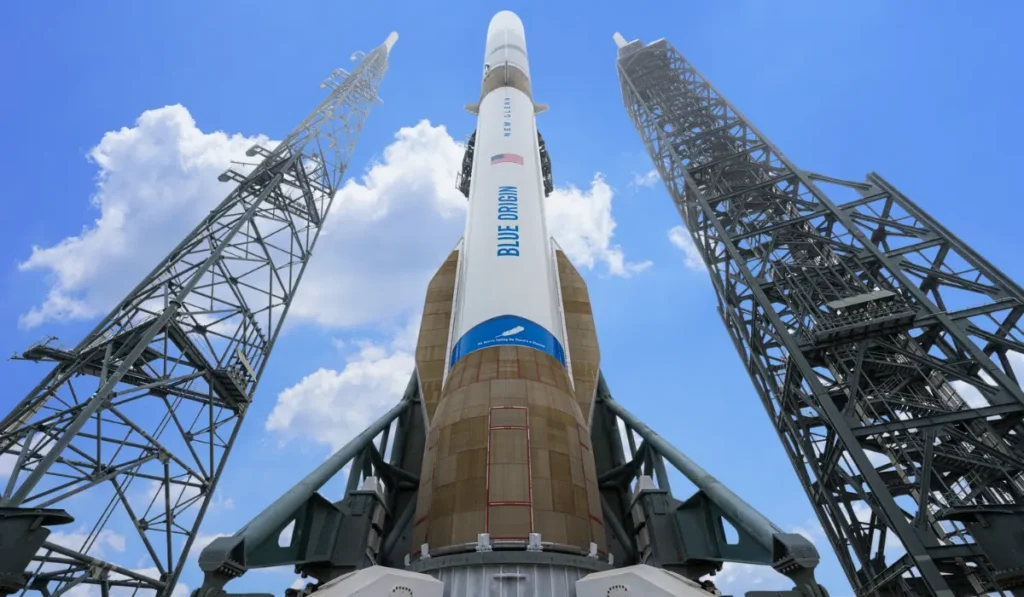
Deployment of the constellation will rely on New Glenn, Blue Origin’s heavy-lift rocket, which is central to the company’s long-term ambitions. The scale of the constellation underscores why Blue Origin views TeraWave as both a launch and infrastructure play.
The proposal was disclosed through recent filings with the Federal Communications Commission (FCC), dated January 21, outlining spectrum usage, orbital slots, and technical specifications. Regulatory approval remains a key hurdle, particularly as concerns about orbital congestion and space debris intensify.
The Space Data Center Catalyst
The timing of TeraWave’s announcement aligns with a broader macro trend: the rapid expansion of AI-driven data centers. As terrestrial facilities approach power and cooling limits, companies are exploring orbital data centers, which can leverage constant solar energy and natural cooling in space.
Blue Origin is positioning TeraWave as the connective tissue for this emerging ecosystem, enabling high-speed data transfer between Earth-based and orbital computing platforms. If successful, the network could redefine how data moves globally and intensify competition with Musk’s already formidable Starlink empire.
With TeraWave, Bezos is signaling that the next battleground in space is not just launch capability, but control of the data highways above Earth.


