

Tesla, Inc. (TSLA) shares closed at $430.41 on January 30, up $13.84, or 3.32%, before edging down 0.18% to $429.63 in after-hours trading, as investors reassess whether the company’s ambitious push into artificial intelligence, autonomy, and robotics can justify its increasingly stretched valuation. With a market capitalization of roughly $1.615 trillion, Tesla remains one of the most valuable companies in the world. Still, the stock is now widely viewed as entering a valuation check phase rather than a momentum-driven rally.
The reassessment comes as Tesla trades at a forward price-to-earnings ratio estimated between 196x and 273x, a level that sharply separates it from traditional automakers and even most high-growth technology peers. While bulls argue the premium reflects Tesla’s long-term AI optionality, skeptics note that current earnings still rely heavily on vehicle sales.
Earnings Beat, but Valuation Questions Persist
Tesla recently reported earnings per share of $0.50, topping expectations of $0.45, offering near-term support for the stock. However, analyst sentiment remains cautious, with a consensus “Hold” rating, signaling that much of the upside tied to future innovation may already be priced in.
Compared with global EV rival BYD, which trades at far lower multiples, Tesla’s valuation underscores how investors increasingly categorize the company as a technology and software platform rather than a pure auto manufacturer. That distinction is now being tested as markets demand clearer execution milestones.
Robotaxi and FSD at the Center of the AI Thesis
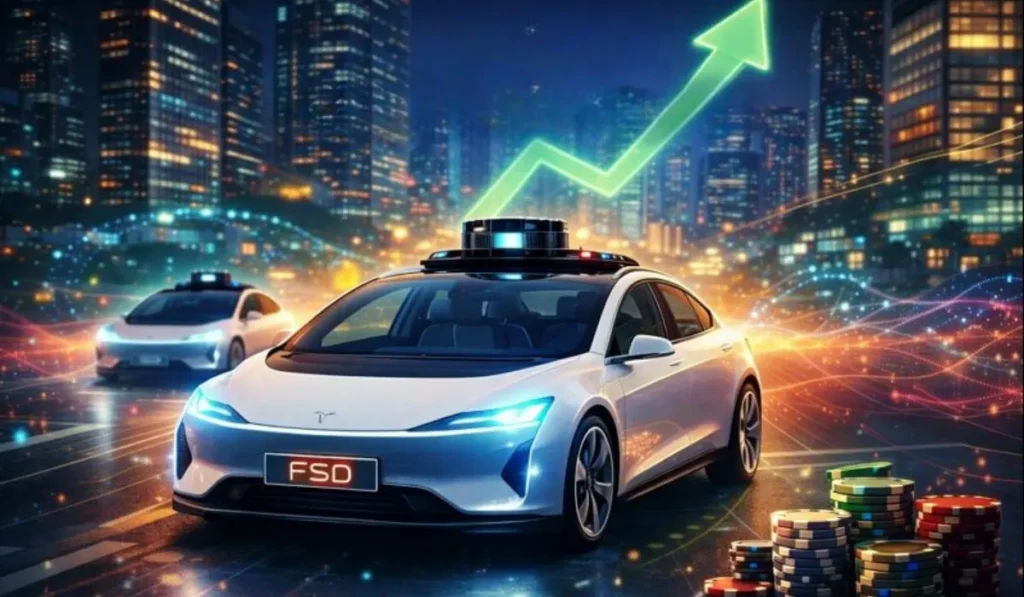
At the heart of Tesla’s long-term narrative is its Robotaxi, or “Cybercab,” program, which management has positioned as a transformational revenue driver. Tesla has reiterated expectations for a 2026 production ramp, with early deployment likely centered in Austin, Texas, where regulatory flexibility could accelerate rollout.
The robotaxi strategy is tightly linked to Full Self-Driving (FSD), which Tesla continues to push toward a subscription-based, software-as-a-service model. Investors view FSD as a potential high-margin, recurring revenue stream, but timelines and regulatory approval remain key risks, making it a focal point of the current valuation check.
Optimus and the Broader Robotics Bet
Tesla’s Optimus humanoid robot adds another layer of long-term optionality. While commercial adoption remains distant, Optimus strengthens Tesla’s positioning in robotics and AI, reinforcing Elon Musk’s vision of leveraging the company’s neural networks and manufacturing expertise beyond vehicles.
SpaceX, xAI, and Shareholder Scrutiny
Investor interest has intensified amid speculation surrounding a future SpaceX IPO, viewed by many US investors as a major liquidity and sentiment catalyst.
However, Tesla’s reported $2 billion investment in xAI has triggered shareholder pushback, with critics raising concerns about conflicts of interest and capital allocation discipline. Supporters argue the investment deepens AI integration across Musk-led companies, but the debate has added another layer of scrutiny as Tesla’s valuation comes under review.
Tesla’s stock is facing a valuation check. As excitement around robotaxis, FSD, Optimus, and AI synergies builds, investors are increasingly focused on execution timelines and measurable progress. Whether Tesla can grow into its premium pricing will likely determine the next major move in TSLA shares.


