

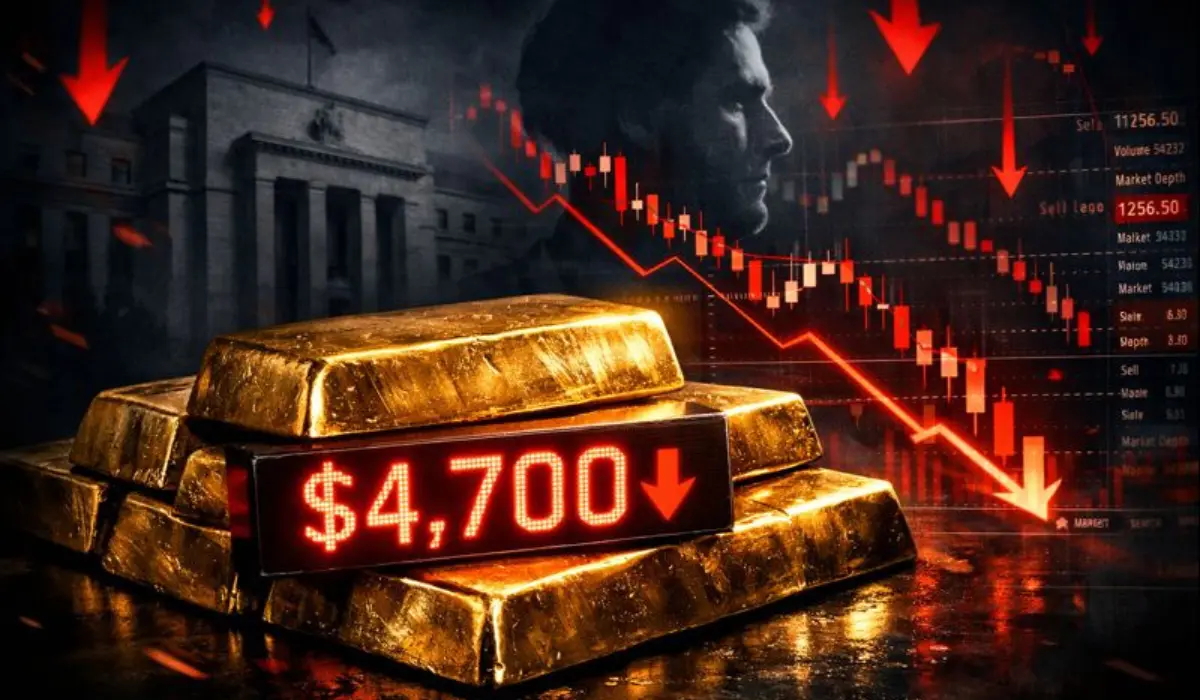
Gold futures extended their sharp sell-off with the ongoing plunge accelerating as a potent mix of hawkish U.S. monetary expectations, a surging dollar, and tighter trading conditions forced investors to unwind leveraged positions. Gold April 2026 futures (GC=F) were trading at $4,698.20, down $46.90, or 0.99%, as of 11:24:48 PM EST, at latest check. The correction marks one of the most violent reversals in precious metals markets in recent years, coming just days after gold posted record highs. Meanwhile, the U.S. Dollar Index (DX-Y.NYB) was trading at 97.10, up 0.11 points, or 0.11%,
The retreat represents a dramatic shift in sentiment after months of relentless upside driven by rate-cut optimism and geopolitical hedging. In parallel, spot gold has now recorded an estimated 17% peak-to-trough drawdown, as profit-booking intensified across global trading desks. Spot gold was trading at $4,680.80 at press time. A break below the current level could signal a deeper slide toward the 50-day EMA at $4,533.
Warsh Nomination Sparks Hawkish Reset in Market Expectations
The sell-off gained momentum following President Donald Trump’s nomination of Kevin Warsh as the next Chair of the Federal Reserve. Warsh, widely viewed by markets as a policy “hawk,” is expected to prioritize inflation control and tighter financial conditions. His nomination has sharply altered near-term expectations, triggering a surge in the U.S. Dollar Index, which gained strong positive momentum and pressured dollar-denominated assets.
A stronger dollar traditionally weighs on gold by increasing its cost for overseas buyers, and the current move has proven no exception. Traders rapidly reduced exposure as the currency rally coincided with rising Treasury yields, reinforcing the perception that the era of ultra-loose policy may be nearing an inflection point.
CME Margin Hike Forces Liquidations Across Futures Markets
Adding fuel to the decline, CME Group announced an increase in maintenance margins on gold futures from 6% to 8%, a move that immediately pressured leveraged positions. The higher margin requirement forced traders to either post additional capital or exit positions, accelerating forced selling across exchanges.
Several gold contracts hit lower circuit limits of 9%, highlighting the mechanical nature of the sell-off. Algorithmic strategies and momentum-driven funds exacerbated volatility as stop-loss orders were triggered in rapid succession, deepening intraday losses.
Silver Crash Underscores Broader Precious Metals Stress
Silver March 2026 futures (SI=F) were trading at $76.86, down $1.67, or 2.13%, as of 11:12:23 PM EST. The spot silver was trading at $79.65, down $25.87, marking a 24.52% decline over the past week (1W). The metal’s sharper decline reflects its thinner liquidity, heavier speculative positioning, and dual sensitivity to both investment flows and industrial demand expectations.
Market participants noted that silver often magnifies moves in gold during corrections, and this episode has proven especially extreme, reinforcing the fragile nature of crowded trades.
Rates Outlook Still Mixed Despite Hawkish Shift
Despite the abrupt repricing, longer-term expectations remain divided. Markets are still pricing in at least two Federal Reserve rate cuts in 2026, suggesting investors believe economic growth may slow after an initial tightening phase. The U.S. 10-year Treasury yield, currently near 4.25%, remains a key variable for precious metals direction in the months ahead.
For now, gold has shifted decisively from momentum-driven euphoria to risk management mode. With volatility elevated and policy clarity still evolving, traders expect sharp two-way moves to persist before the market finds a durable floor.


