


Amazon.com, Inc. (AMZN) closed at $208.72, down $1.60 (-0.76%) at the 4:00 PM EST close, before rebounding 0.69% to $210.16 in pre-market trading as of 6:31:52 AM EST. The company is reportedly preparing to launch an AI content marketplace, a move that could significantly expand monetization opportunities across its cloud ecosystem while intensifying competition with Microsoft.
According to reports, internal Amazon Web Services (AWS) slides reveal plans for a marketplace that would allow publishers, data owners, and rights holders to license proprietary content directly for AI training and inference. The initiative positions Amazon not just as a cloud infrastructure provider, but as a broker at the center of the rapidly growing AI data economy.
AWS as the “Broker” Advantage
The marketplace is expected to be deeply integrated into Amazon Web Services (AWS), with tools such as AWS Bedrock and the AWS Quick Suite enabling publishers to manage, license, and monitor how their data is used by AI developers.
Amazon’s strategic edge lies in its scale. As the world’s largest cloud provider, AWS already hosts vast amounts of training data and AI workloads. By keeping licensed content where models are trained and deployed, Amazon can reduce latency, compliance friction, and legal complexity for both content owners and AI developers.
This “broker” role could prove highly lucrative. Amazon is expected to take a commission on each licensing transaction, effectively creating a high-margin toll booth for AI training data, an increasingly scarce and valuable resource as foundation models grow more data-hungry.
Competitive Pressure From Microsoft
Amazon’s move comes as Microsoft (NASDAQ: MSFT) launched its own Publisher Content Marketplace (PCM) earlier this month, signaling that Big Tech firms are racing to formalize how copyrighted and proprietary data is sourced for AI.
While Microsoft has leveraged its OpenAI partnership to drive adoption, Amazon is countering with breadth. AWS supports a wide range of third-party models and customers, giving it flexibility and neutrality that may appeal to publishers wary of single-model ecosystems.
Citizens Reiterates Bullish Outlook
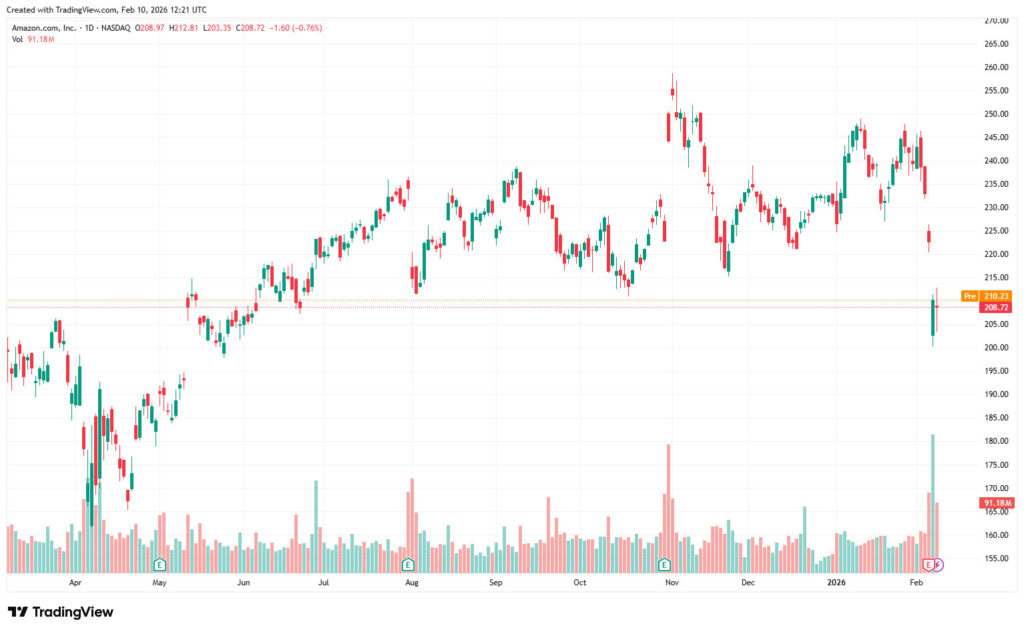
Despite recent volatility, Citizens, led by analyst Andrew Boone, reiterated a Market Outperform rating on Amazon on Tuesday, maintaining a $315 price target. The reaffirmation comes after Amazon shares fell roughly 14% over the past week, largely due to investor concerns around capital spending.
Citizens argues the market is underestimating AWS’s long-term growth potential, particularly in power and capacity expansion. The firm forecasts AWS revenue growth accelerating to 30.5% by the end of 2026, well above current consensus expectations.
“Gigawatt-scale capacity additions are being misread as margin-negative,” Citizens wrote, noting that early infrastructure investments typically precede periods of outsized operating leverage.
$200 Billion Capex And Infrastructure Push
Amazon has signaled plans to spend up to $200 billion in capital expenditures in 2026, primarily focused on AI infrastructure, data centers, and custom silicon. As part of this push, AWS recently signed a multi-year chip supply agreement with STMicroelectronics, securing critical components for next-generation AI servers.
Andy Jassy, President and CEO, Amazon, stated,
“With such strong demand for our existing offerings and seminal opportunities like AI, chips, robotics, and low-earth orbit satellites, we expect to invest about $200 billion in capital expenditures across Amazon in 2026, and anticipate strong long-term return on invested capital.”
The investment surge is also being fueled by partners such as Anthropic, Amazon’s key AI collaborator, which is projected to spend more than $19 billion on AWS training and inference workloads in 2026 alone.
Monetization Meets Scale
While near-term spending has weighed on sentiment, the emerging AI content marketplace highlights Amazon’s broader strategy: use scale to intermediate the AI economy. If successful, the platform could unlock recurring, high-margin revenue streams layered on top of AWS’s already dominant infrastructure business.
For investors, the question is no longer whether Amazon will participate in AI monetization, but how large its cut of the ecosystem can become.


