

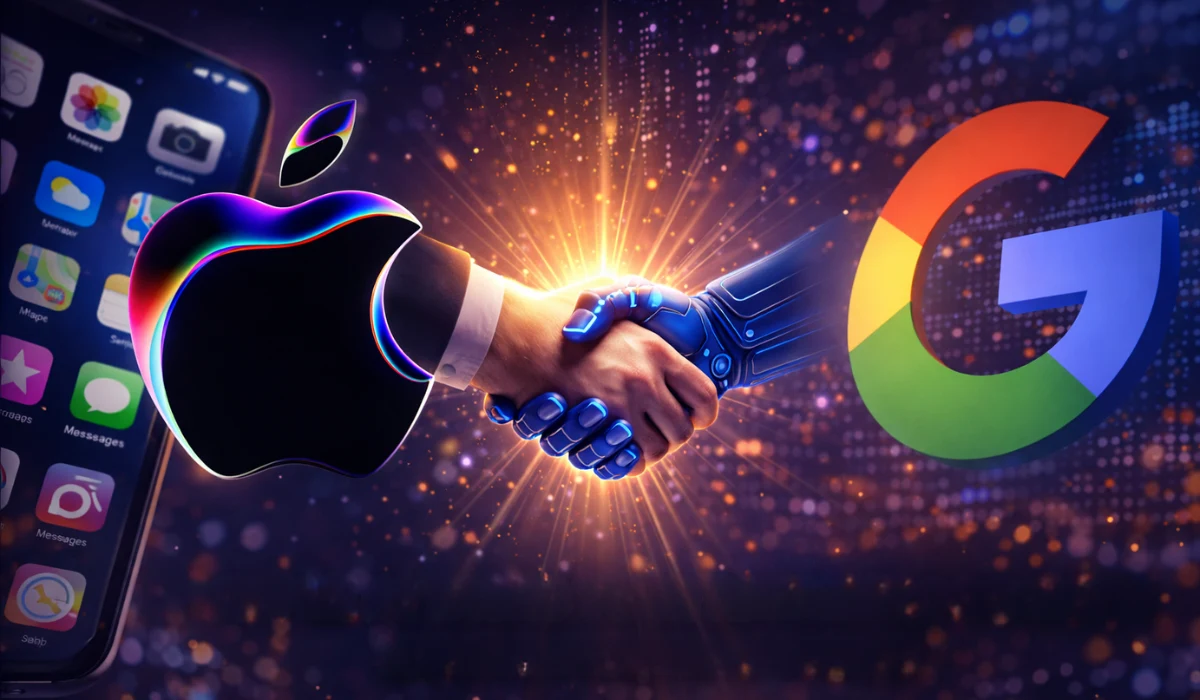
Silicon Valley behemoths Apple and Google have joined forces to power the former’s future artificial intelligence products and services. The multi-year deal will see Apple leverage Google’s Gemini models for a revamped Siri slated for launch in the first half of 2026.
In a joint statement released on Monday, Apple said that it determined Google’s technology to be the “most capable” for its foundational models. Reports indicate the iPhone-maker could pay Google around $1 billion for access to its AI stack and cloud services. Apple previously worked with OpenAI and Anthropic for Apple Intelligence, but with limited success.
EXCLUSIVE: Apple is in talks to build Google’s Gemini AI engine into the iPhone in a potential blockbuster deal.
— Bloomberg (@business) March 18, 2024
Here's what we know so far https://t.co/e3XYmn05vL pic.twitter.com/2CMZ1PveKg
Reported $1B Apple-Google Deal Would Put Gemini In Siri
The multi-year partnership means that the next generation of Apple Foundation Models will be based on Google’s Gemini and cloud computing technology. However, the deal is not exclusive, as Apple has historically focused on vertical integration, relying on its own hardware and software.
Apple noted that Apple Intelligence, a personal intelligence system that integrates generative AI across its ecosystem of devices – iPhone, iPad, Mac, Apple Vision Pro, and Apple Watch – will continue to run when applicable, as well as in its Private Cloud Compute network, iCloud, which maintains strict privacy standards. Launched in October 2024, it was the company’s answer to the ChatGPT, Perplexity, Anthropic, Claude, and Gemini-led consumer-grade generative AI revolution, but it has been stumbling ever since, with reviews ranging from “underwhelming” to outright alarmed.
Joint Statement: Apple and Google have entered into a multi-year collaboration under which the next generation of Apple Foundation Models will be based on Google's Gemini models and cloud technology. These models will help power future Apple Intelligence features, including a…
— News from Google (@NewsFromGoogle) January 12, 2026
Cupertino faced the wrath of the public for Apple Intelligence, facing heavy criticism for lagging behind its competitors. The company’s foundational model integrates AI into various existing operating system functions, such as searching for photos and summarizing notifications. It also emphasized privacy heavily, with much of the AI processing taking place locally on the users’ devices or through a tightly-controlled infrastructure. Apple confirmed that it will maintain those privacy standards through its partnership with Google.
Apple Taps Gemini Engineer To Lead AI After Lagging Performance
Apple Intelligence was delayed multiple times, marring its rollout and sparking several false advertising class-action lawsuits for claiming to provide services that the system did not offer at launch. The notification summary feature, meant to condense multiple alerts into smaller snippets, ended up generating a series of embarrassing and untrue headlines for users. In a test conducted by the BBC, the model falsely reported that English darts player Luke Littler had won a championship before the final had happened.
AI-powered Siri was a major overhaul promised by the company, but it ended up being a black eye. A Bloomberg report from early last year revealed that when Craig Federighi, Apple’s software chief, tested the new Siri on his iPhone just weeks before its planned launch in April 2025, he was dismayed by the number of features it had been touting that didn’t work. This event led to further delays, triggering lawsuits from iPhone 16 buyers who had been promised an AI-powered personal assistant in Siri at launch.
In December 2025, Apple’s AI chief, John Giannandrea, stepped down from a role he has had since 2018. He was replaced by Amar Subramanya, a former Microsoft executive, who served as lead engineer for the Gemini Assistant at Google. Giannandrea had already been sidelined by the company months before his resignation, largely due to the result of the Apple Intelligence fiasco. There were also reports that Apple CEO Tim Cook had stripped Siri from Giannandrea’s oversight in March 2025, handing it over to Mike Rockwell, creator of Vision Pro. He also removed Giannandrea from its robotics division.
Bloomberg’s investigation revealed organizational dysfunction at Apple, primarily stemming from weak communication between its AI and marketing departments, budget misalignments, and a leadership crisis that had some employees call Giannandrea’s team “AI/MLess”.
Apple is now relying on its arch rival Google’s Gemini to power the next generation model of Siri. This is an astonishing and humbling twist in the intense rivalry between the two Silicon Valley giants, who have competing against each other for the better part of the last 15 years, across mobile operating systems, app stores, browsers, cloud services, maps, smart home devices, and now AI.
Gemini-Powered “More Personalized” Siri Slated for Launch in Spring 2026
Multiple reports from last year indicated that Apple is actively searching for an AI partner and is open to acquiring AI firms to get ahead in the race. In July, the company was in the lead to acquire Perplexity, the AI-powered search engine, and held constructive talks with OpenAI and Anthropic about using their models to support the updated version of Siri. Apple has already integrated ChatGPT into Apple Intelligence, but with Gemini expected to power Siri, the tech giant believes it can make up for the lost ground.
Apple delayed the rollout of its “more personalized” Siri voice assistant several times in the past, but a spokesperson said an overhauled Siri, powered by Gemini, is expected to be launched this spring. During the October 2025 earnings call, Cook said the company was “making good progress” on the product.
The deal is a major victory for Google, which has been on a winning streak since releasing the Gemini 3 model, which many experts and users found to be performing better than the latest ChatGPT models. OpenAI has taken this threat seriously, issuing an internal “code red” and allocating more resources to GPT-5.2.


