

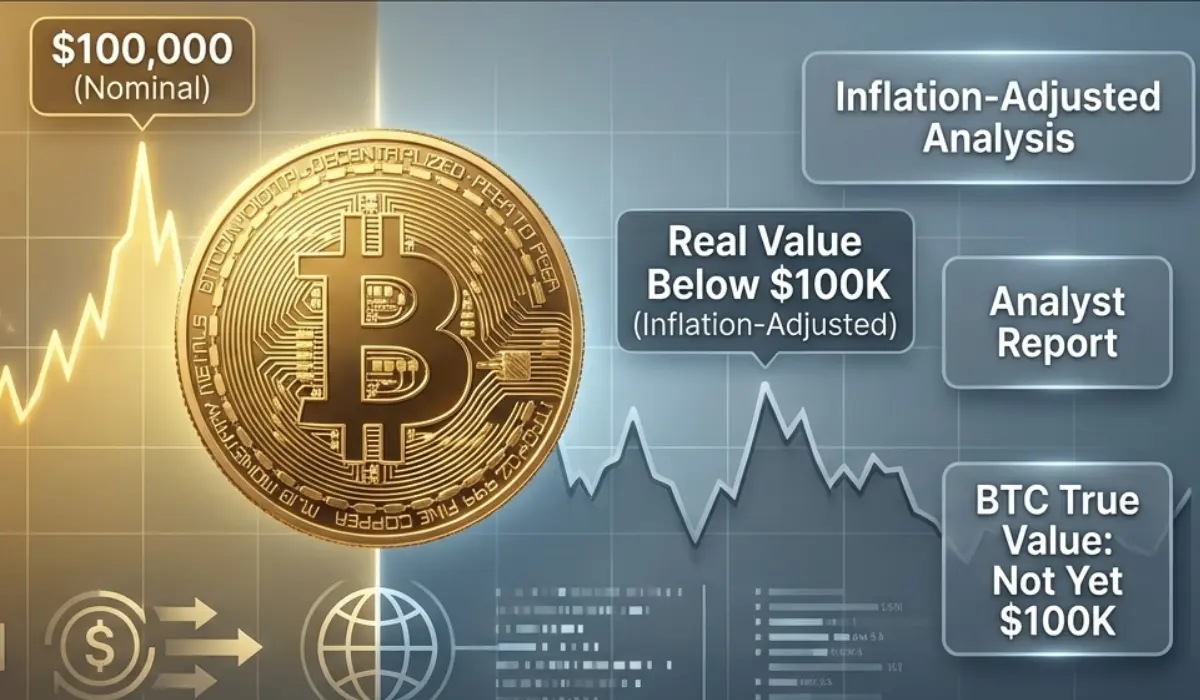
According to the Head of Firmwide Research at Galaxy Digital, Alex Thorn, Bitcoin’s rally towards the $126,000 all-time high price cannot be considered when inflation is factored into the picture. On Tuesday, Thorn said that “If you adjust the price of Bitcoin for inflation using 2020 dollars, BTC never crossed $100,000.” According to Thorn, the king of cryptocurrencies, BTC simply grazed the six-figure price at a maximum value of $99848.
Thorn’s analysis comes after the CPI (Consumer Price Index) report came out on Friday last week. Even though BTC surpassed the nominal value of $126,000, since the US dollar had declined in actual purchasing power, Thorn says it cannot be argued that Bitcoin reached the psychological $100,000 level.
The $100,000 Illusion: Why Bitcoin Hasn’t Actually Broken Its Most Famous Barrier
Thorn’s statement highlights how the nominal price and the real price are different when the inflation rates of the US dollar are taken into account. This difference is what drives Thorn to believe that the actual price of Bitcoin never crossed the $100,000 mark. Thorn has made use of the deflator method to arrive at this conclusion.
According to the method, Thorn chose 2020 as the baseline year for the price of the US dollar. This constant value has lost its purchasing power courtesy of inflation over the years, according to Thorn. A major reason Thorn points out as a factor that drove this inflation was the COVID-19 pandemic and the consequent monetary expansion, or money printing by the Federal Reserve.
By 2024, the data collected by Thorn indicated that the inflation rate rose by 24% starting from the baseline year of 2020. In simple terms, this means that $1 accounted for roughly $0.80 in 2020 terms. By applying the incremental decline of the dollar from 2020 to 2025, Thorn calculated that the price peak in October of $126,000 amounted to only $99,848 in terms of 2020 purchasing power.
Read More: Best Time & Strategy To Exit On A Meme Coin?
Understanding the Debasement Trade: Fiat Flexibility vs. Bitcoin’s Fixed Supply
Thorn’s statements actually carry weight as the price of goods has gone up by 1.25 times compared to what they were in the year 2020. This means that a dollar at the moment can purchase only 80% of what it could have been used for purchasing back in 2020. When this data is carefully addressed, we can see how Thorn’s analysis of the $1 to $0.80 is factually accurate.
However, this is not essentially the end of the road for Bitcoin as currency inflation often provides more opportunities for debasement trade. This particular type of trade relies on the currency’s devaluation over time. Normally, in a debasement trade, capital is moved into assets with a finite or capped supply. This includes precious metals, oil, and digital assets like Bitcoin, which have a fixed supply.
This is one of the reasons why Bitcoin is often called the digital equivalent of gold. The supply of fiat currencies is flexible. The national banks of a country can issue more currency based on the socioeconomic conditions prevailing in the country at any given time. In contrast to this, a digital asset like Bitcoin has a fixed supply. This means that over time, assets like Bitcoin will appreciate due to the supply-demand dynamics. This makes them an ideal candidate for debasement trade.


