

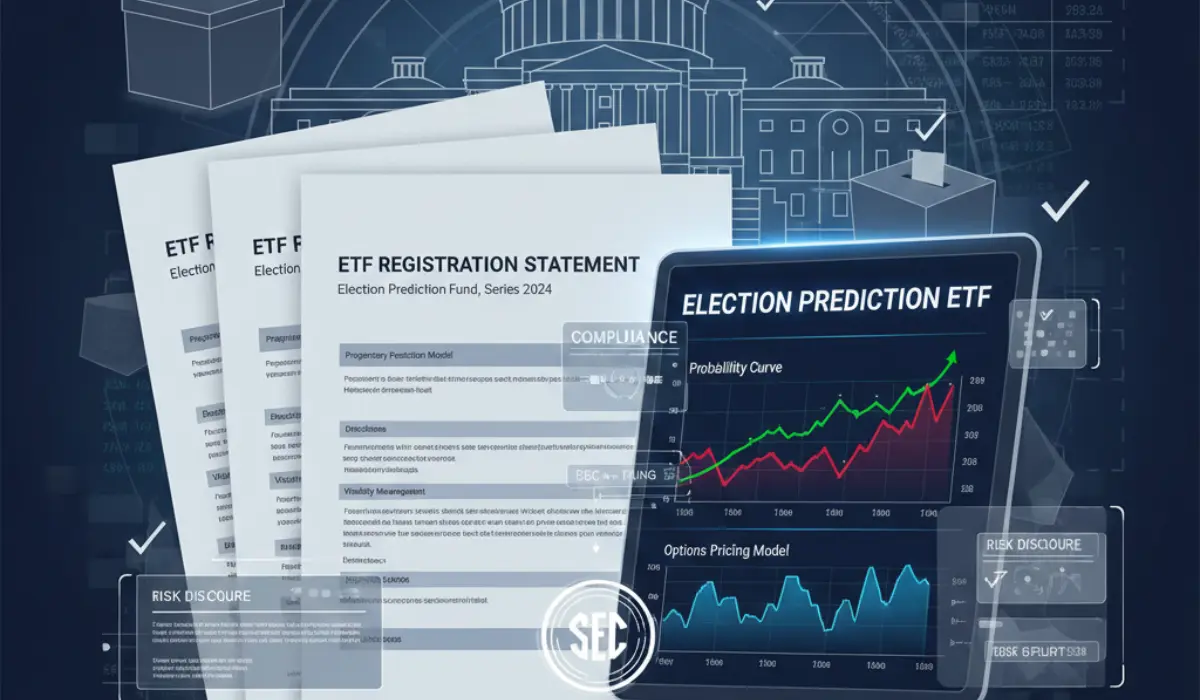
As the U.S. political landscape grows increasingly polarized, Wall Street is preparing to let investors trade that volatility directly in their brokerage accounts.
Major exchange-traded fund issuers Bitwise, Roundhill, and GraniteShares have filed prospectuses with the U.S. Securities and Exchange Commission (SEC) for a first-of-its-kind suite of “prediction market” ETFs, aiming to bring the speculative fervor of platforms like Polymarket and Kalshi to the regulated market.
Wall Street Files First U.S. Election Prediction ETFs
The filings, revealed Tuesday, describe how the proposed funds would track the outcomes of the 2026 Congressional midterms and the 2028 U.S. Presidential election. If approved, they would represent the first time retail and institutional investors can hedge political risk — or speculate on an election winner — through a standard ticker symbol.
Instead of tracking traditional assets, these funds will primarily invest in binary event contracts traded on federally regulated exchanges. These contracts, popularized by platforms like Kalshi, settle at a fixed value of $1 if a particular event occurs and $0 if it does not. Because the underlying assets are event contracts, an ETF betting on a specific political party could lose 100% of its value the moment an election is called for the opponent.
Leading the charge is Bitwise Asset Management, which has introduced a new sub-brand for the venture: PredictionShares. Bitwise’s lineup will comprise six prediction-market-style ETFs listed on NYSE Arca specifically tied to the 2028 presidential race and both chambers of Congress in 2026.
The first two funds will pay out if either a Republican or a Democrat wins the U.S. presidential election in November 2028. The next two will pay out if either Democrats or Republicans win the Senate in November 2026, and the remaining two pay out if either party wins the House this year.
Each fund is set to invest at least 80% of its net assets in binary event contracts, or political prediction market derivatives traded on CFTC-regulated exchanges. In essence, the company is offering separate ETFs for each race and one for each party, and investors can choose their preferred fund. The price of each ETF’s shares on any given day reflects the market’s implied probability of that outcome, fluctuating between $0 and $1 based on polling, news, and sentiment.
Roundhill Investments and GraniteShares followed suit with similar prospectus filings, proposing six ETFs each that would invest in binary event contracts based on the outcomes of the presidential, Senate, and House elections.
For years, prediction markets have offered a glimpse into collective foresight, often proving more accurate than traditional polls due to participants having “skin in the game.” Now, Wall Street wants a piece of that action.
“The ETF-ization of everything continues,” commented Bloomberg ETF analyst James Seyffart. “This opens a huge door to all kinds of stuff. Prediction market apps are easy to use, but ETFs are just that much easier for institutional money to access, and they operate in a framework that sophisticated investors already understand.“
Winner-Takes-All’ Election ETFs Spark Debate on Wall Street
The filings come at a pivotal moment, following recent regulatory clarifications and legislative shifts. The GENIUS Act provided a broader framework for innovative financial products, while recent court decisions have affirmed the Commodity Futures Trading Commission’s (CFTC) jurisdiction over event contracts, paving the way for regulated trading.
The proposed ETFs are not for the faint of heart. Their reliance on binary event contracts means they are inherently “winner-take-all” instruments. The prospectuses are explicit about these risks, detailing scenarios where a fund could plummet to near zero the moment an election is definitively called against its target outcome. This extreme volatility and the potential for total loss set these ETFs apart from almost any other product in the market.
Advocates argue that these ETFs will provide an unprecedented, real-time barometer of public sentiment, reflecting financial commitments rather than mere opinions. They believe this market-based forecasting could offer more accurate insights into election outcomes than traditional polling methods, which are often criticized for their methodology and potential biases.
However, critics and some regulatory bodies remain cautious. They warn of scenarios where well-capitalized political actors could attempt to move ETF prices to influence public perception or create an artificial narrative. Then there is the ethical dilemma of insider trading, where political insiders could trade with non-public information regarding election strategies or outcomes. There are also liquidity and volatility risks, such as whether the underlying prediction markets can sustain the massive capital flows and intense volatility that an ETF structure can introduce.
While the filings mark a significant step, the SEC’s approval process is rigorous. The Commission will scrutinize the unique risks and operational challenges of these products, particularly given their novel nature. However, the precedent set by other event-based trading approvals suggests a path forward.
Should Bitwise, Roundhill, and GraniteShares’ ETFs gain approval, they could fundamentally alter the landscape of political engagement in the financial markets. These products could become a staple in diversified portfolios, offering new hedging strategies for businesses impacted by political shifts, or simply a novel way for individuals to put their money where their political convictions lie. Regardless of their eventual impact, these prediction market ETFs signify that in the age of financialization, even the democratic elections are becoming an asset class.


